New Kukleny – Square and Cooperative Housing

1st prize
  • Author MACH OFFICE + ARAMÉ STUDIO
  • Barcelona, Spain
Annotation

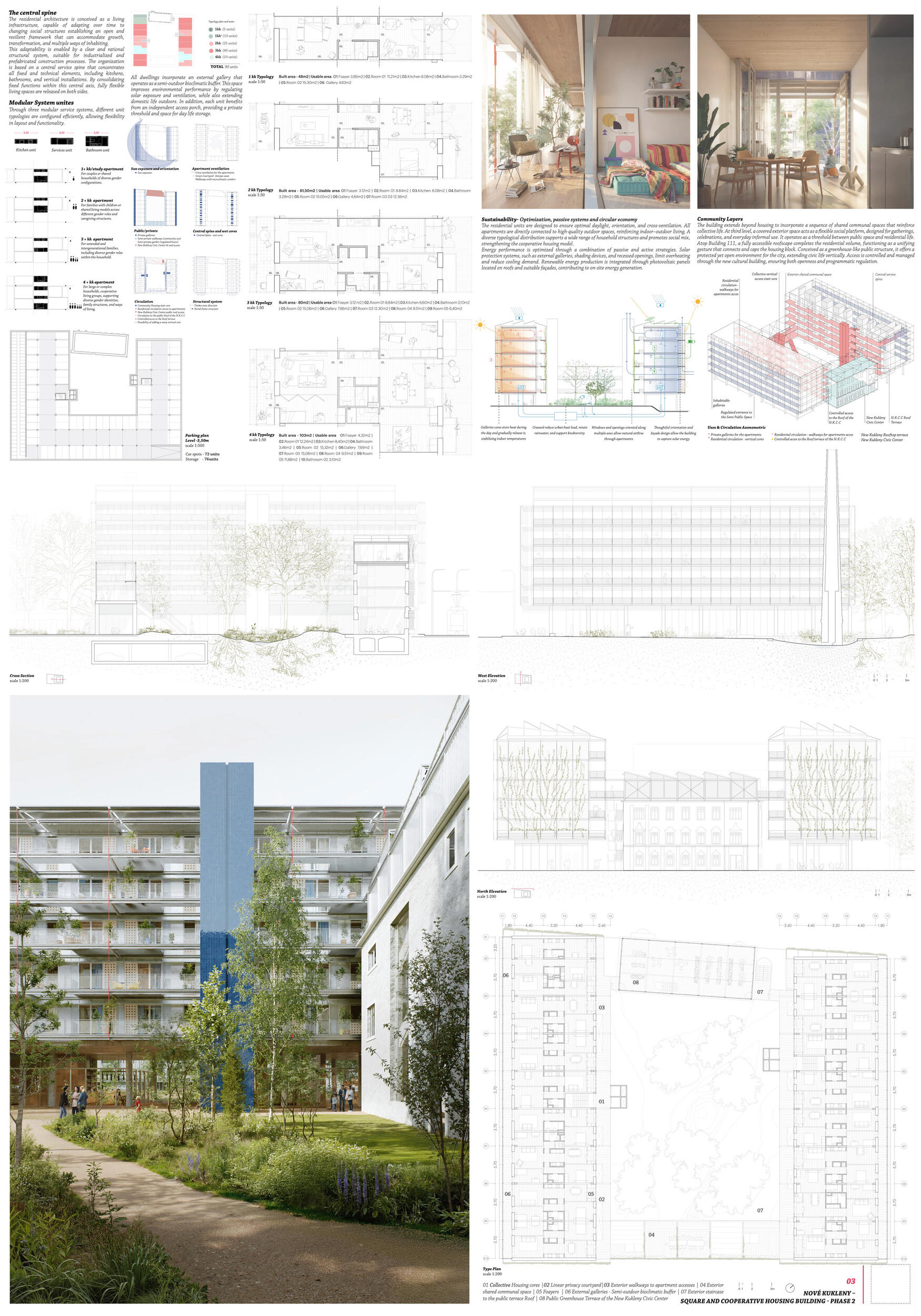
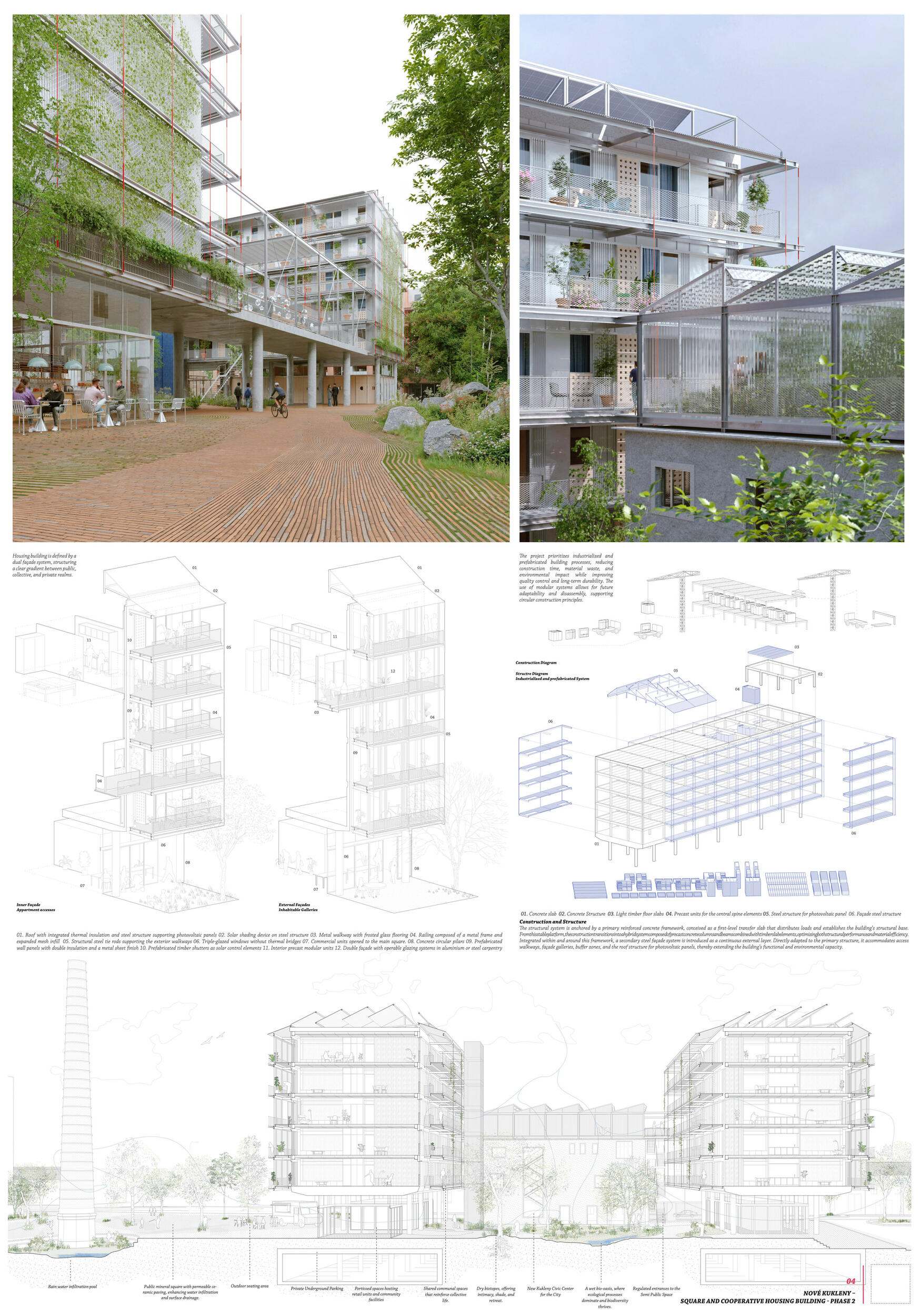
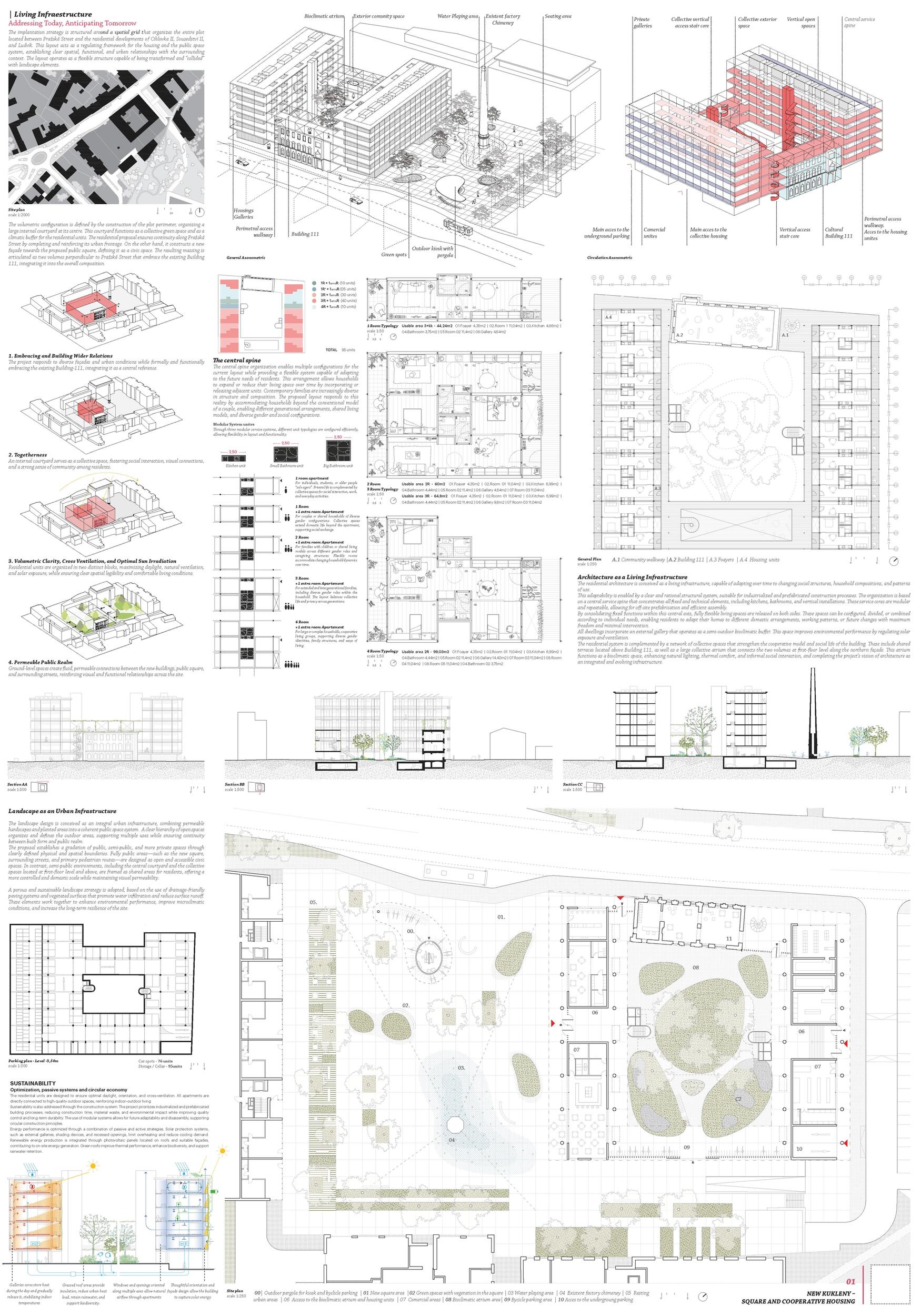
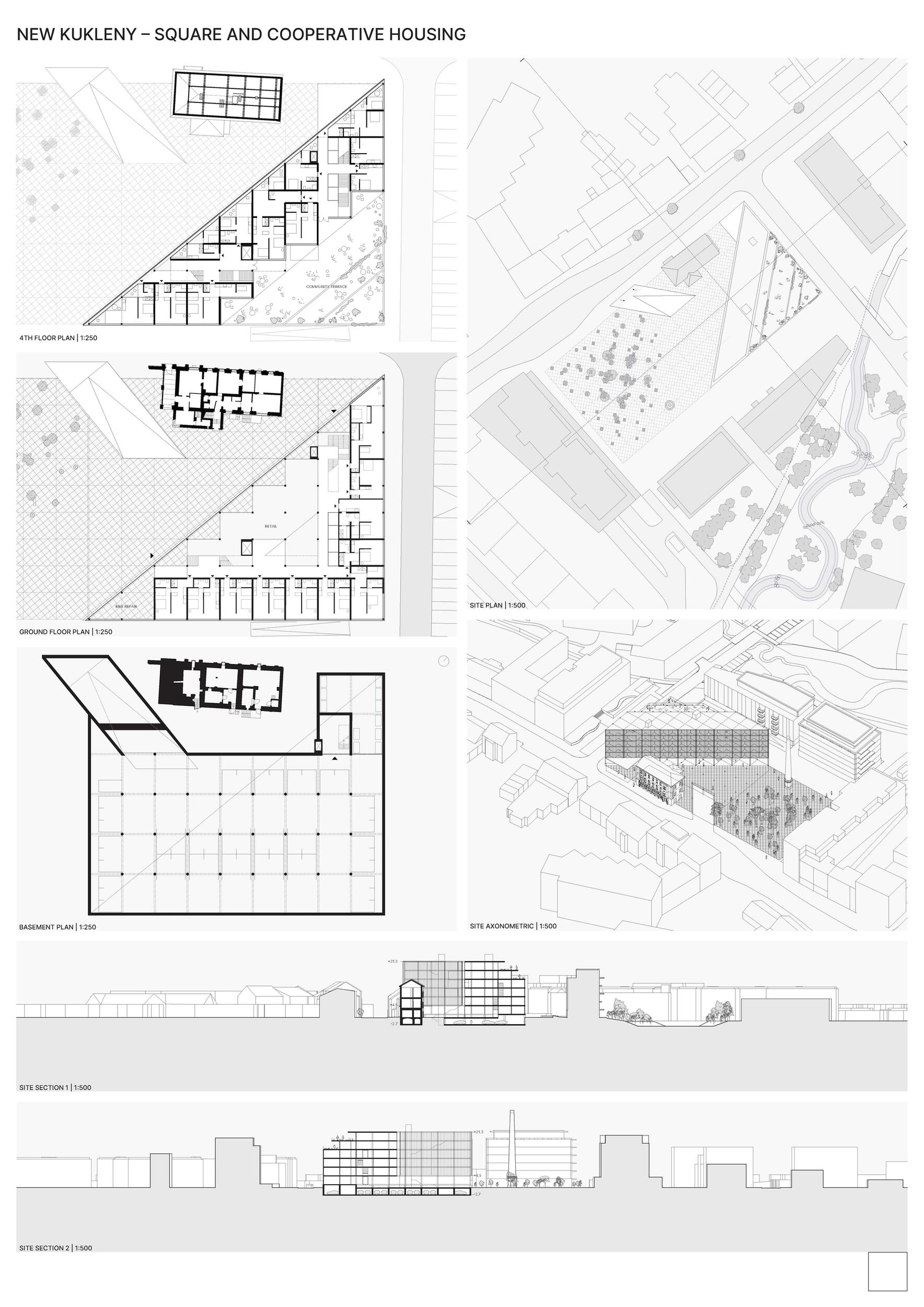
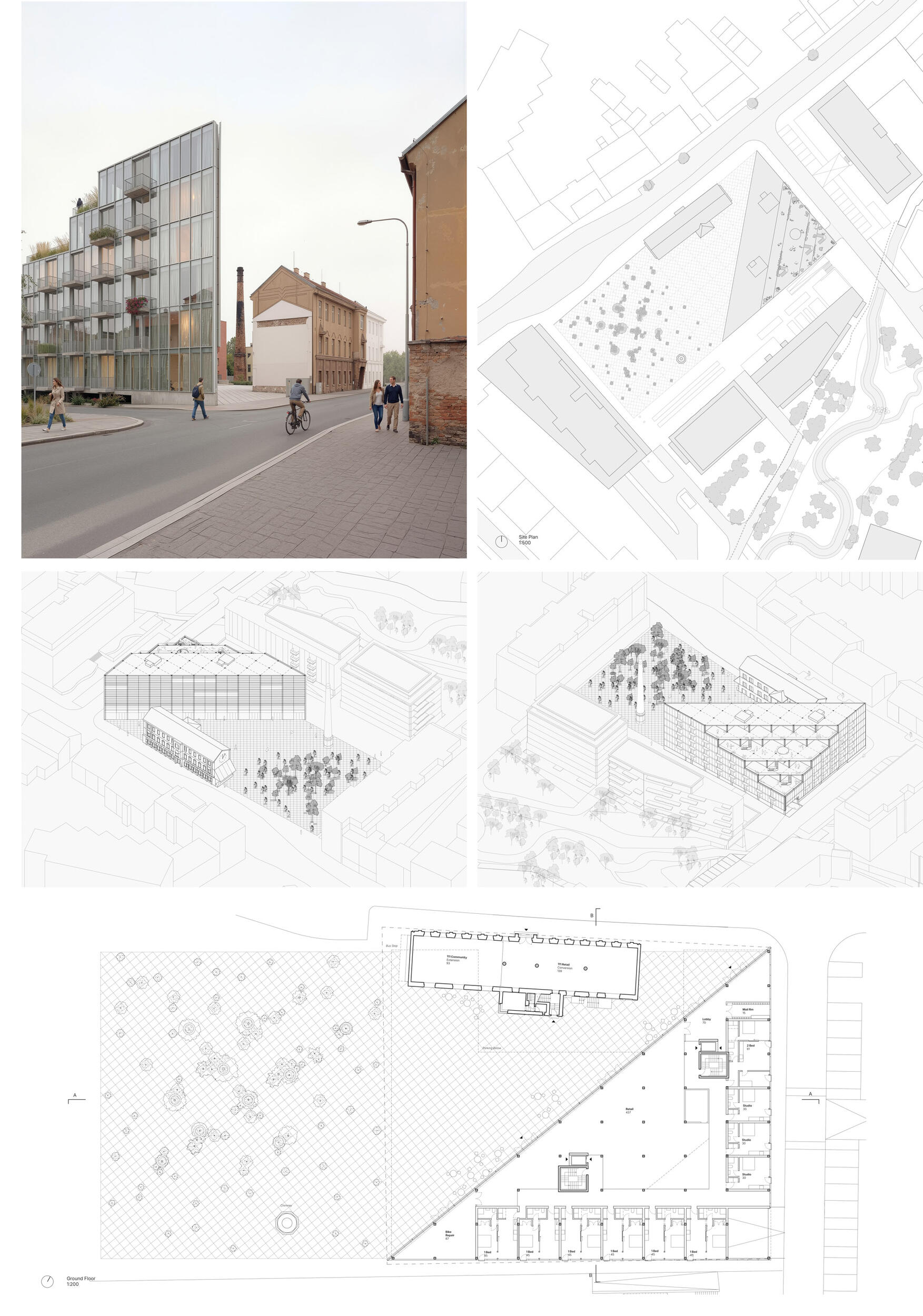
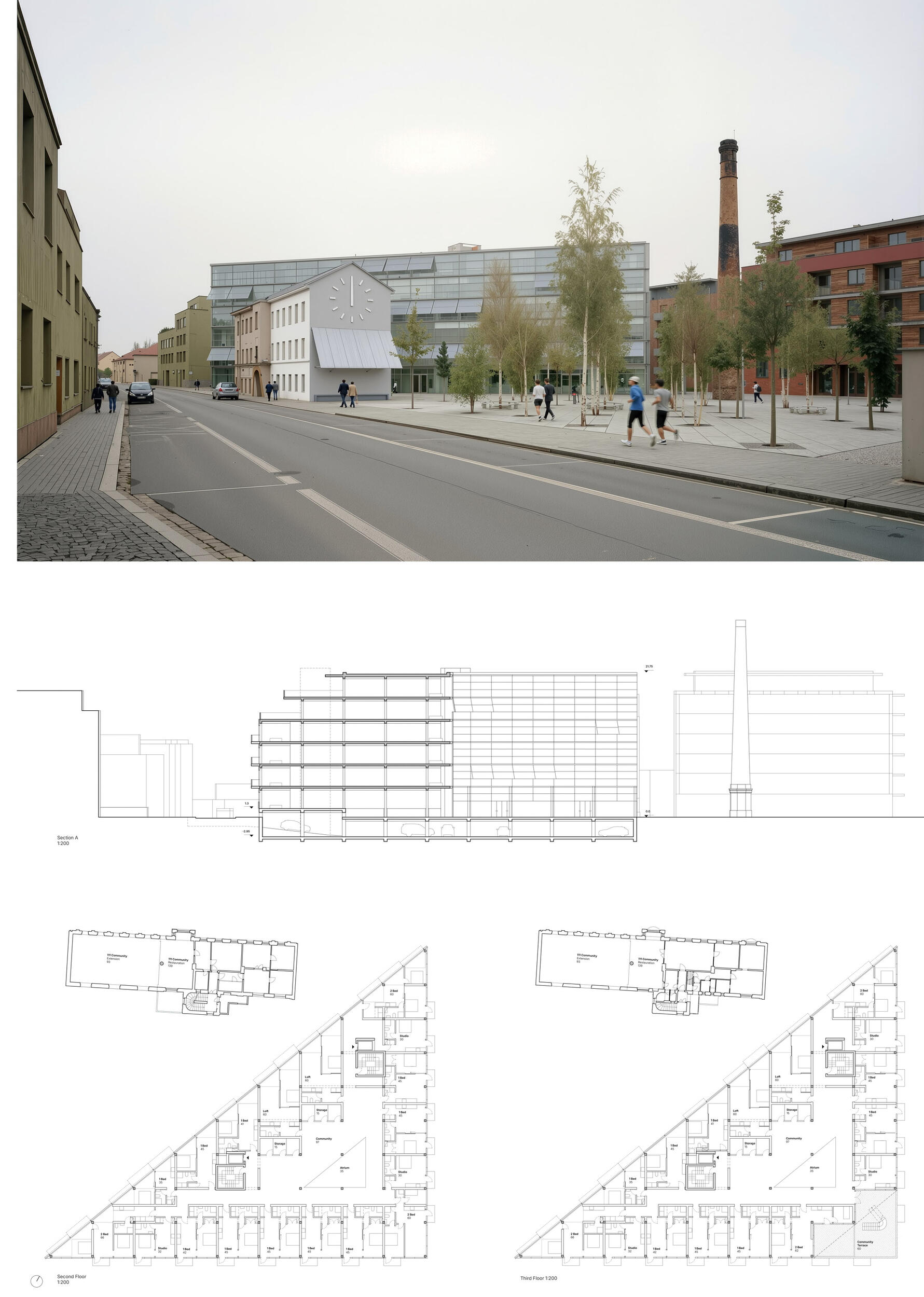
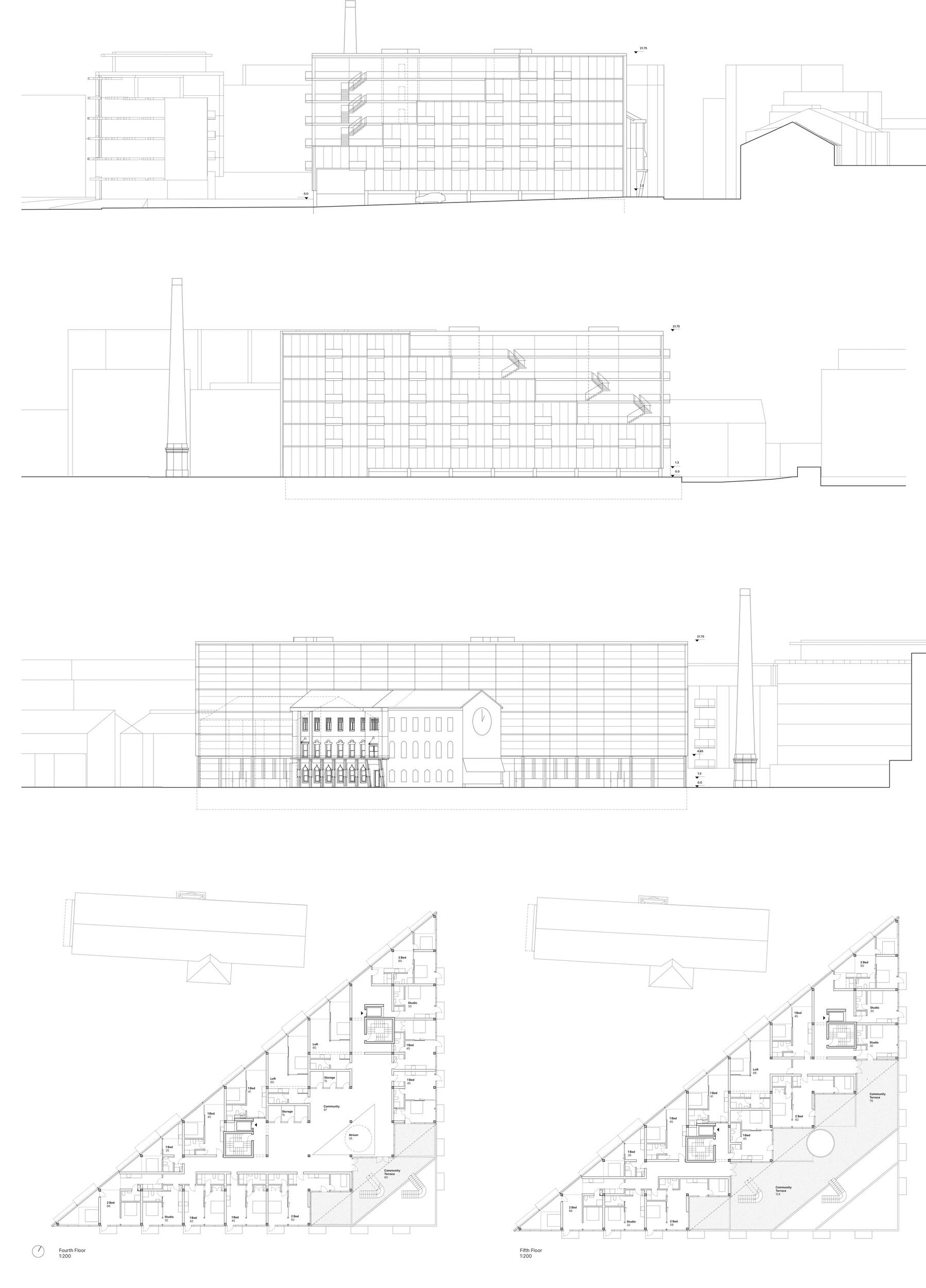
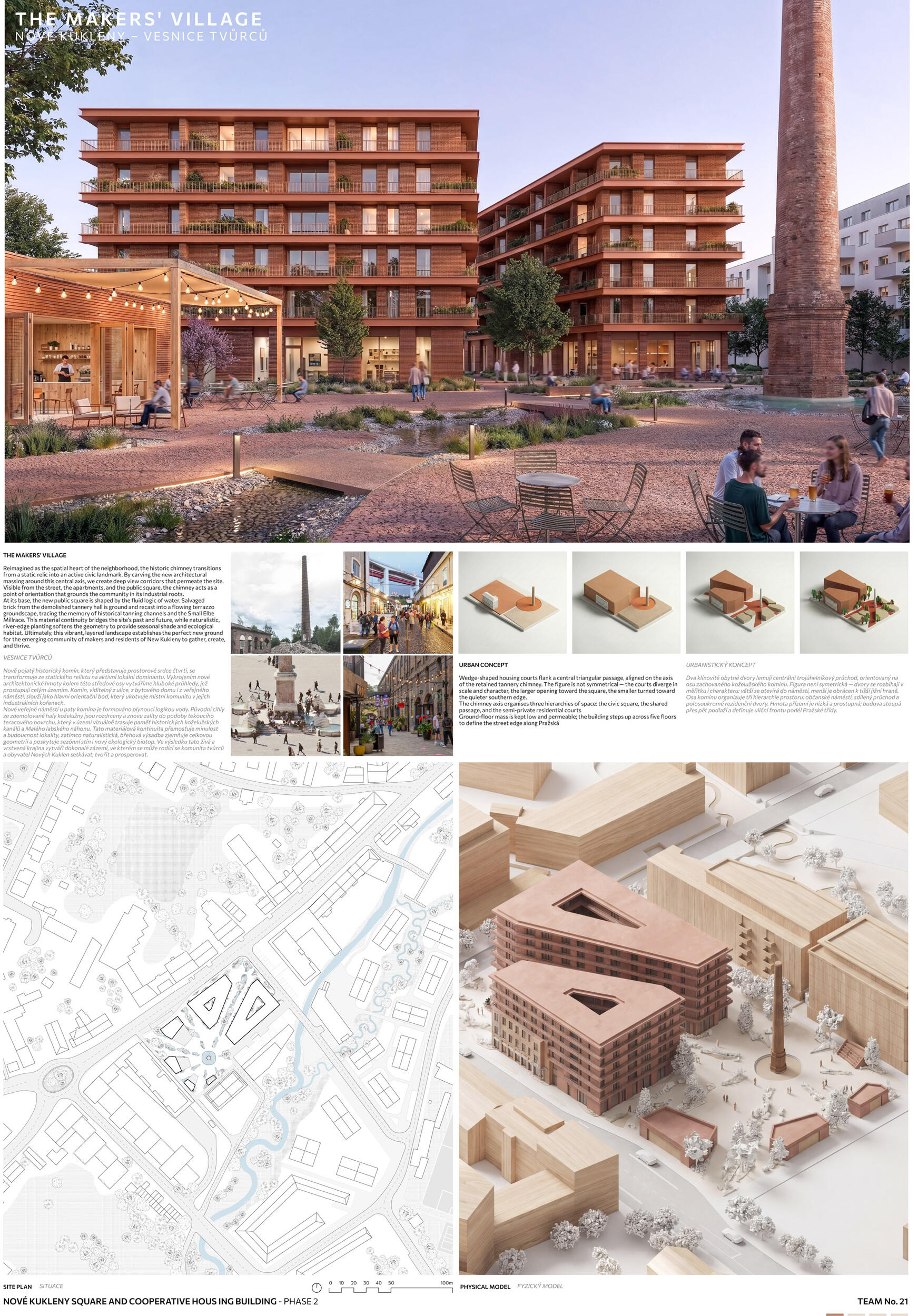
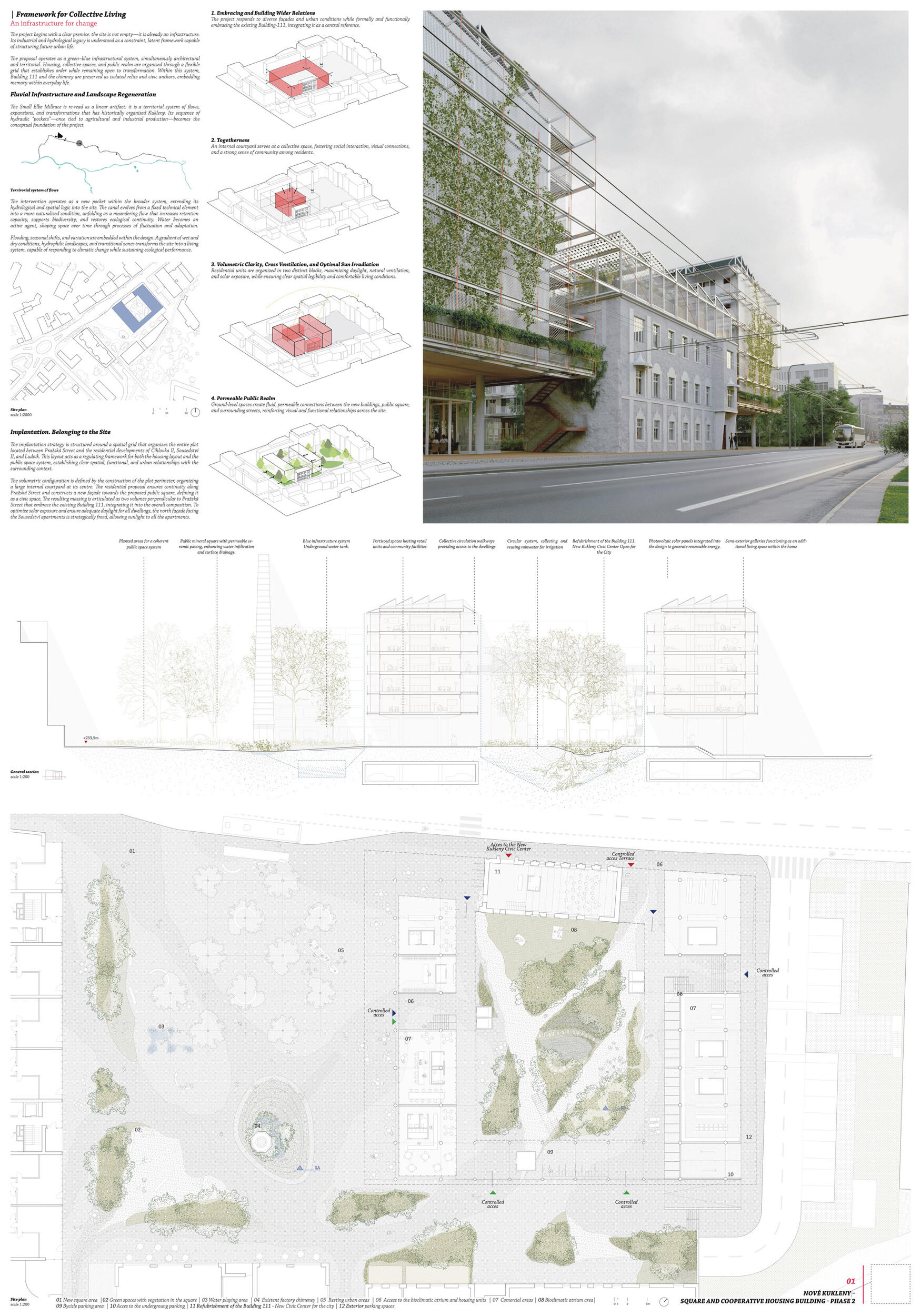
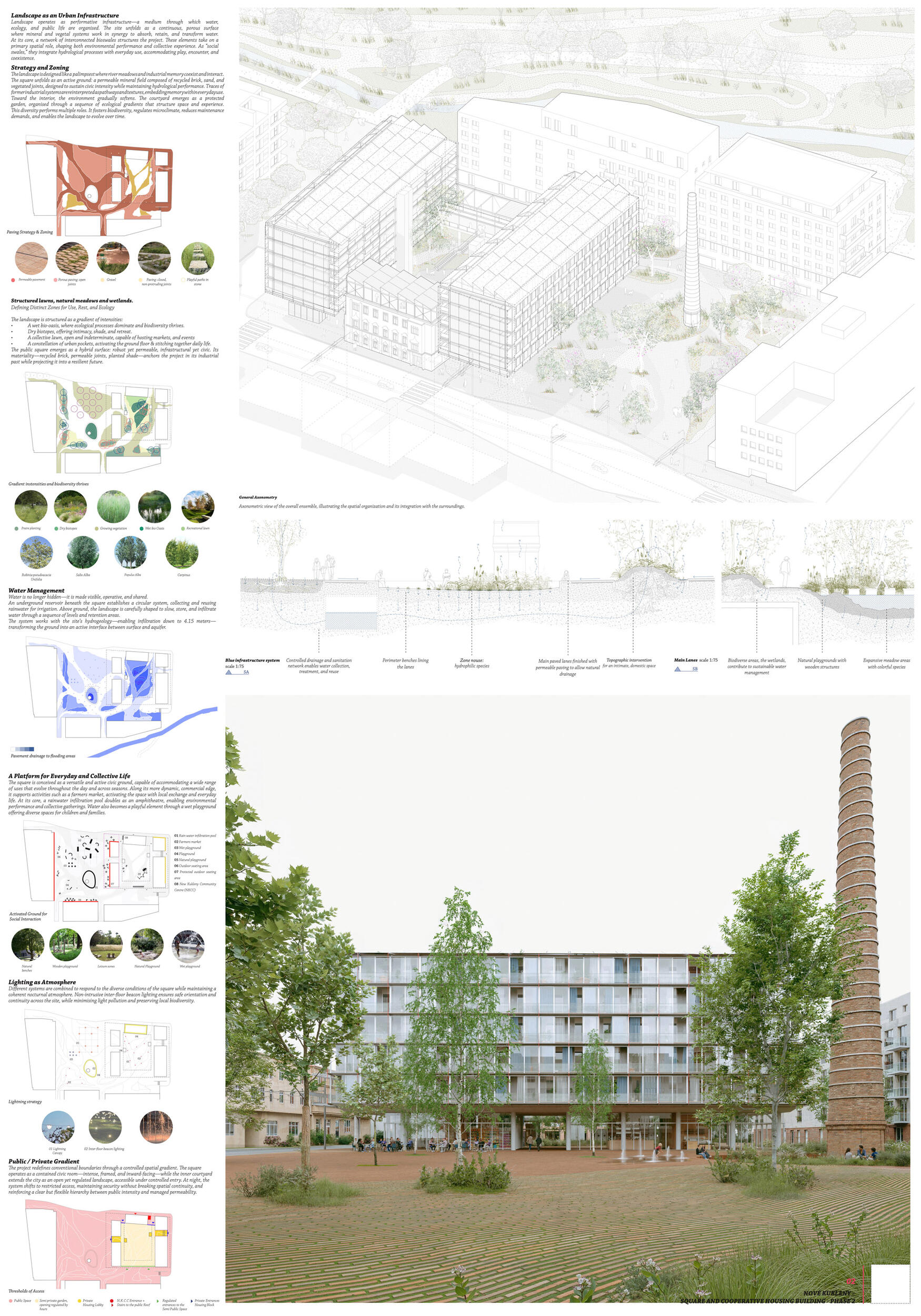
The design strategy is based on the recognition of the site’s industrial legacy as a structural and spatial resource, allowing the project to establish continuity between past and future. The proposal is conceived as an infrastructural system operating simultaneously at architectural and landscape scales. It organizes housing, collective spaces, and public realm into a flexible framework grid, while formally and functionally integrating the existing Building 111 and the chimney as active social components. The public square is conceived as both a civic space and a landscape infrastructure, responding to a fluvial system that integrates water as a structuring element. Meanwhile the residential units are designed as adaptable and flexible dwellings, based on a modular and rational structural system that enables multiple layouts and future reconfiguration. through the integration of housing, public space, and landscape infrastructure, the proposal delivers an affordable, resilient, and community-oriented residential framework capable of evolving with the district and supporting a sustainable urban future.

Jury Evaluation

The project proposes a contemporary framework for collective living that integrates the site’s industrial legacy, ecological systems, and social cohabitation into a coherent urban strategy. By incorporating Building 111 and the chimney as active references, and by grounding its constructive logic and programmatic organization in rational principles, the proposal conceptually preserves the site’s history. As a result, the project is conceived as an infrastructural system operating simultaneously at architectural and landscape scales. The building is conceived through a layered spatial organization that offers a gradual transition from public to collective to private spaces. Inhabitable galleries, designed as outdoor rooms, also function as climatic buffers towards the exterior. External walkways, separated by small slab openings, provide privacy for the inhabitants, while curtains introduce a final layer of domestic modulation. The residential units are designed as adaptable and flexible dwellings based on a modular and rational structural system that enables multiple layouts and future reconfiguration. Their dual orientation allows for cross-ventilation and efficient passive cooling. A transfer slab at the first-floor level distributes the loads from the repetitive prefabricated hybrid structure above, while simultaneously blurring the threshold between the inner courtyard and the public square. The superimposed analysis of the historical fluvial system of the Small Elbe Millrace leads to the integration of water as a structuring element within the park, fostering ecological systems such as retention areas, permeable surfaces, wet bio-oases, and dry biotopes. Bricks from the former factory are reused as paving material. While the courtyard is planted with large trees that provide subtle cooling for residents, the public square is defined by hard surfaces that emphasize its polyvalent character. The design emphasizes cohabitation and the social importance of shared spaces. The semi-public courtyard, elevated communal walkways, collective terraces, and civic ground floor create a rich gradient between public and private life. The new public park and square function as complementary spaces: the park accommodates a wide range of public uses, while the inner courtyard offers a more intimate collective environment.
Previous Next
2nd prize
  • Author biondifajt + Gustava Grüntuch & Felix Schuschan + muui design studio: Tomohito Kiname, Akihiko Ono, Li Moonfier
  • Berlin, Germany / Tokyo, Japan
Annotation

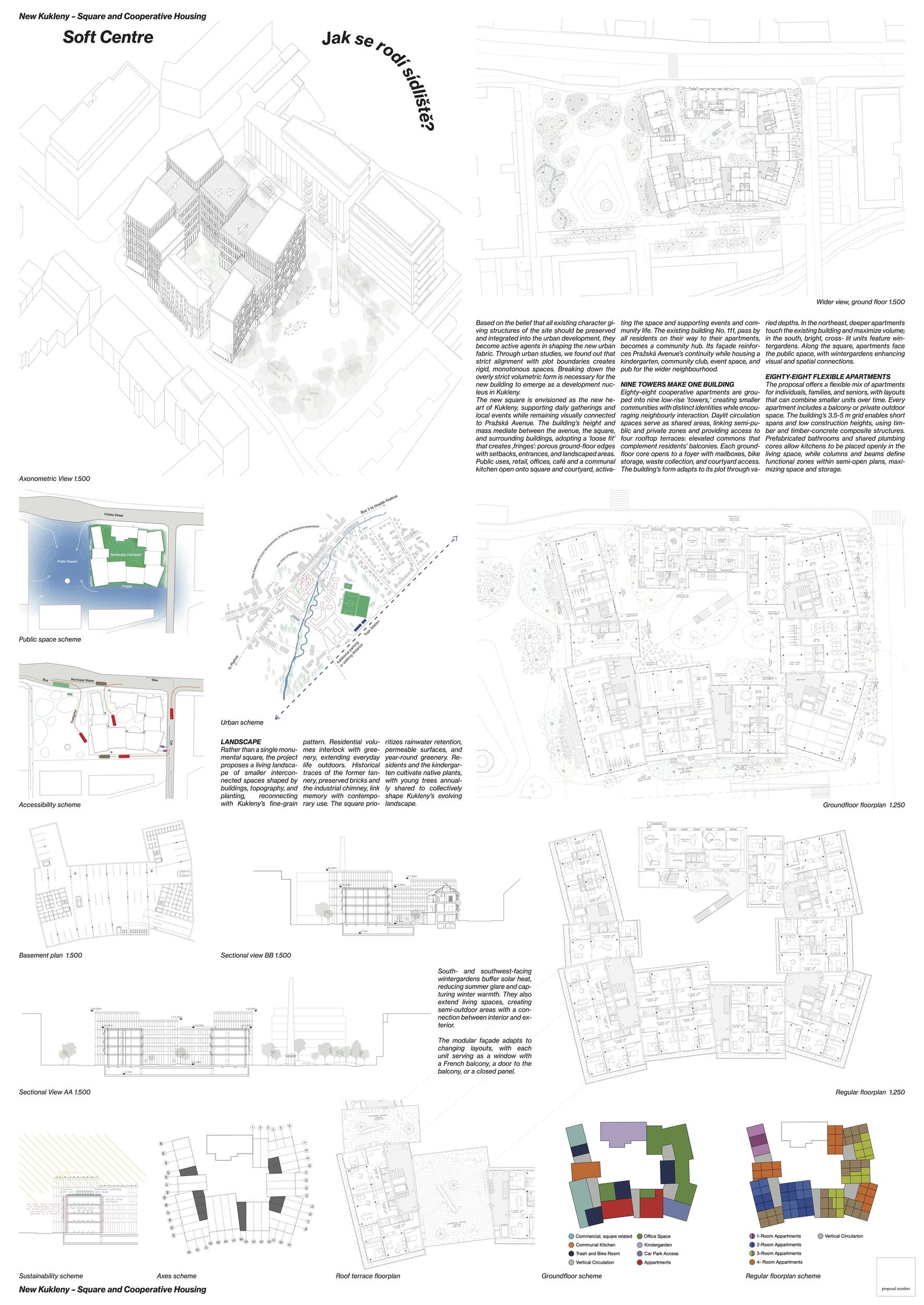
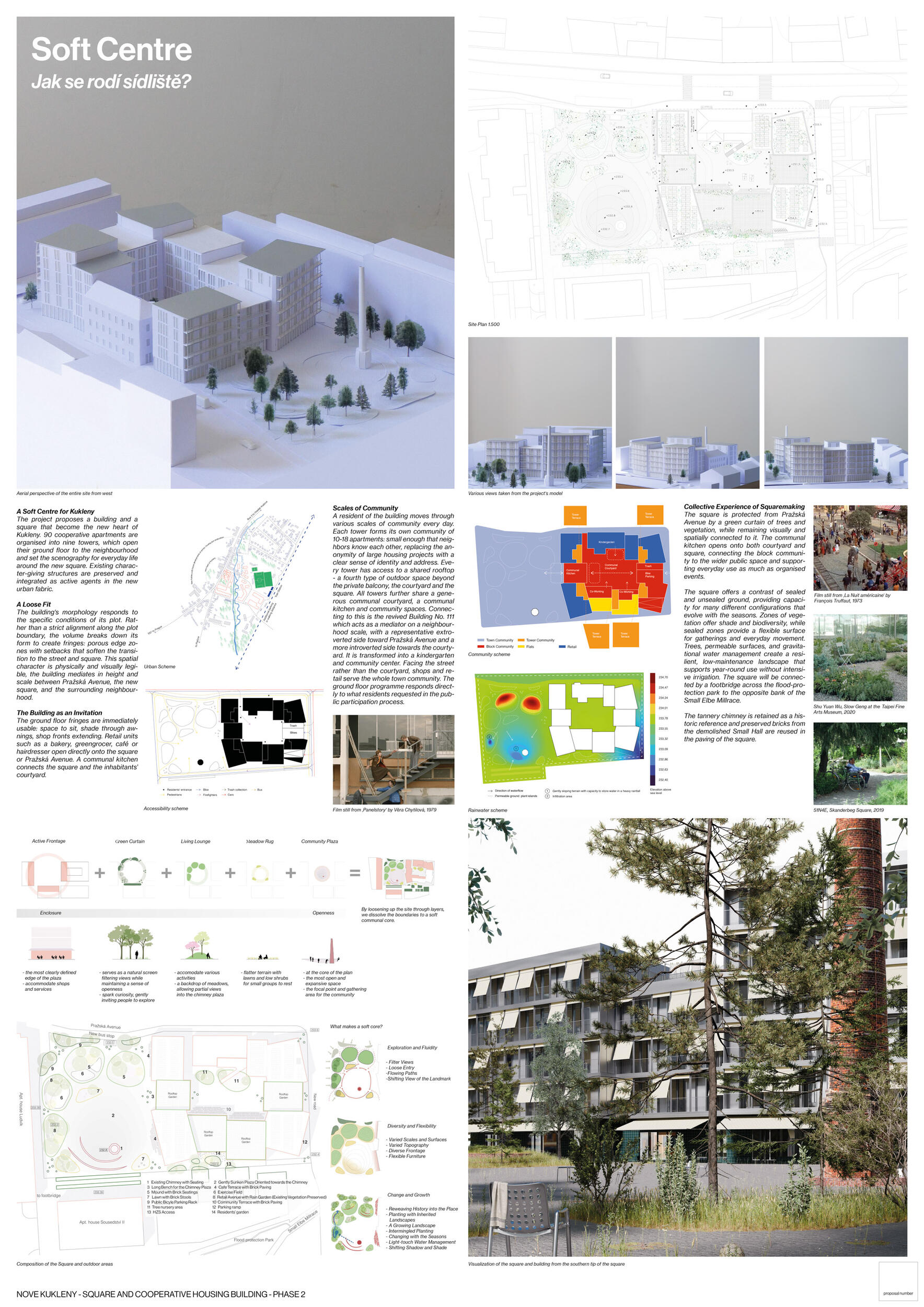
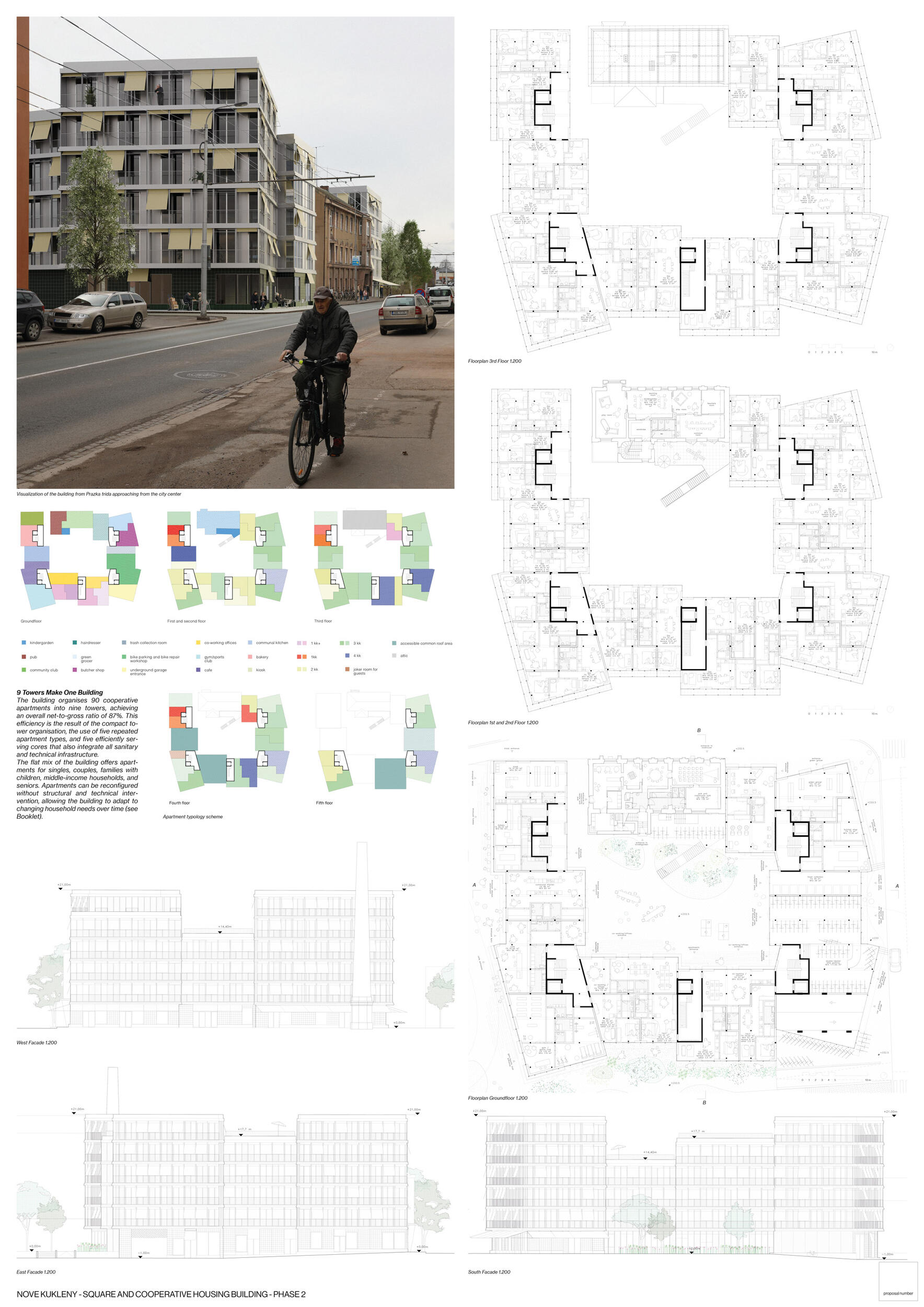
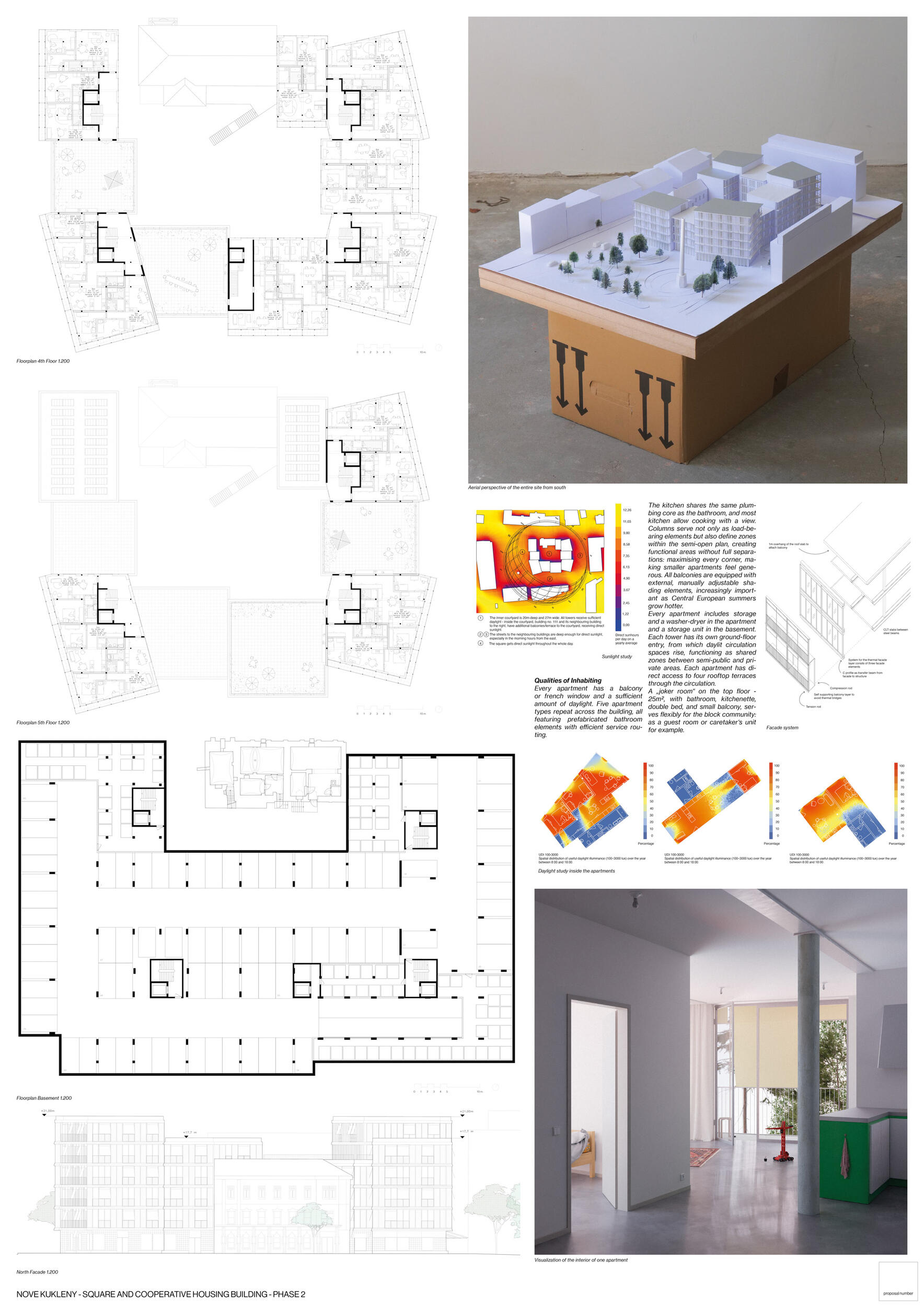
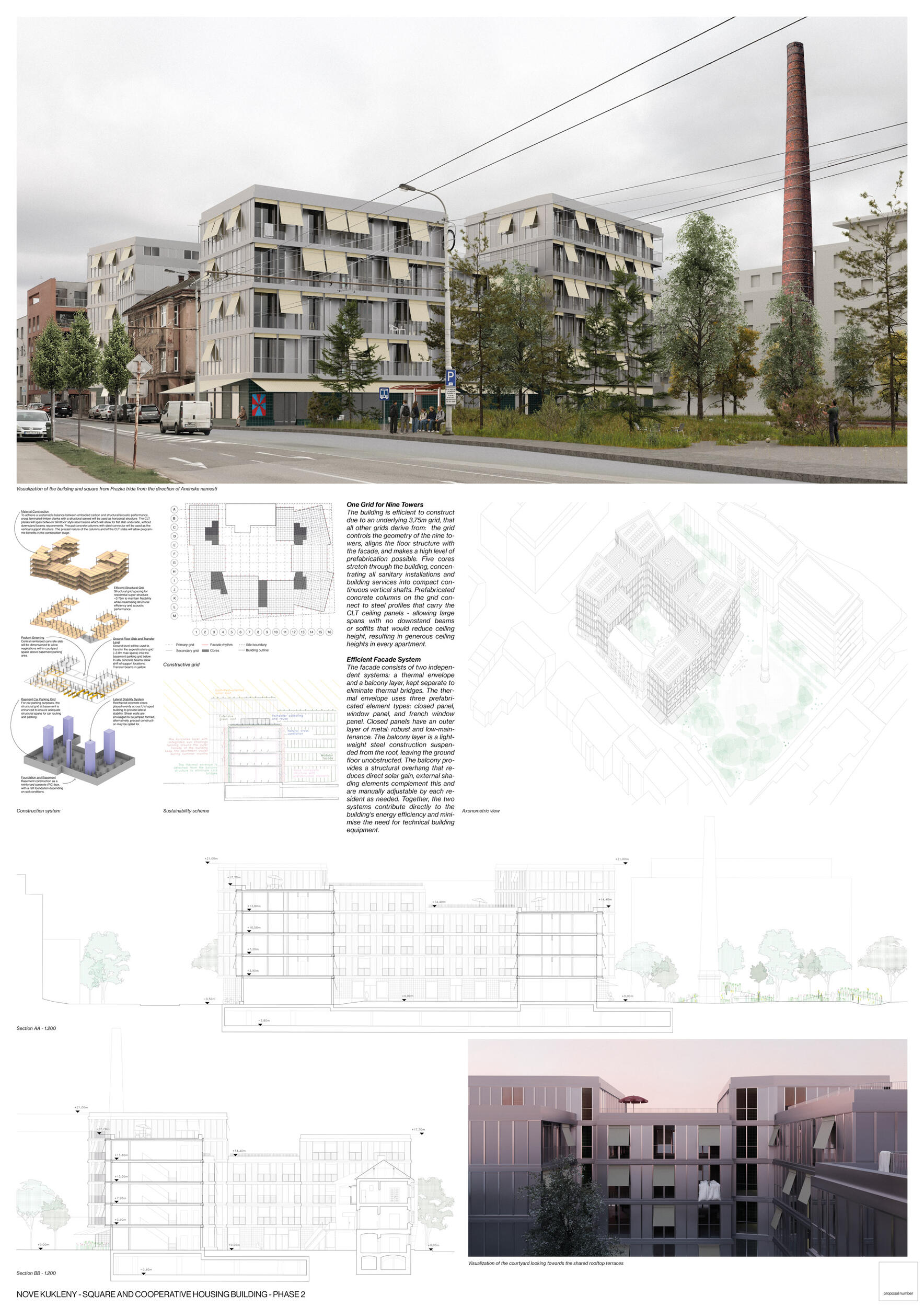
To build this new part of Kukleny means to design the scenography of everyday spaces. The site offers qualities: proximity to mobility infrastructure, sports facilities, and natural landscapes - a high density of inhabitants and activities is planned. 90 apartments are organised into nine towers: the proposed building is structured into smaller communities with shared spaces and rooftops, framing cooperative living as a collective social infrastructure and space of possibilities. The building opens its ground floor to both residents and the wider neighbourhood of Kukleny: an inner courtyard provides a protected space for residents, while public-facing uses address the new square and the avenue, interweaving building with its surrounding public space. The building‘s morphology responds to the specific conditions of its plot. Rather than a strict alignment along the plot boundary, the volume is articulated into smaller parts to create fringes: porous edge zones with setbacks that soften the transition to the street and square. A 3.75 m grid organises the geometry of all nine towers, aligns the floor structure with the facade, and enables a high degree of prefabrication throughout. A limited set of elements, repeated, ensures construction efficiency and cost control, while maintaining the quality of the apartments.

Jury Evaluation

The “Soft Centre” proposal presents an approach that seeks to overcome the rigid historical block structure and redefine it for contemporary conditions. The individual “building blocks” of the scheme correspond to the modulation of houses in traditional urban blocks, while at the same time establishing the identity of communities within each module. They also create a articulated interface at the boundary between façades and public space. The assumption of certain interactions between residents and the public within this interface was what impressed the jury and led to the project’s advancement to the next round. The nine modules representing individual houses within the urban block could, beyond their social dimension, bring the proposal closer to the principles of an organically grown city and contribute to its better integration. However, the continuous horizontal layering of all modules with uniform balcony lines ultimately negates this potential. The structural system of the modules allows for the required flat mix of 90 units organized around five stair cores and meets current demands for adaptable housing. Access to the inner courtyard is provided only from Pražská Street, determining that entrances to the residential parts of the buildings are primarily oriented from this space, which in turn maximizes the perimeter for urban amenities. The rather constrained and direct entrances to some apartments can be seen as problematic, especially in relation to the oversized shared circulation spaces on the upper floors. The layout design is generally quite subjective, resulting in spaces within apartments that are difficult to use and, given the geographical context of the project, also interior areas with insufficient daylight. The limited depth of balconies is compensated by generous shared terraces, reinforcing the project’s strong community-oriented concept (further supported by features such as a communal kitchen connecting the courtyard with the square, shared co-working spaces, and a guest apartment for short-term stays). Building No. 111 is attached to the new block and retained in its original form, adapted to accommodate a kindergarten and a community center for the residents of Kukleny. These functions are oriented towards the inner courtyard, which is equipped with play and leisure elements as well as modest landscape design. The remaining ground floor is carefully designed for small-scale services and retail, oriented towards Pražská Street and the new square. The landscape design achieves an appropriate balance between natural and urban character. The focal point of the square is an open, gently sloping gathering space around the chimney, intended for the broader community and framed by composed green islands providing shade from mature trees. Overall, the proposal can be evaluated as high-quality due to its strong conceptual foundation, thoughtful urban design, and pronounced emphasis on the social dimension of housing. Its weaker aspects lie in the rationality of the apartment layouts and in the resulting architectural expression, where a tension emerges between the strong fragmentation of individual modules and their ultimate unification through a uniform grid of continuous balconies. As a result, the potential for a more specific and distinctive solution for a new local center of the urban district is diminished.

Previous Next
3rd prize
  • Author Architecture Matters + Cornelius Pelzer + Nicholas Arvanitis
  • Team Amélia Brandão Costa, Rodrigo da Costa Lima, Cornelius Pelzer, Nicholas Arvanitis
  • Porto, Portugal / Dallas, USA / Chaidari, Greece
Annotation

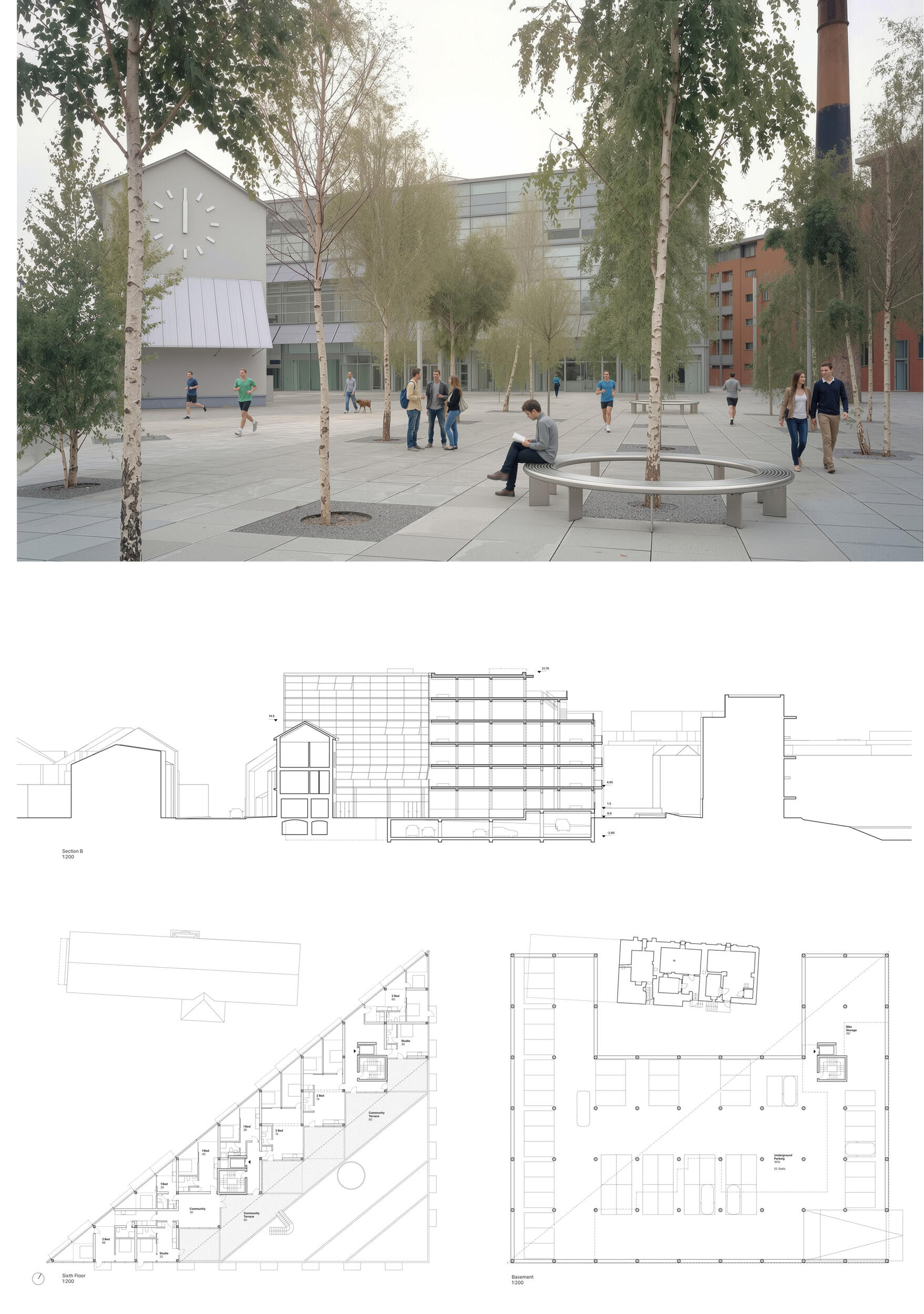
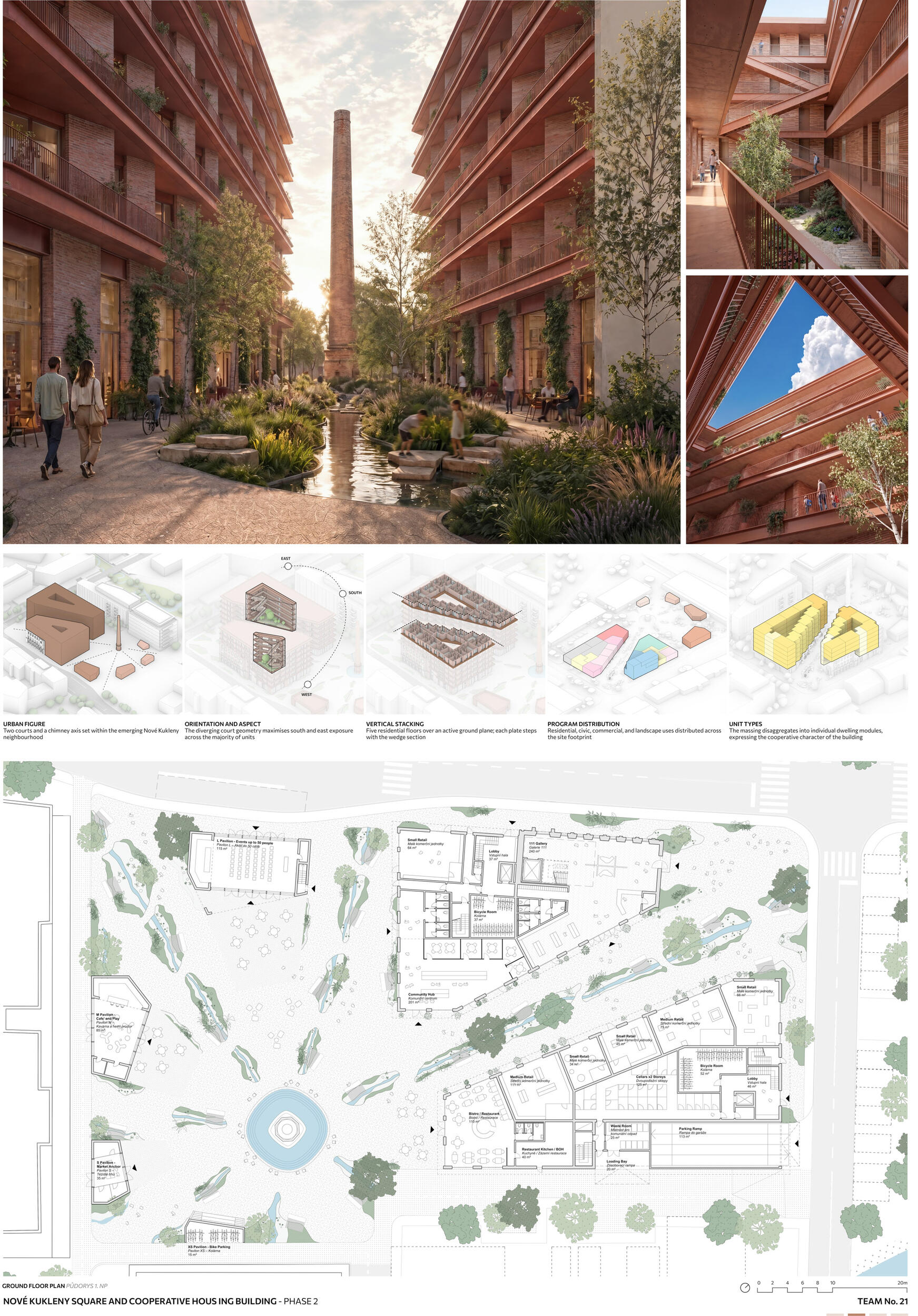
A triangular building bisects the plot on a diagonal. It pulls entry from the north into commerce and a public pocket at the square. Along the plaza, the façade meets life; a resident atrium filters public to private. At the rear, plates step down into shared terraces with river views toward Hradec Králové. A simple grid keeps units flexible, widening below grade for parking. The existing building is preserved and extended along Pražská Avenue to reinforce the original character of the evolving streetscape and serve as a buffer from traffic. The square echoes the diagonal with planting that guides movement, manages rainwater, and provides refuge. The ground floor is exclusively for retail, whereas the residential level is slightly raised to provide a sense of privacy and also natural light for the parking tucked underneath the building. Our proposal entirely avoids building no. 111 which we believe is a significant asset to the character of the neighborhood. By preserving and adding to this the existing building, we are providing the potential for its reimagination as a flexible, community space.

Jury Evaluation

The project proposes a strong conceptual framework for collective living through a single, clear formal gesture: a triangular building that bisects the plot diagonally. This operation simultaneously frames the public square, organizes the transition from the street into the site, and generates a sequence of shared terraces opening in the opposite direction, towards the river and the wider landscape of Hradec Králové. The jury recognized the clarity and ambition of this compact urban strategy, which gives the project a distinctive identity while resolving several contextual conditions through one architectural move. The building’s diagonal position produces a productive tension between public frontage and communal interior life. Along the plaza, the façade engages directly with the public realm, while the residential atrium mediates the transition from public to private. At the rear, the stepped plates create generous collective terraces that offer shared outdoor spaces and long views. This spatial organization gives the proposal a strong sense of community, particularly through the atrium spaces distributed across the residential floors. The housing is organized through a series of perimeter units, producing dwellings with a loft-like character. The compactness of the plan allows the proposal to achieve a significant number of units while maintaining access to private balconies, shared terraces, storage, and collective areas. The simple structural grid also suggests a degree of flexibility and constructional efficiency, supporting the ambition for adaptable housing and a rational building system. The project also makes a convincing urban contribution by preserving Building 111 and extending it along Pražská Avenue. This decision reinforces the existing character of the streetscape, creates a buffer from traffic, and opens the possibility of reimagining the historic structure as a flexible community space. The public square, structured by diagonal planting, offers an open civic surface that can accommodate movement, gathering, rainwater management, and moments of refuge. At the same time, the jury noted that the proposal would benefit from further development. The current housing mix offers limited possibilities for larger family units and some floor plans present unresolved circulation issues that should be addressed in a next phase. Nevertheless, the jury valued the strength of the highly compact proposal, the clarity of its formal and urban strategy, and the social potential embedded in its collective spaces. The proposal stands out as a conceptually precise and promising project whose architectural intelligence lies in its ability to transform a simple triangular gesture into an urban, residential, and communal framework.

Previous Next
4th prize
  • Author OH BOI + VEN.KU architekti
  • Team Ján Paločko, Jan Kubát, Johana Trojanová, Matěj Příman, Martin Jireš, Linda Kaliská, Julie Horáčková, Ondřej Valigura, Iveta Olšovská
  • Brno
Annotation

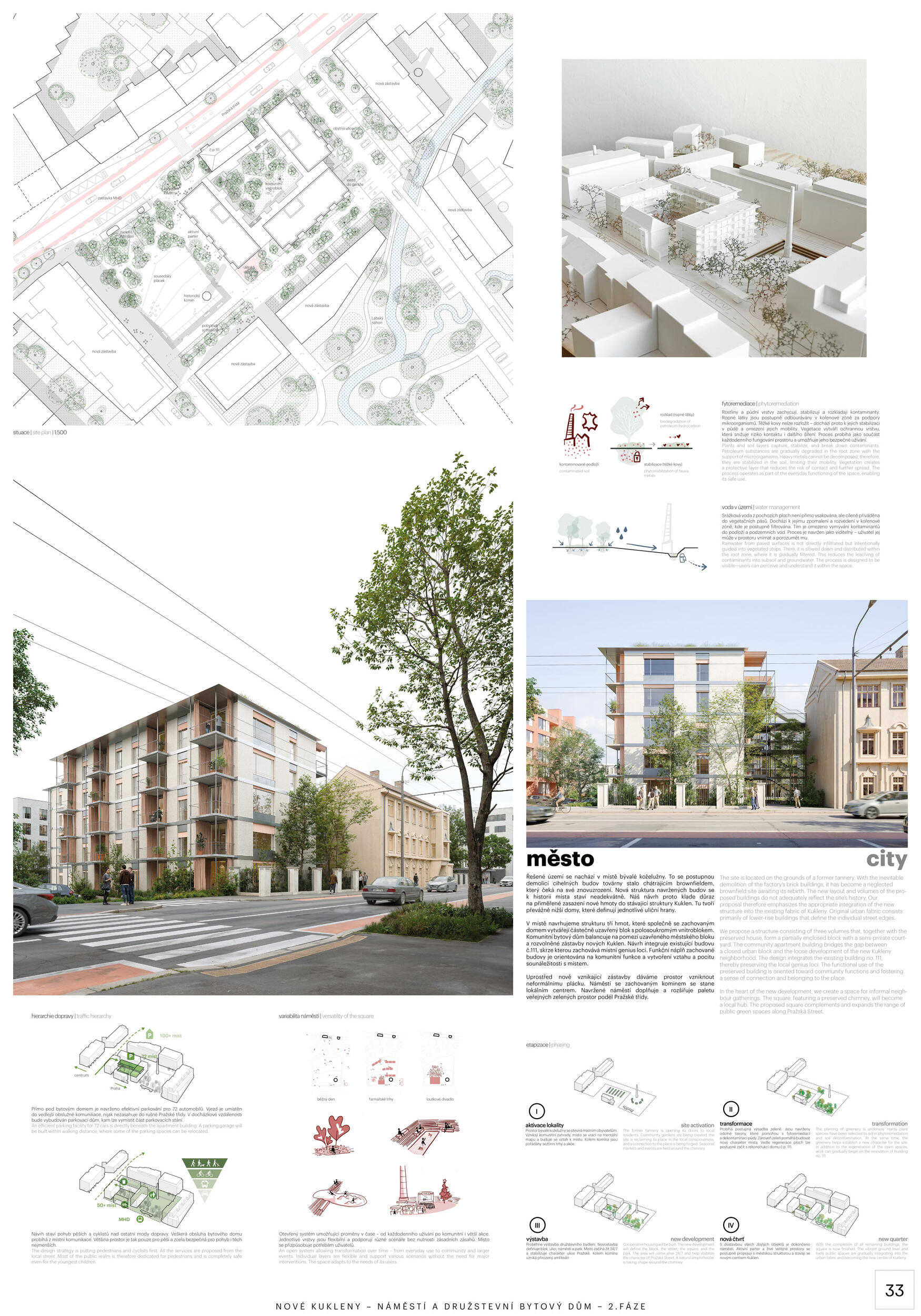
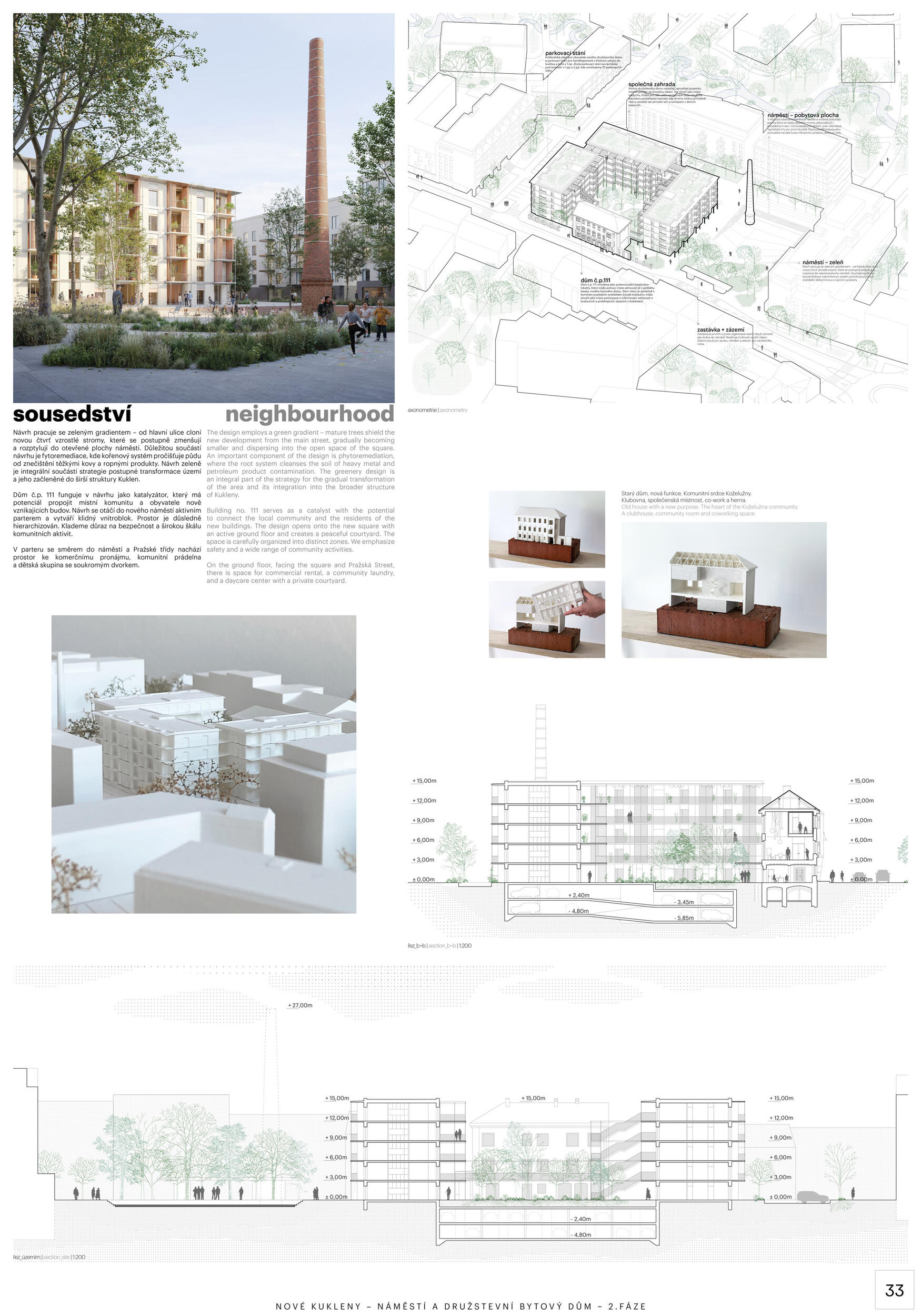
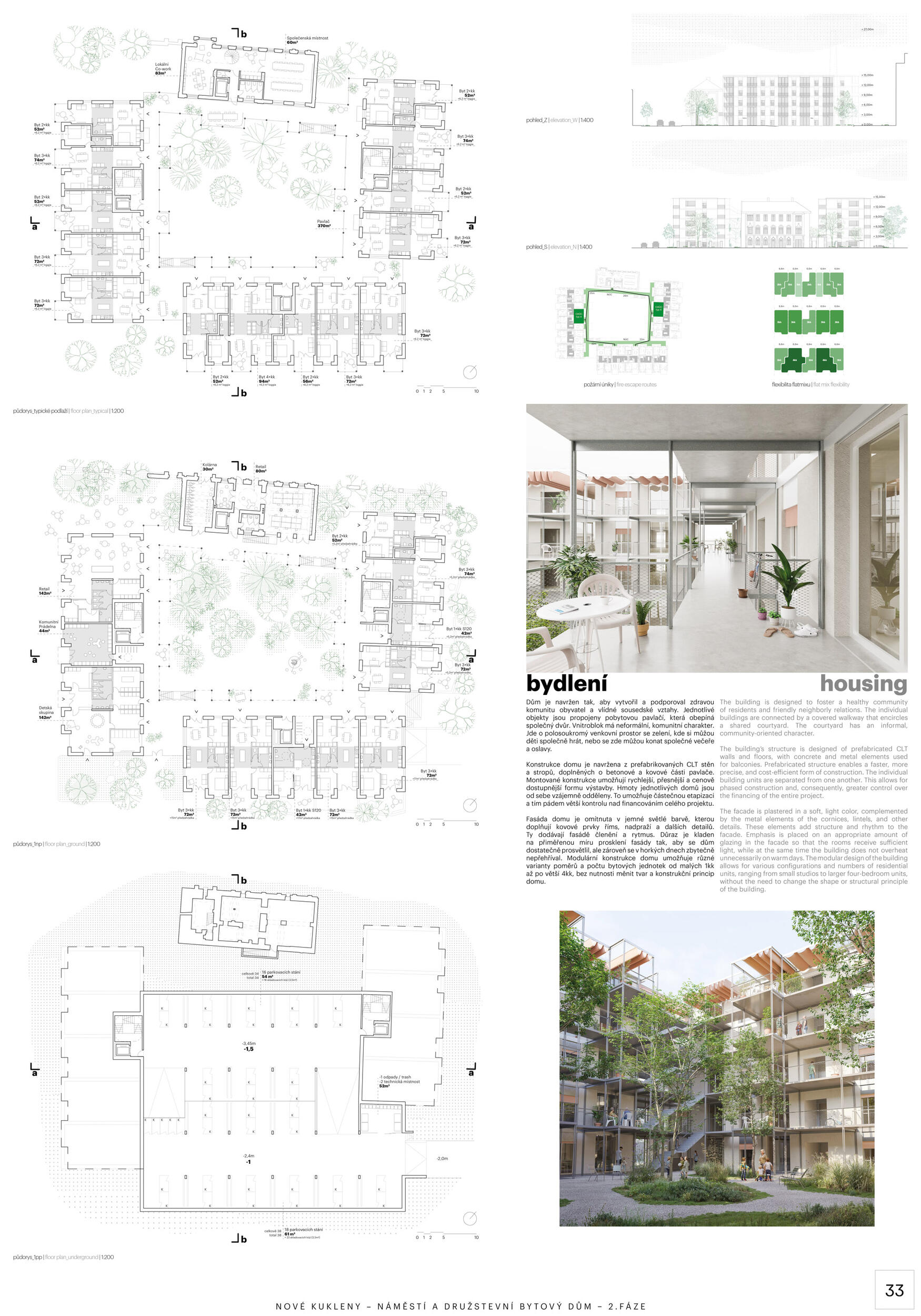
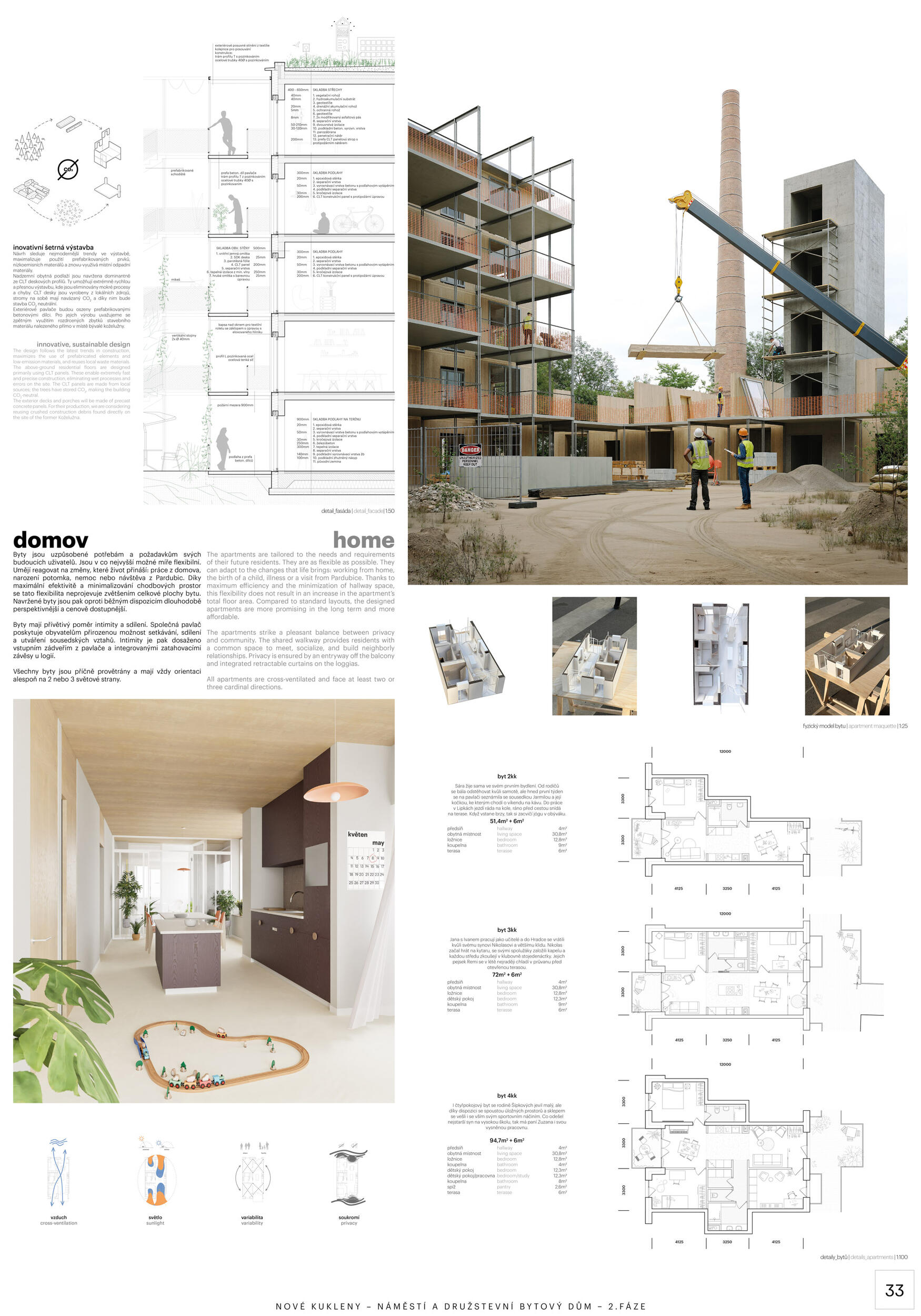
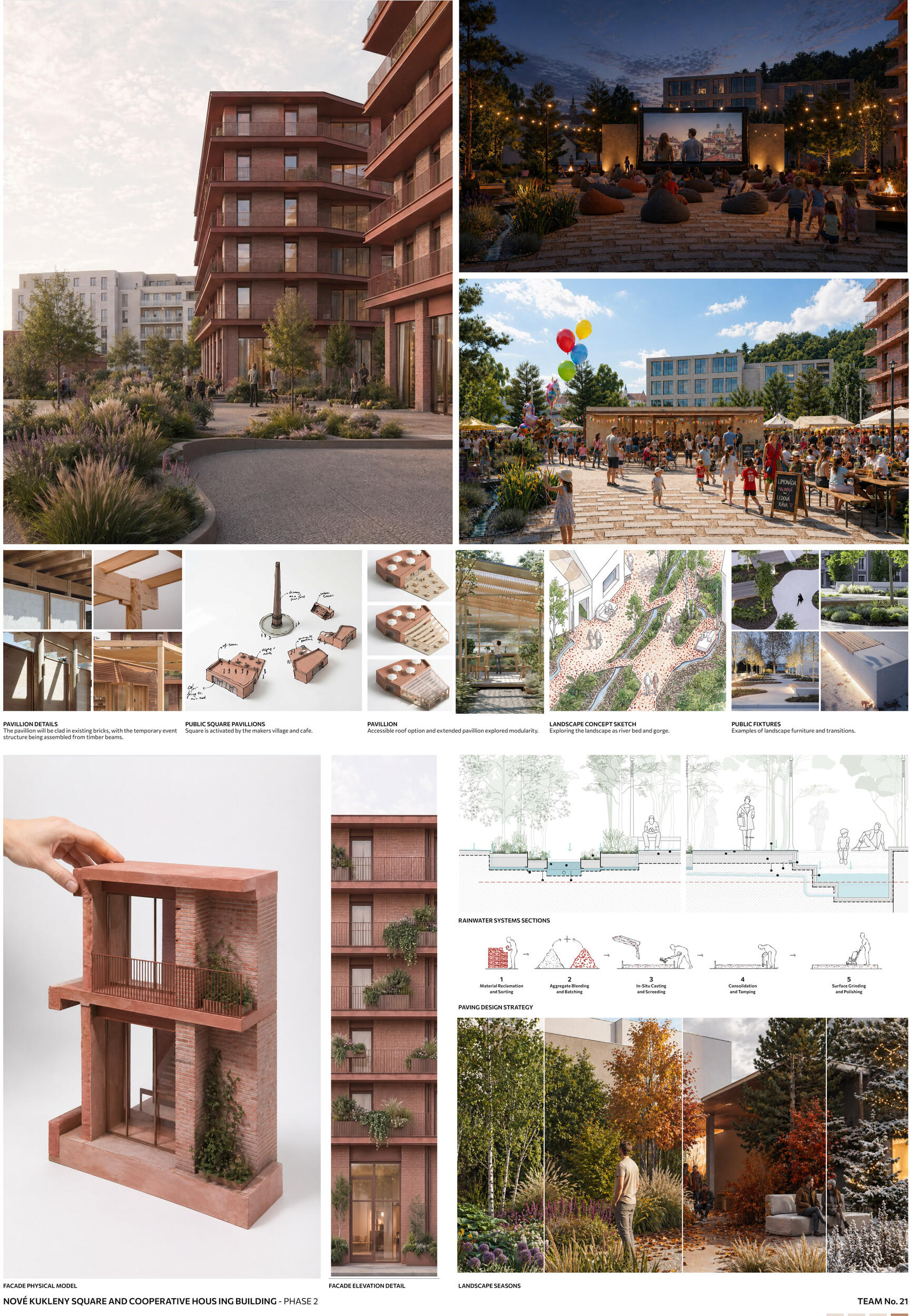
We propose a structure consisting of three volumes that, together with the preserved house, form a partially enclosed block with a semi-private courtyard. The community apartment building bridges the gap between a closed urban block and the loose development of the new Kukleny neighborhood. The design integrates the existing building no. 111, thereby preserving the local genius loci. The functional use of the preserved building is oriented toward community functions and fostering a sense of connection and belonging to the place. In the heart of the new development, we create a space for informal neighbour gatherings. The square, featuring a preserved chimney, will become a local hub. The proposed square complements and expands the range of public green spaces along Pražská Street. The building is designed to foster a healthy community of residents and friendly neighborly relations. The individual buildings are connected by a covered walkway that encircles a shared courtyard. The courtyard has an informal, community-oriented character.

Jury Evaluation

The project works with three new buildings which, together with the existing structure, form a block with recessed corners. This composition creates a high-quality semi-private courtyard and establishes a pleasant, community-oriented residential environment. The proposal responds well to the scale of the surrounding development, and the jury particularly appreciated the treatment of public space and the relationship of the building to the newly emerging square. The square itself is designed with great sensitivity, employing the principle of a green filter from the street and tram stop. The space gradually opens into the central area of the square and makes use of the natural topography. A simple concept of stepped seating creates a natural amphitheater around the preserved chimney, allowing for flexible use of the space for everyday life as well as community and urban events. The jury responded very positively to the principle of lowering the square, which feels natural and offers a wide range of uses. The jury had mixed feelings about the recessed corner facing Pražská Avenue. This location was considered an important urban moment; however, the solution with front gardens and fencing did not create a sufficiently strong urban character nor an appropriate expression for the center of the new district. The architecture of the building is based on a simple and legible modular structural principle, enabling efficient and well-organized layouts. The project appears rational and clear, while also offering a pleasant human scale and residential atmosphere. The gallery access system was highly appreciated for supporting a strong sense of community and activating life within the courtyard. Combined with mature greenery and projecting balconies, the galleries create a high-quality living environment and encourage social interaction among residents. The apartment layouts were positively evaluated, particularly for their efficiency and high-quality internal organization. A significant benefit is the cross-ventilation of the units, which improves indoor environmental quality. A weaker aspect of the proposal, however, lies in the corner conditions of the block, where a conflict arises between the depth of the access galleries and the daylight access to the apartments. In some cases, bedrooms are located in these areas and may be significantly shaded. The landscape design was also well received, especially in its careful gradation of public, semi-private, and green spaces. The courtyard, enriched with mature vegetation, offers a high-quality environment and good conditions for everyday community life. The main weakness identified by the jury concerns the design of the two-level underground parking. The proposal does not fully utilize the footprint beneath the buildings themselves, and parking capacity extends beneath a large portion of the courtyard. This creates a contradiction with the intended quality of greenery, as the soil depth above the structure is minimal in some areas, limiting the potential for planting large trees. Some aspects of the façade detailing were also considered debatable, as they were not entirely convincing in the presented form, although the jury acknowledged their potential for further development in subsequent project phases. Overall, the jury appreciated the project for its clarity, strong urban concept, well-resolved layouts, and pronounced community character. The treatment of the square, the gallery system, and the public realm were particularly praised. Despite certain shortcomings in the corner conditions, daylight access in some units, and the concept of underground parking, the proposal represents a thoughtful and high-quality solution with significant potential for further development.

Previous Next
5th prize
  • Author Studio Lowe Architecture
  • Team Stefano Vitale, Luca Fontana, Mark Lowe
  • London, UK
Annotation

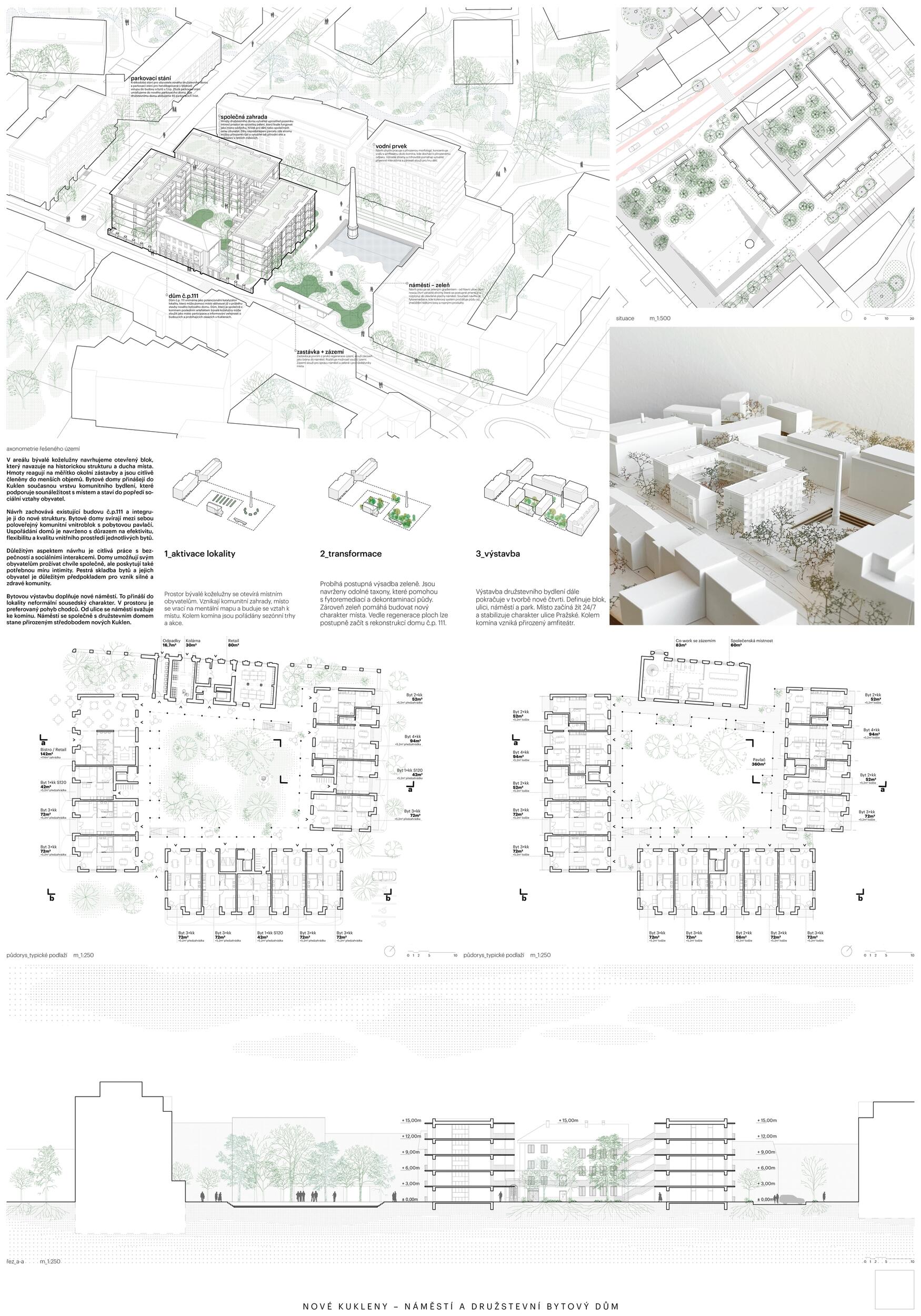
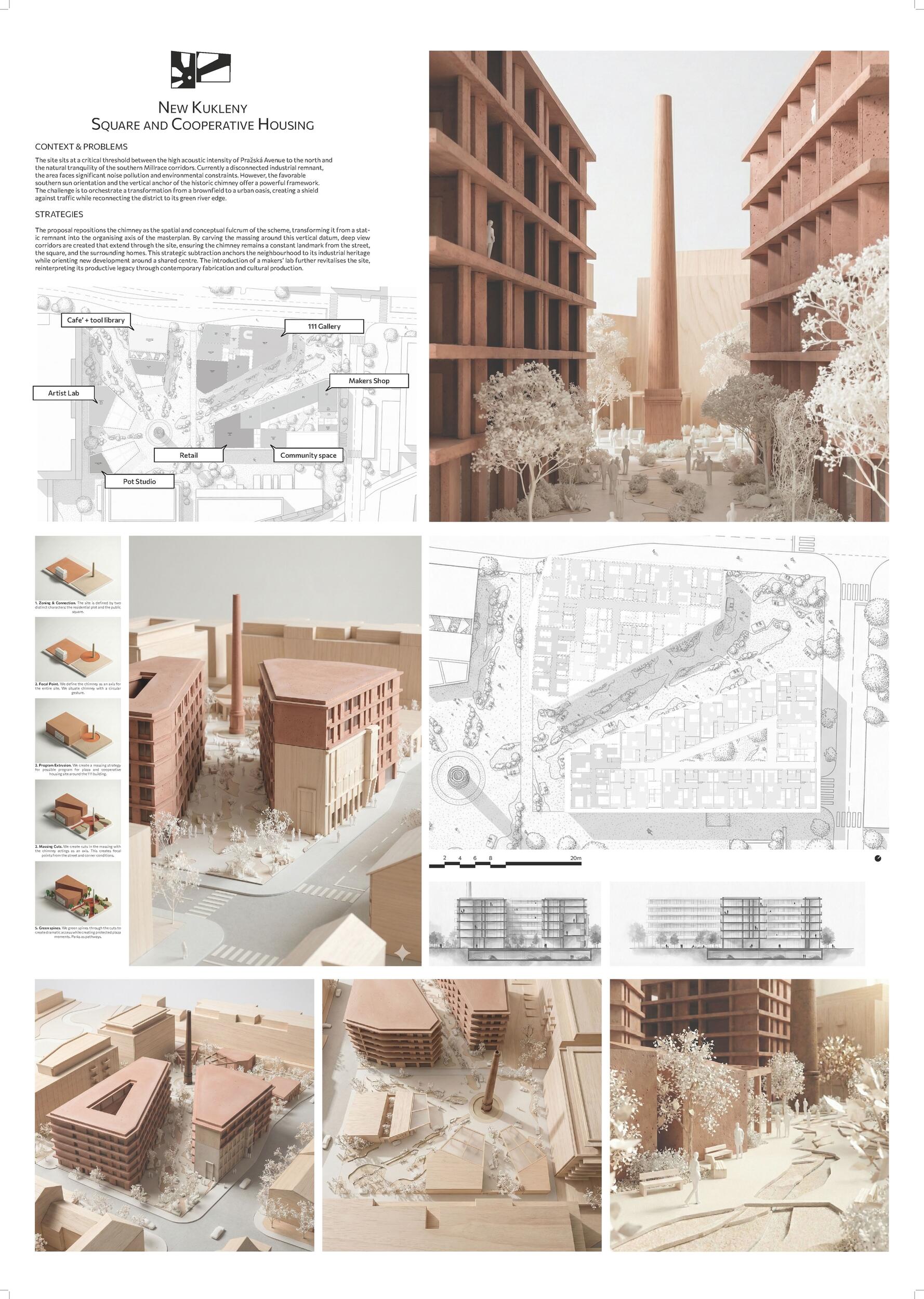
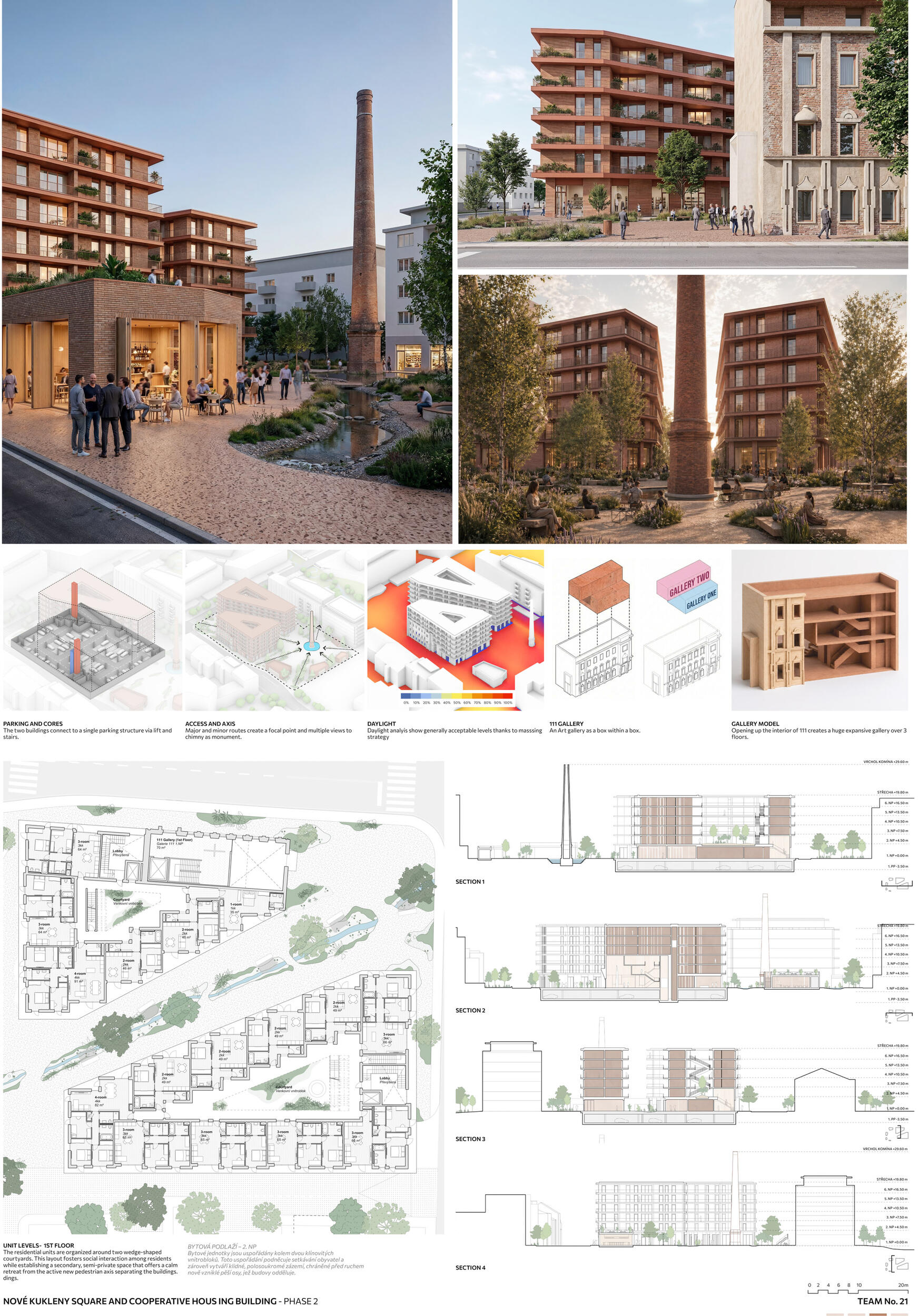
The genesis of the proposal transforms the chimney from a static relic into the absolute spatial fulcrum. By carving the architectural massing around this axis, we generate deep view corridors that permeate the site. This strategic subtraction ensures the chimney acts as a ubiquitous landmark, visible from the street, the square, and the apartments, orienting the entire neighborhood and anchoring the community around its industrial heart. The design introduces a dynamic hybrid typology, merging the spatial efficiency of a linear block with the community focus of a traditional courtyard. By articulating the internal courts, the architecture maximizes natural light and cross-ventilation while creating distinct, welcoming spaces that foster resident interaction. This sculpted massing allows a central pedestrian axis to bisect the site, establishing a clear spatial hierarchy that transitions gracefully from the active public promenade into the sheltered, semi-private courtyards.

Jury Evaluation

The jury selected the proposal for the shortlist due to its inventive and innovative urban solution. This highly detailed proposal has two defining characteristics. The first is a strong emphasis on a vibrant ground level and an effort to develop and invigorate local community life in public spaces. The second is the strong subordination of the entire concept to its focal point in the form of the original chimney of the former tannery. The pair of buildings with a trapezoidal floor plan proposed by the team features well-designed apartment layouts served by outdoor galleries from an open atrium. This is an efficient solution; only two vertical cores are needed for a large number of apartments. The architects provided well-utilizable balconies for the apartments facing the radial street; in other parts of the building envelope, they appear too shallow and difficult to use. The diagonal intersection of the block offers interesting micro-spaces at the street’s terminus and allows for perfect accessibility through the area. However, this results in the minimization of courtyards and the absence of semi-public space for the building’s residents. The original building at No. 111 is practically fully integrated into the new structure, which houses a public gallery. However, inserting a parking garage beneath its mass and adding three stories appears structurally unrealistic. The design for the square is complemented by several radially arranged single-story pavilions in an effort to introduce and activate public and community functions. The landscape design incorporates complex water features that are extremely high-maintenance. As a result, the concept is overambitious, difficult to adapt, and the large number of undesirable public functions would place an unsustainable burden on the project, both in terms of investment and operation. The symbolic role of the factory chimney as the absolute focal point of the proposed microcosm also appears questionable. Overall, the design fails to meet the client’s needs, which focus on cost-effectiveness and low operating costs, with the expectation of a gradual development of the public areas on the parterre.

Previous Next