Memorial to Pilots and Members of the RAF in the Mladá Boleslav Region

1st Prize
  • Author Jacob Dahlgren & LASOVSKY JOHANSSON ARCHITECTS
  • Copenhagen and Stockholm, Denmark and Sweden
Annotation

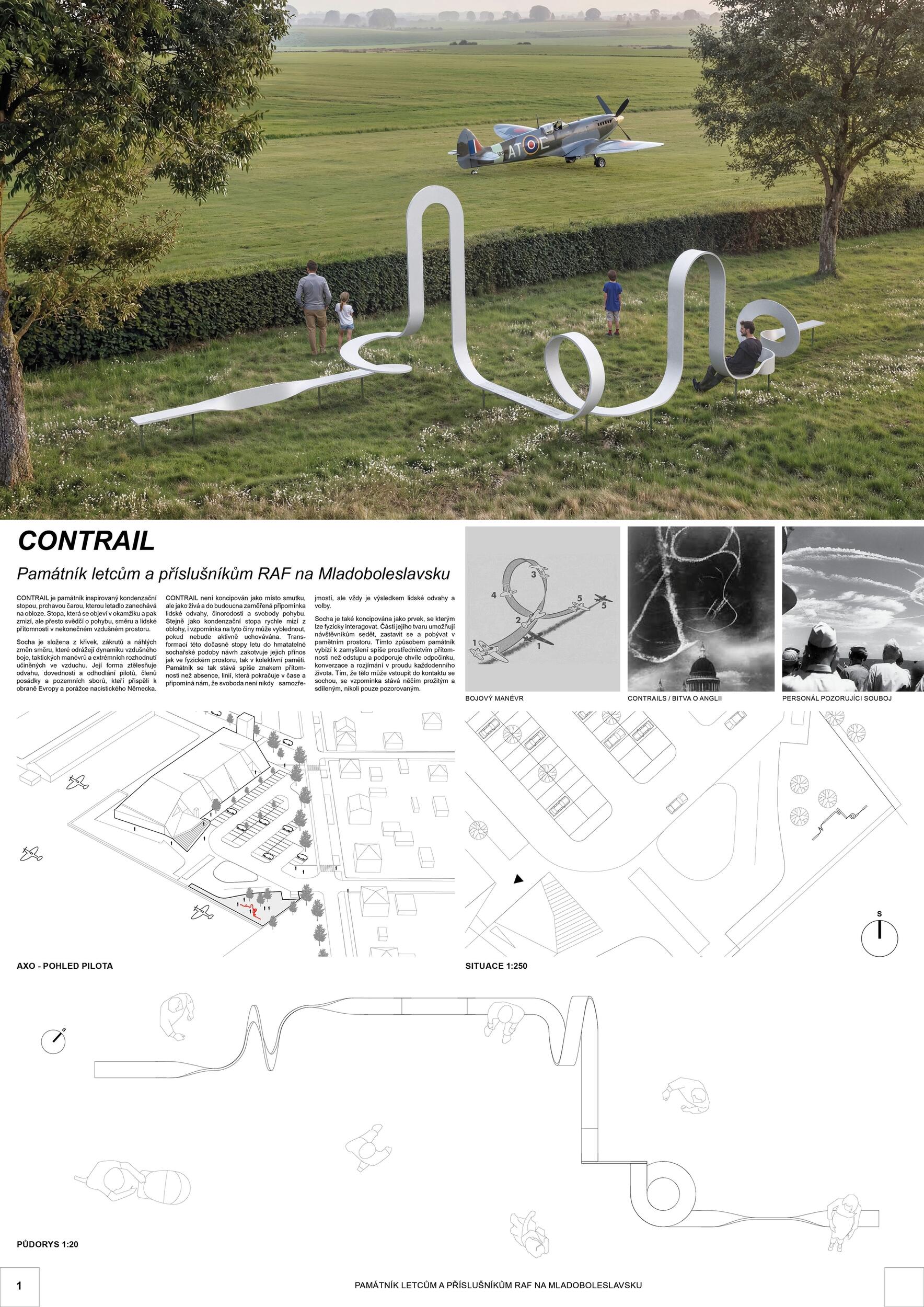
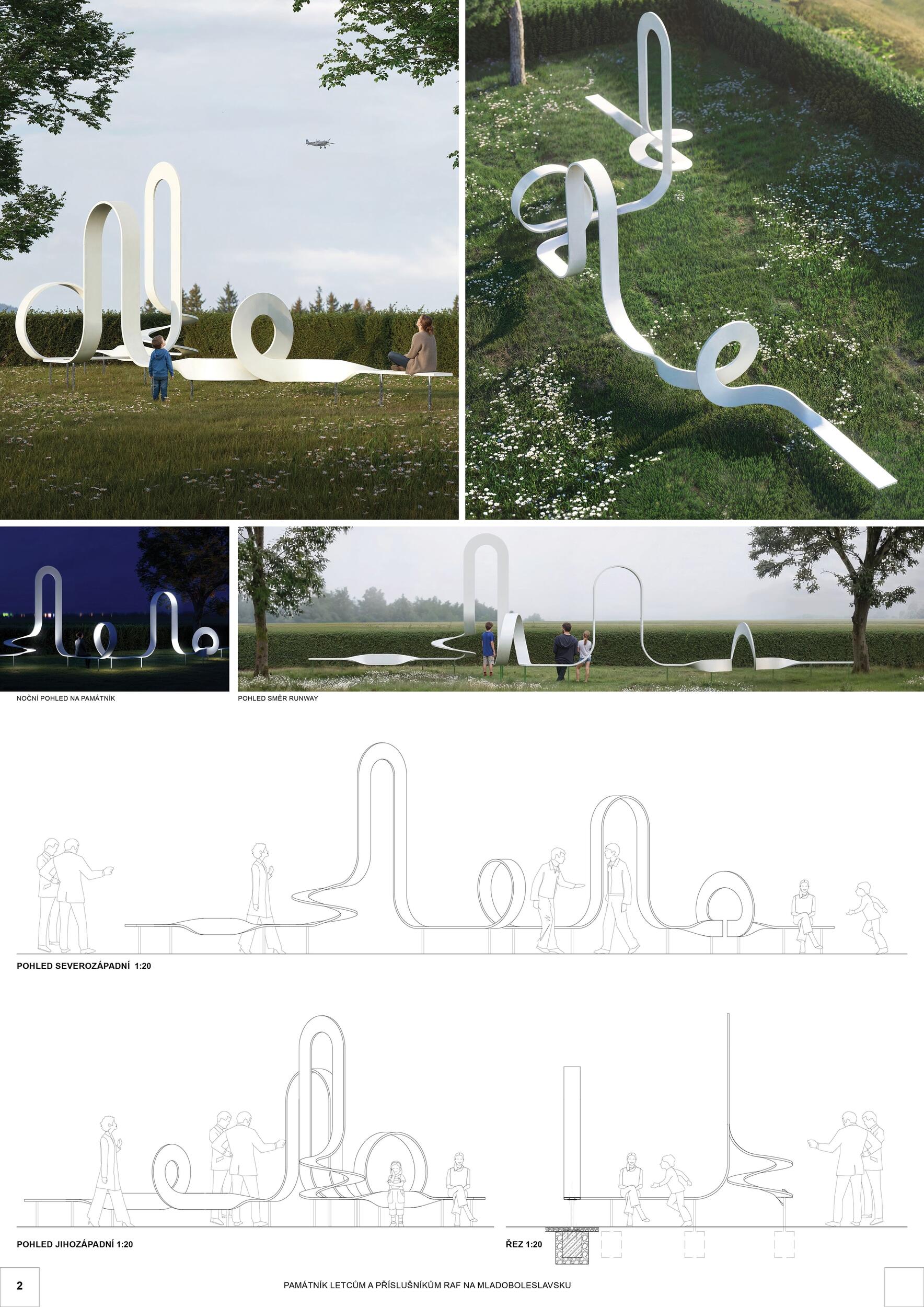
CONTRAIL is a memorial inspired by the contrail, the fleeting line that an aircraft leaves in the sky. A trail that appears for a moment and then disappears, yet it is a testament to movement, direction and human presence in the infinite airspace. The sculpture is composed of curves, twists and sudden changes of direction that reflect the dynamics of air combat, tactical maneuvers and extreme decisions made in the air. Its form embodies the courage, skill and determination of the pilots, aircrew and ground forces who contributed to the defense of Europe and the defeat of Nazi Germany. CONTRAIL is not conceived as a place of mourning, but as a living and future-oriented reminder of human courage, enterprise and freedom of movement. Just as contrails quickly disappear from the sky, the memory of these deeds can fade if not actively preserved. By transforming this temporary flight path into a tangible sculptural form, the design anchors their contribution both in physical space and in collective memory. The monument thus becomes a sign of presence rather than absence, a line that continues through time, reminding us that freedom is never taken for granted, but is always the result of human courage and choice.

Jury Evaluation

The jury evaluates the design as the most refined, compact and balanced in terms of artistic quality, function and relationship to the place. It is a clearly legible author's object in a public space, which can function both as a memorial and as a civilian place for staying, stopping and everyday use. The work with the condensation trail motif is not confined to unambiguous symbolism, but leaves room for various levels of interpretation. However, the names of the fallen are sensitively integrated into the design and do not disrupt the overall abstract expression of the work, which makes the memorial not appear reverential in the traditional sense, but rather as an open space of memory for the wider community of the Mladá Boleslav region. The jury appreciates the sober aesthetics, clear and credible author's handwriting and realistic approach to the future aging of the object, maintenance and operation. The design acts as a single coherent whole that does not overwhelm the surroundings, but cultivates them and offers a memorable linear orientation element on the edge of the airport landscape. A significant contribution is the fact that of all the solutions, it most significantly creates a "civil place" - a space that is not separated from everyday life, but naturally and easily integrates into it. The jury also positively evaluates that the design includes lighting for the work. At the same time, the question remains as to how the authors specifically want to achieve the lighting effects presented in the supplied visualization.
Previous Next
2nd Prize
  • Author Zzyzx OAS1S, Anna Fiedlerová
  • Team Anna Fiedlerová, Ondřej Fiedler, Sabína Martináková, Matouš Kučera
  • Prague
Annotation

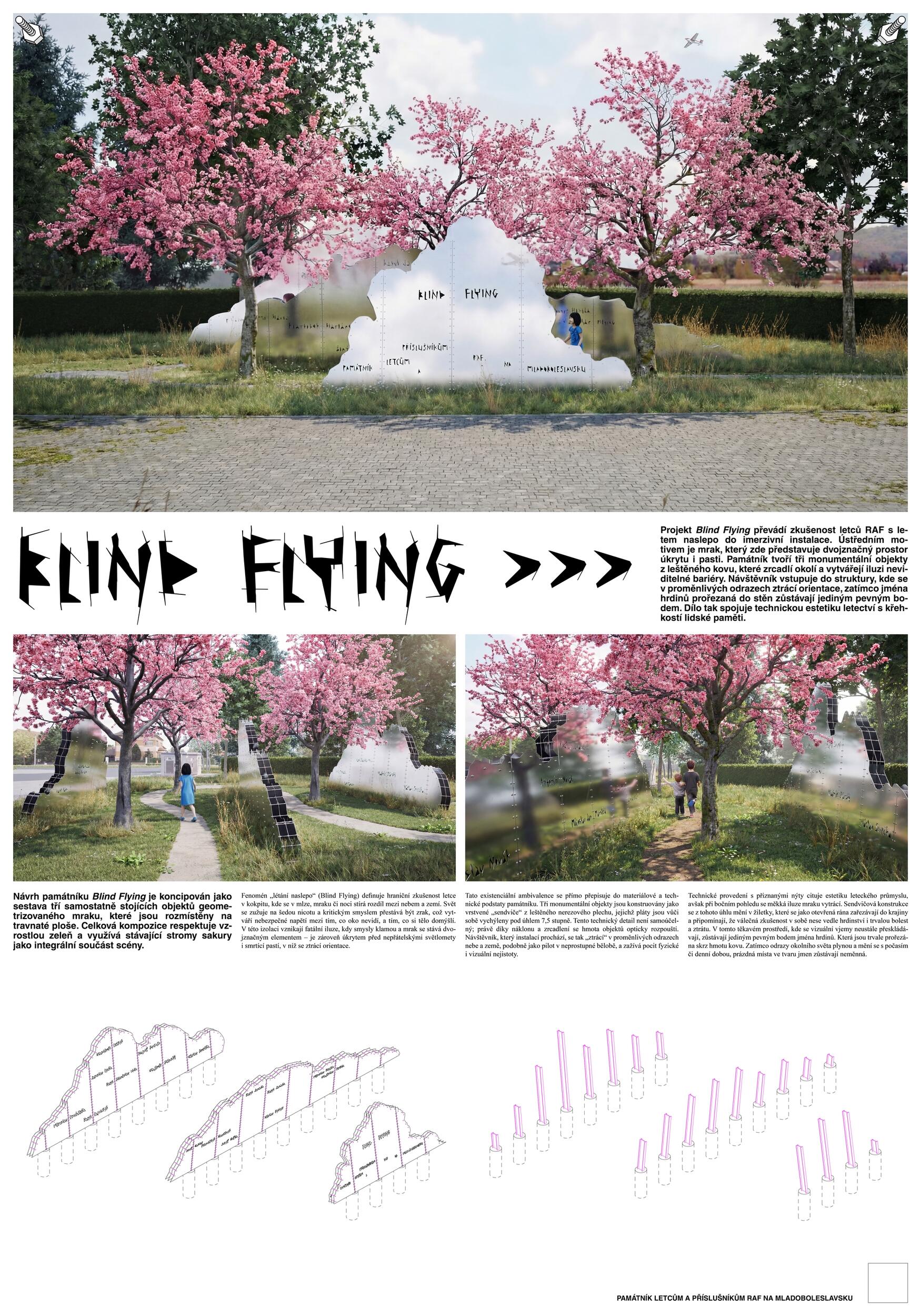
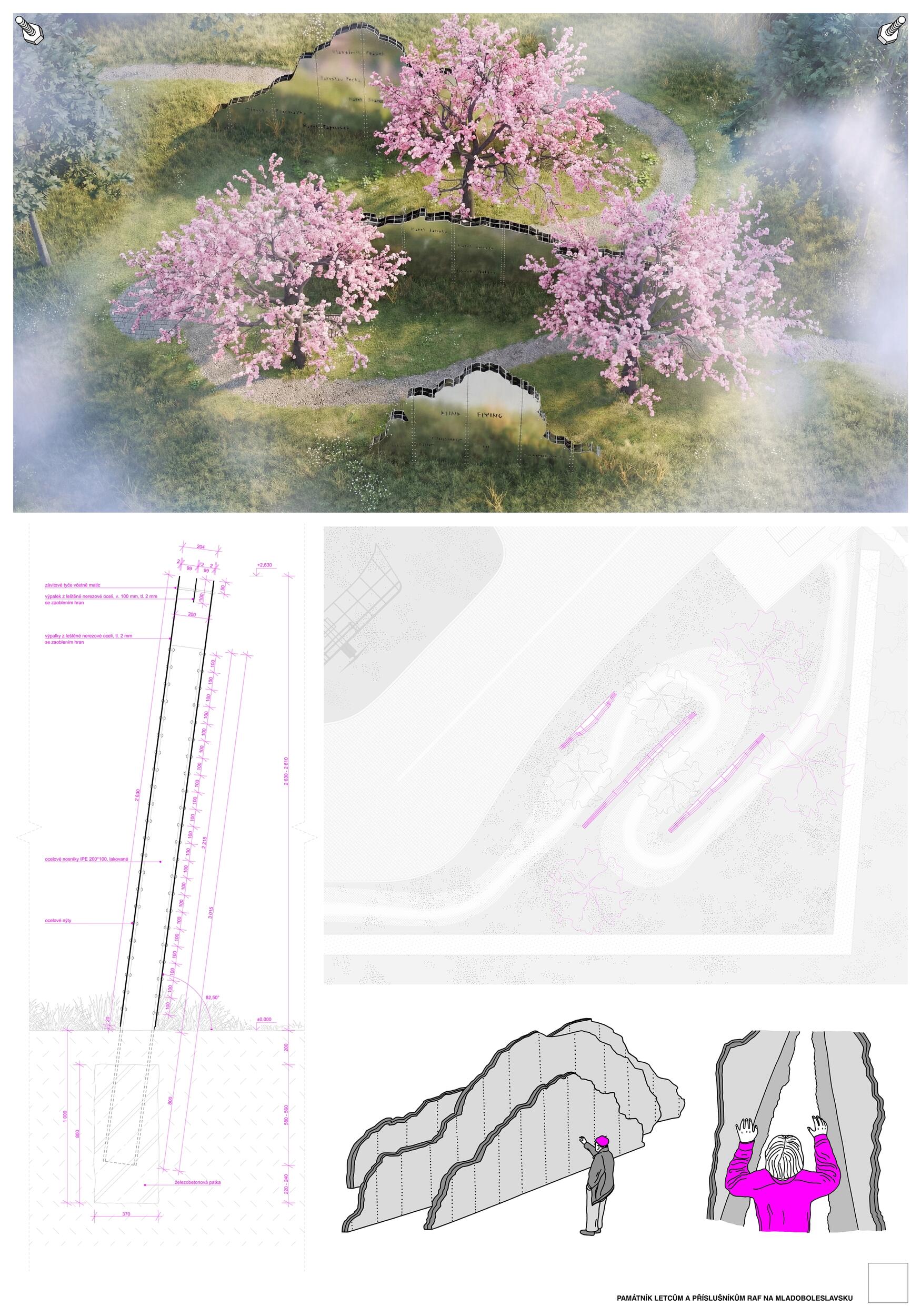
The Blind Flying project translates the RAF pilots’ experience of flying blind into an immersive installation. The central motif is the cloud, which here represents an ambiguous space of both shelter and trap. The memorial consists of three monumental objects made of polished metal that mirror the surroundings and create the illusion of an invisible barrier. The visitor enters the structure, where the orientation is lost in the changing reflections, while the names of the heroes carved into the walls remain the only fixed point. The work thus combines the technical aesthetics of aviation with the fragility of human memory.

Jury Evaluation

The jury perceives this proposal as bold and original, with a clearly legible anchoring in the current younger generation. It brings a distinctive, experimental and “street”-like artistic language that works with immersive space, mirroring of the surroundings and the physical entry of the visitor into the structure of the monument. The work with the environment is perceived positively, where the landscape, the architecture of the museum and the visitors themselves are reflected in the shiny surfaces, which makes the monument changeable and situational, but at the same time the jury draws attention to the safety aspects of using mirrored surfaces near air traffic. The jury perceives a certain tension between the artistic form and the work with text. The textual level introduces a rather explanatory, interpretatively literal guiding element into the proposal, which in places contrasts with the otherwise open and abstract character of the work. The narrow openings between two mirrored surfaces may, in the proposed scope, represent a challenge for the safety and maintenance of objects in public space. The limited presence of elements that allow for longer stays or pauses may reduce the potential of the design to function as a natural community place.

Previous Next
3rd Prize
  • Author Martin Papcún
  • Jílové u Prahy
Annotation

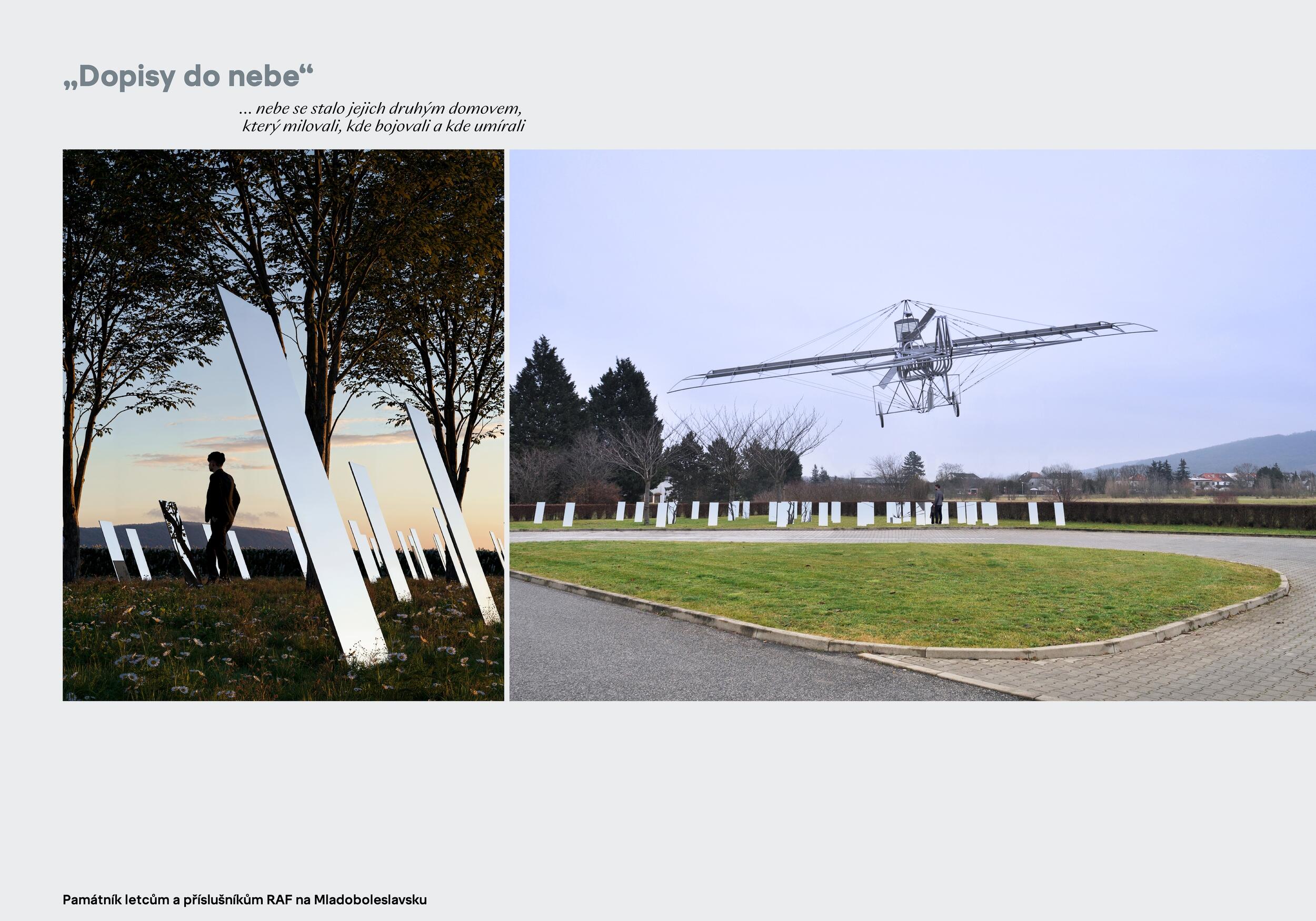
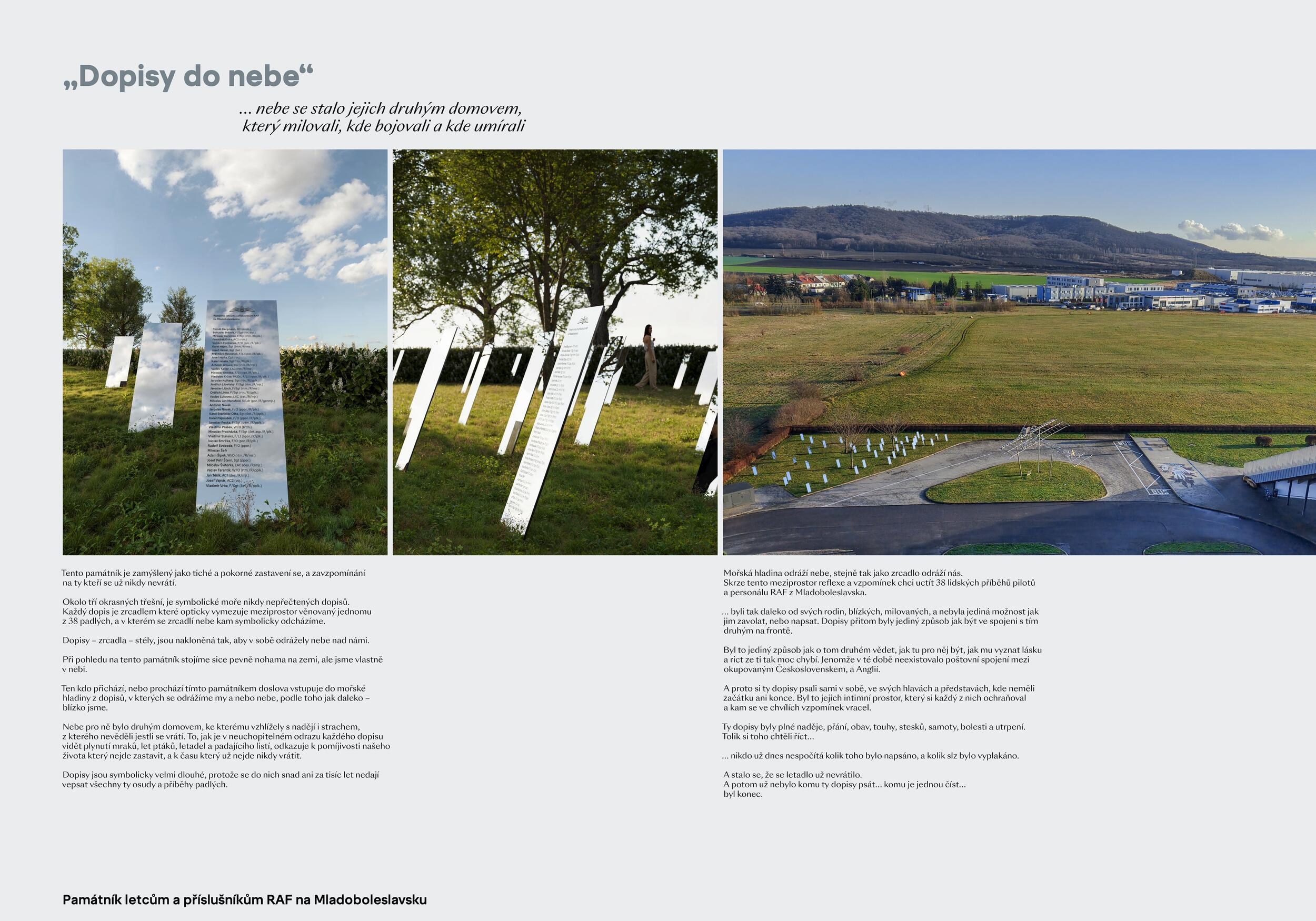
This monument is intended as a silent and humble stop, and a remembrance of those who will never return. Around three ornamental cherry trees, there is a symbolic sea of ​​never-read letters. Each letter is a mirror that optically defines the space dedicated to one of the 38 fallen, and in which the sky is reflected, where we symbolically leave. The letters - mirrors - steles, are tilted so as to reflect the sky above us. When looking at this monument, we stand firmly on the ground, but we are actually in heaven. Whoever comes or passes through this monument literally enters the sea surface of the letters, in which we or the sky are reflected, depending on how far - close we are. Heaven was a second home for them, to which they looked up with hope and fear, from which they did not know if they would return. The way in which the passing of clouds, the flight of birds, airplanes, and falling leaves can be seen in the elusive reflection of each letter refers to the transience of our lives, which cannot be stopped, and to time that can never be returned. The letters are symbolically very long, because perhaps even in a thousand years all the fates and stories of the fallen cannot be written in them.

Jury Evaluation

The jury evaluates the third proposal as a proposal that, from the point of view of contemporary artistic language, moves more within the framework of already established means of expression, while it stands out with its understandable and easily readable memorial morphology for the public. The inspiration from land art and minimalist forms refers to the established practices of modern art in public space. The dialogue with the existing aircraft by Metoděj Vlach is positively evaluated, which the proposal conceptually expands and integrates into the overall composition of the place. The proposal may appear accessible and “low-threshold” for the general public. At the same time, the jury perceives that the way in which the individual elements are arranged may evoke associations with a traditional field of reverence for some visitors, thereby strengthening the calm and static character of the place at the expense of a more open, process-based concept of memory. Working with names on a separate matte board in the context of glossy surfaces appears to be semantically open and suggests the possibility of further conceptual unification of the individual layers of the design. The jury also recommends paying attention to the operational and safety aspects associated with the use of reflective surfaces in the vicinity of air traffic.

Previous Next