SuperMost – SuperPrior

1st Place
  • Author re:architekti + baukuh + panorama
  • Czech Republic, Italy, Belgium
Annotation

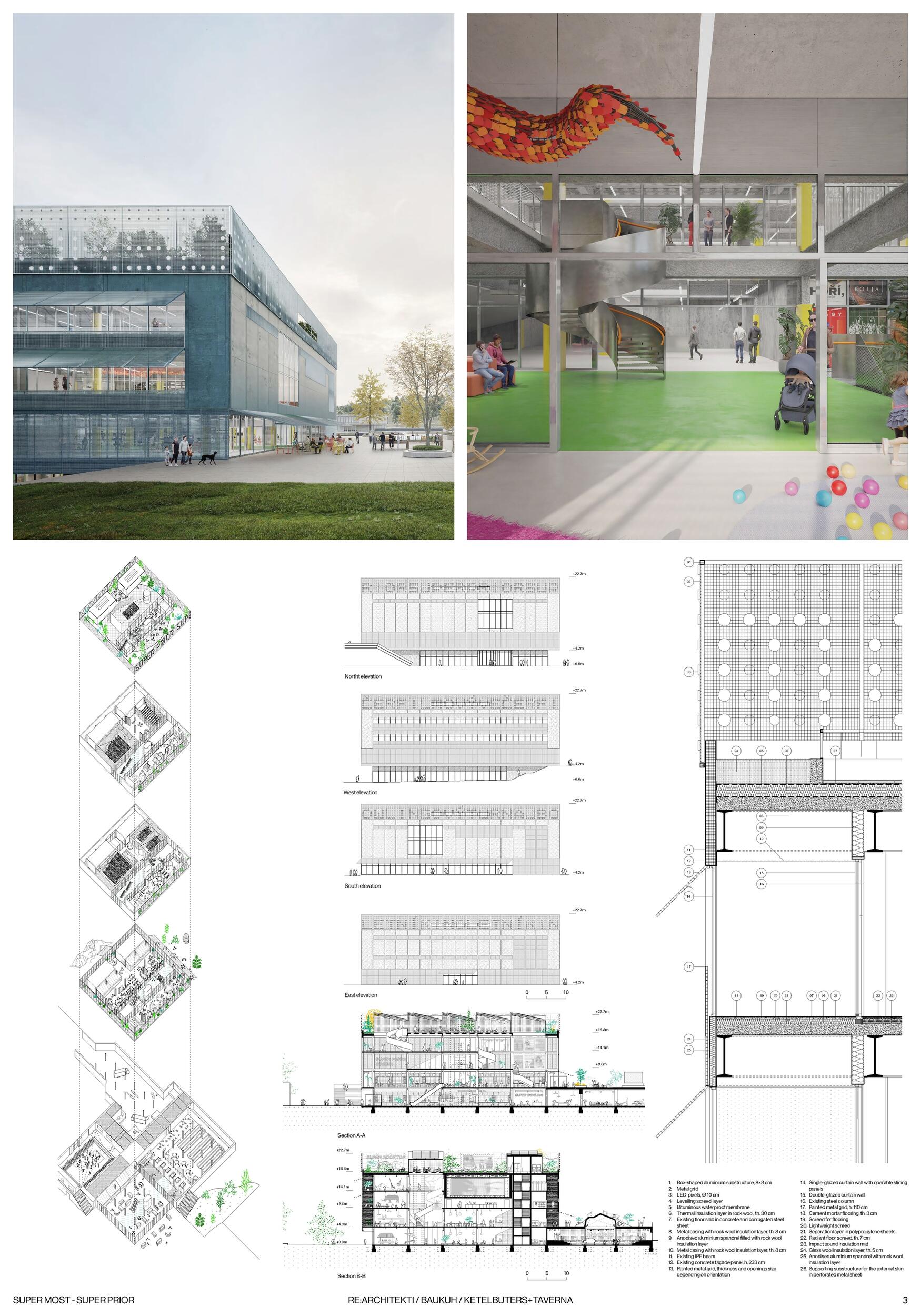
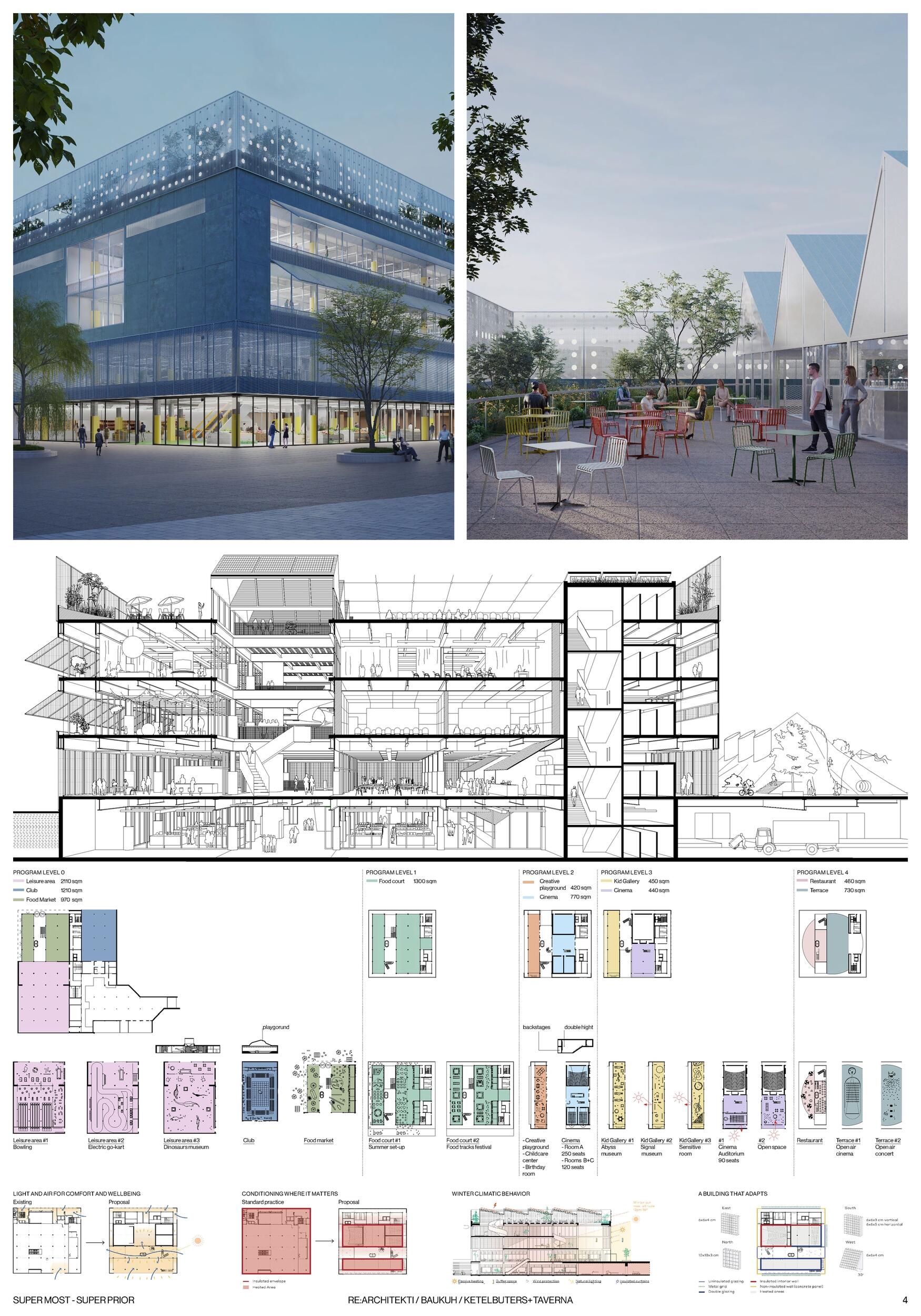
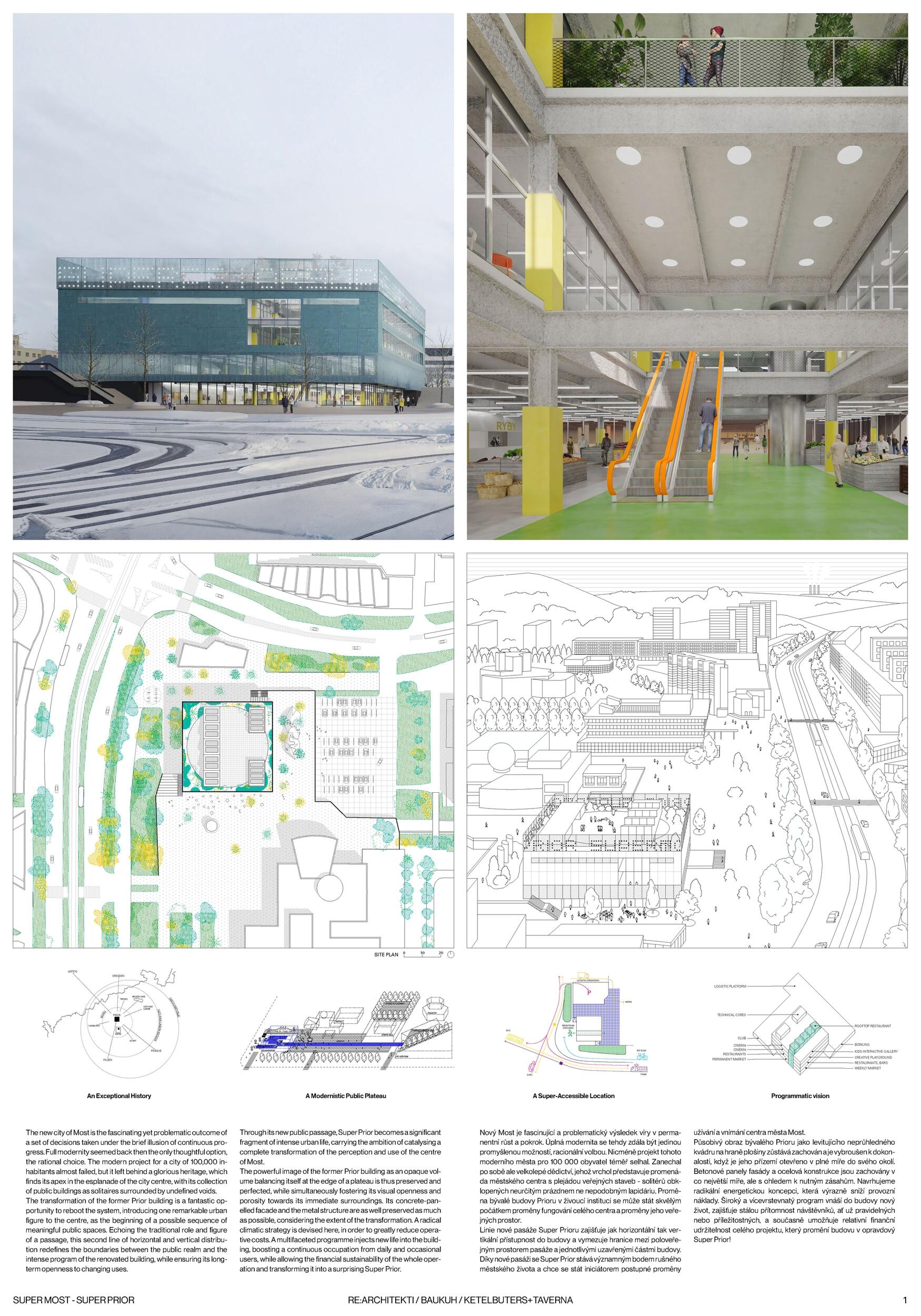
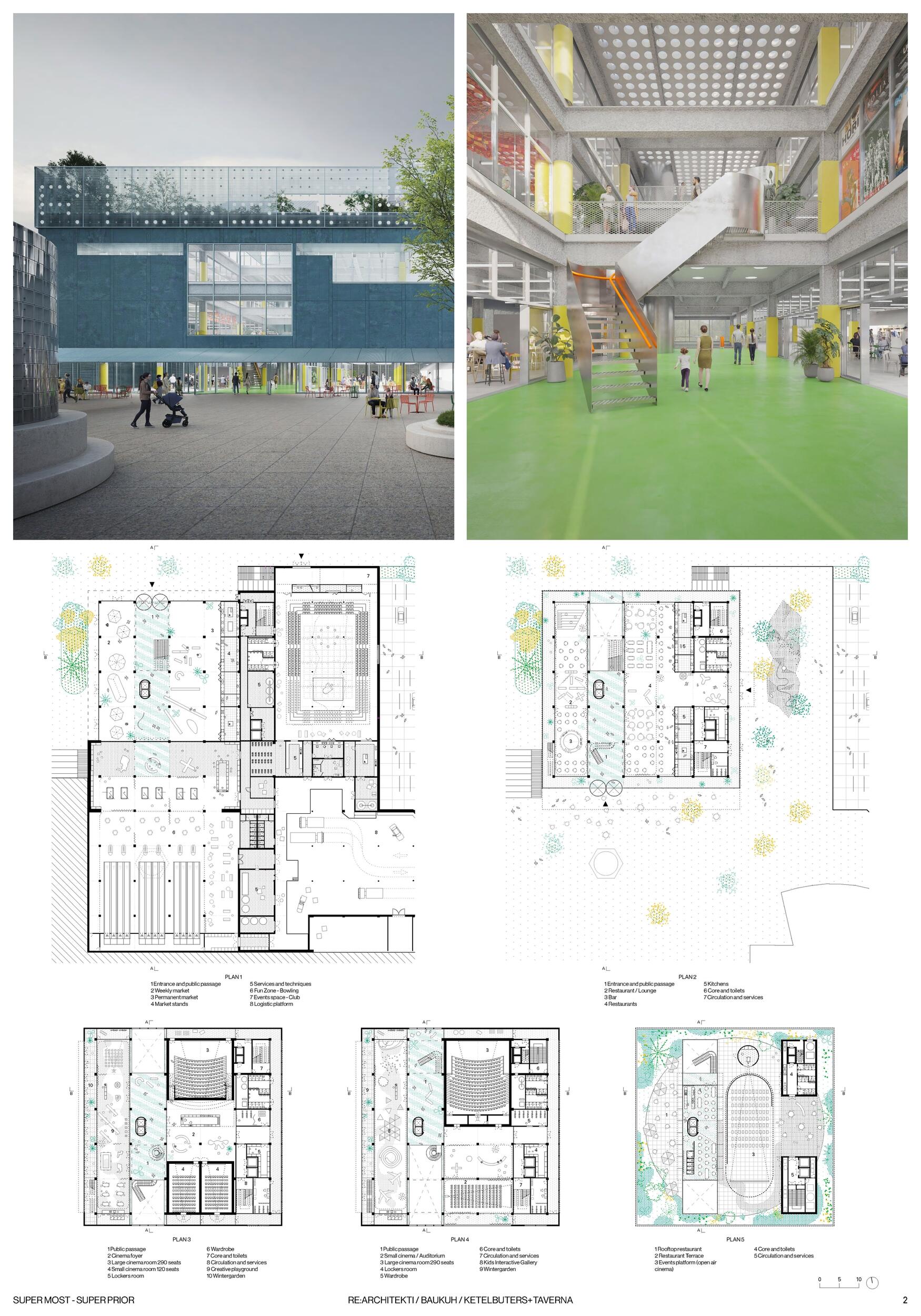
The proposal is based on several fundamental ideas. From an urban perspective, the key is to maintain a functional and as open as possible north–south passage through the building, while opening both ground floors to the surroundings to the greatest extent, thereby creating a new centripetal point within the otherwise ambiguous urban fabric. In terms of internal organisation, the central tool is the creation of a generous passageway that supports orientation and the sense of a large public interior, while linking together the building’s various functions. Its character recalls the covered urban arcades known from traditional cities. Regarding the building’s architectural character, we aim to build upon the original qualities of the Prior – a clear, closed volume levitating above the city’s ground plane. Concrete, glass, and steel frames, all in a strong, ordered composition. The extensive underground spaces are integrated into the system of the building and the city, making use of their enclosed and separate character. In their eastern section, we propose a music club with a separate entrance, and in the southern part beneath the square a big entertainment facility, open to changing uses over time. The public passage is designed to offer sheltered public spaces, not unlike an indoor square, surrounded by a food market and a food court, a proper restaurant, a cinema, spaces for entertainment and kids areas. It builds upon the original concept of the passage that connected two levels of public space on the north and south sides of the former department store. The passage is the only space where a significant intervention into the building’s structure takes place. It envisions new vertical connections through staircases and elevators, a new floor with glass tiles, and the opening of atriums spanning multiple levels on both the southern and northern sides of the building. Its space serves as a place to dwell and pause; it is clear and easily legible, under social oversight, while at the same time seamlessly connected to the outdoor areas adjoining the new ground plane of the Prior building on both levels. The Prior building must be transformed into a magnet of urban life. We therefore open both ground levels to their surroundings, and selectively extend the inner grid of pillars into the public spaces, punctuating them with oversized tree-pots here you can sit down in the shadow. The floor remains mineral, as such easily accessible and open to various uses (biergarten, weekly market, etc.), but the plateau is morphed into a forested square. Two distinct architectural elements further define the character of the public space: on the east an artificial hill offers an unconventional playground while hiding the car park and expanding the space of the club below; on the south, among the trees, an oversized lantern signals the presence of the vast underground space for entertainment.

Jury Evaluation

The proposal demonstrates a very high standard of architectural, operational, and functional resolution. The architectural concept is clear and legible, and the operational relationships are resolved optimally, particularly with regard to flexible use of the space. The central motif of the passage, which appropriately links the building to its surroundings, is effectively supported by a layered programme. The scheme meets the requirements for sustainability, accessibility, and operational logic. Its architectural expression – grounded in a rigorous study of the modernist department store typology – is timeless, appropriate to the site context, and conveys a cohesive overall impression.
Previous Next
2nd Place
  • Author Baumschlager Eberle + A8000
  • Germany, Czech Republic
Annotation

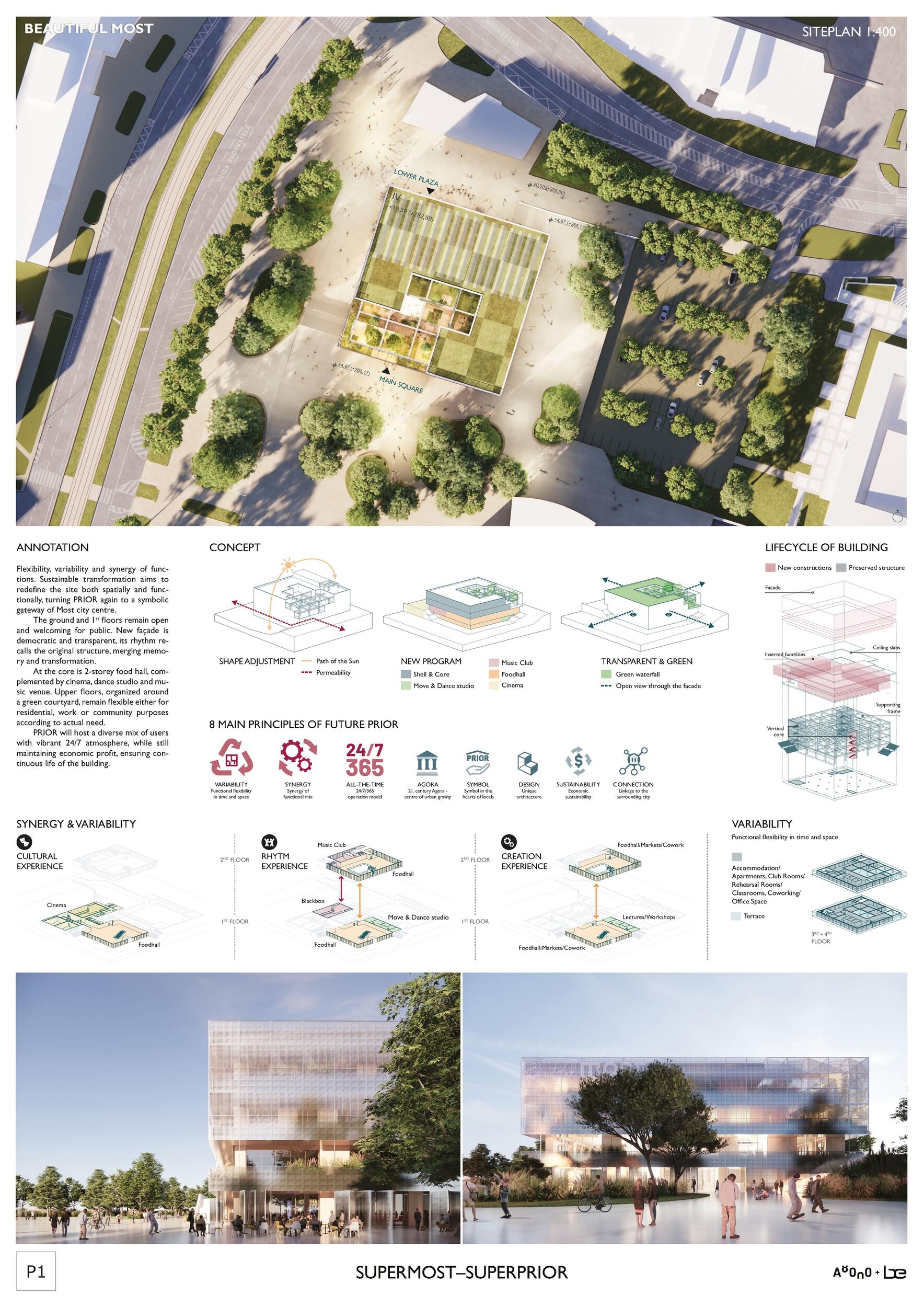
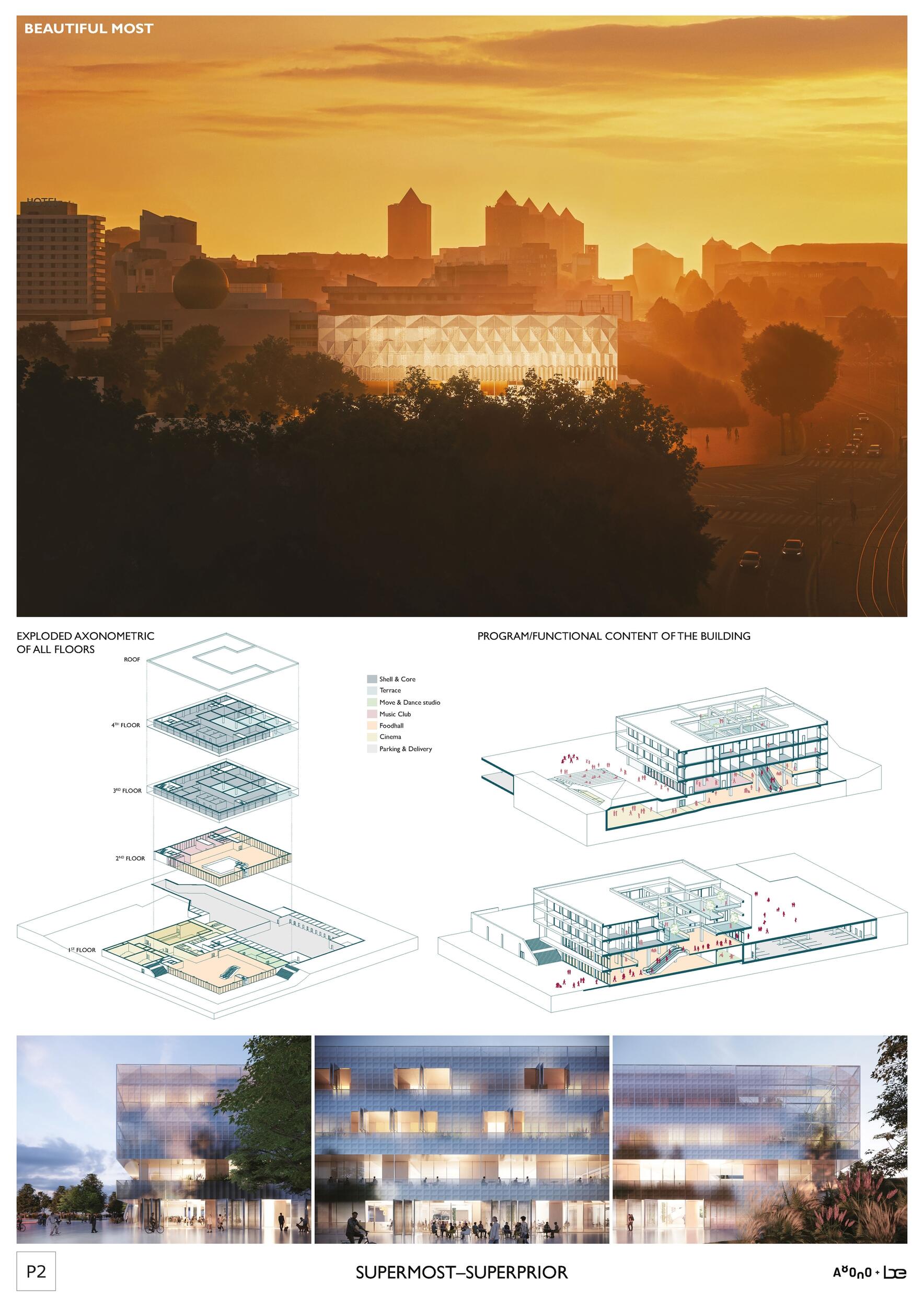
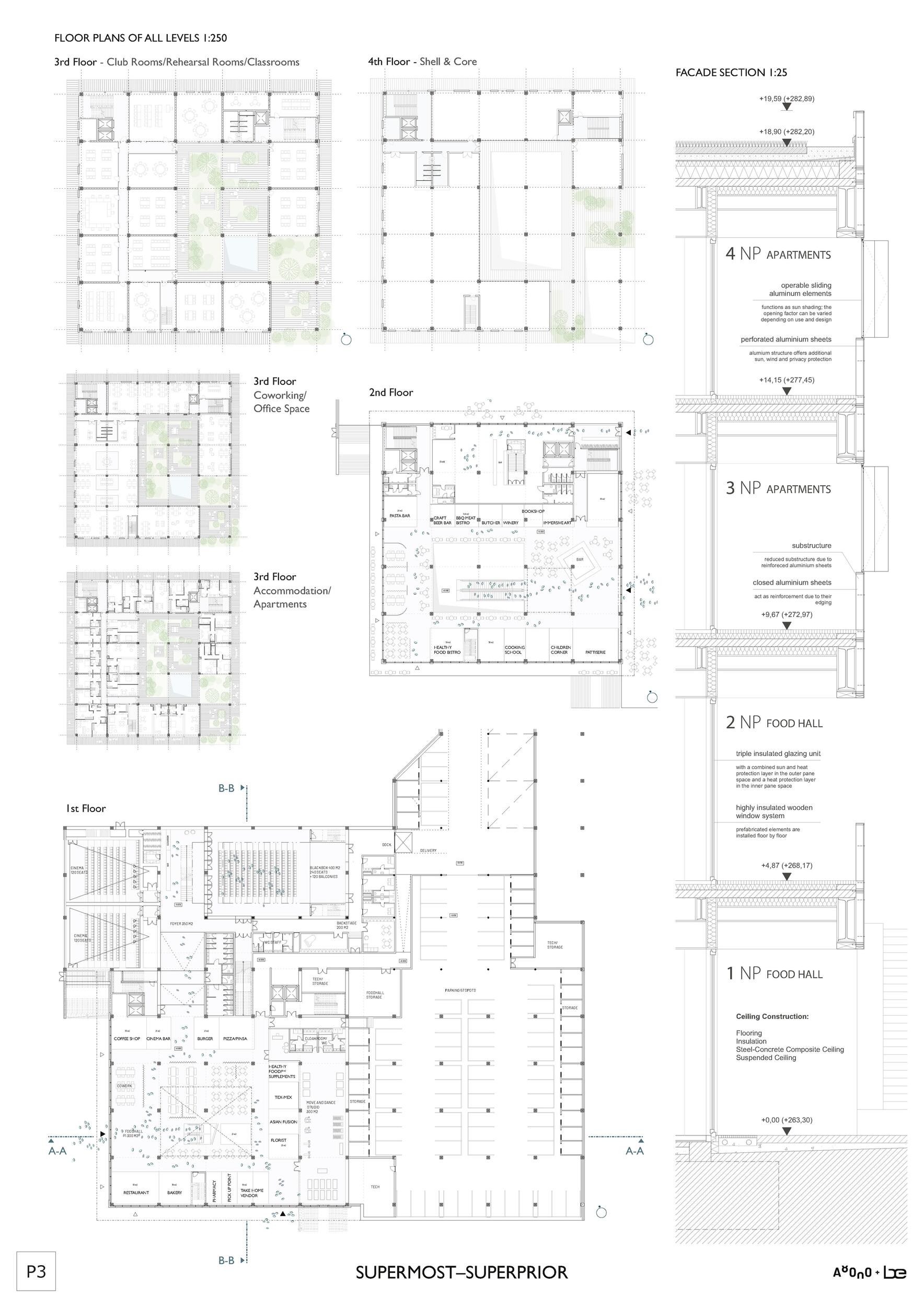
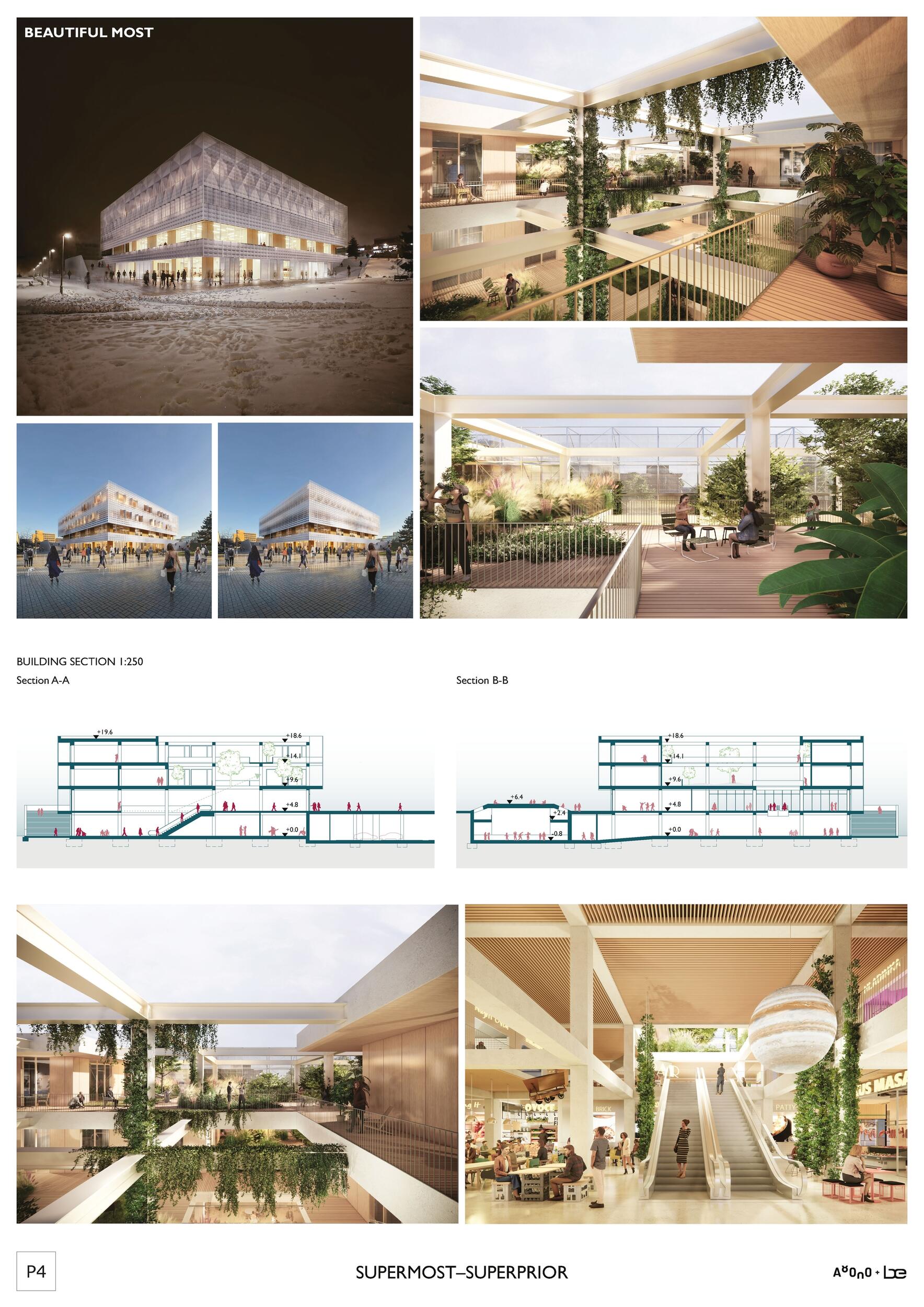
Flexibility, variability and synergy of functions. Sustainable transformation aims to redefine the site both spatially and functionally, turning PRIOR again to a symbolic gateway of Most city centre. The ground and 1st floors remain open and welcoming for public. New façade is democratic and transparent, its rhythm recalls the original structure, merging memory and transformation. At the core is 2-storey food hall, complemented by cinema, dance studio and music venue. Upper floors, organized around a green courtyard, remain flexible either for residential, work or community purposes according to actual need. PRIOR will host a diverse mix of users with vibrant 24/7 atmosphere, while still maintaining economic profit, ensuring continuous life of the building. We honor the legacy of the past by preserving the building’s original mass and structural character, while introducing new layers that reflect the former language. The granularity in the new façade becomes a contemporary veil — open, transparent, yet rooted in memory. The composition retains the clear division between the main volume and the base. At the southeast corner, the partial deconstruction of the load-bearing system opens the building toward the square of Velké mostecké stávky, creating a viable urban dialogue. Equally important is the continuity of public life. The ground floor and first floor remain open and transparent, their connection reinforced by the existing escalators, ensuring permeability and interaction between both levels. The new façade embodies democratic openness and transparency. The PRIOR occupies a strategically important corner plot in the very heart of Most. Its location and scale have long defined the Modernist urban concept of the city center. At the time of its construction, the department store represented a modern landmark that shaped everyday life. Today, after decades of use and gradual decline, we are faced with an opportunity to bring this dominant structure back to life. Its planned reconstruction and transformation hold the potential to redefine the site both spatially and functionally. PRIOR can once again become a symbolic gateway to the city center and a strong catalyst for its renewal.

Jury Evaluation

The proposal is prepared to a high professional standard, particularly in operational and economic terms. It works with a functional mix, flexibility, and an all-day operating scenario, including a management and programming model. The ambition to fundamentally transform the building is evident; however, the programme concept is at times not fully credible and raises doubts about feasibility and long-term sustainability. The external architectural expression reads as generic, and the relationship to the site context is not articulated convincingly. Certain elements (such as the oversized use of greenery in the interior) may be financially and operationally demanding. The community dimension remains largely declarative.

Previous Next
3rd Place
  • Author DATA + Atelier Altan
  • France
Annotation

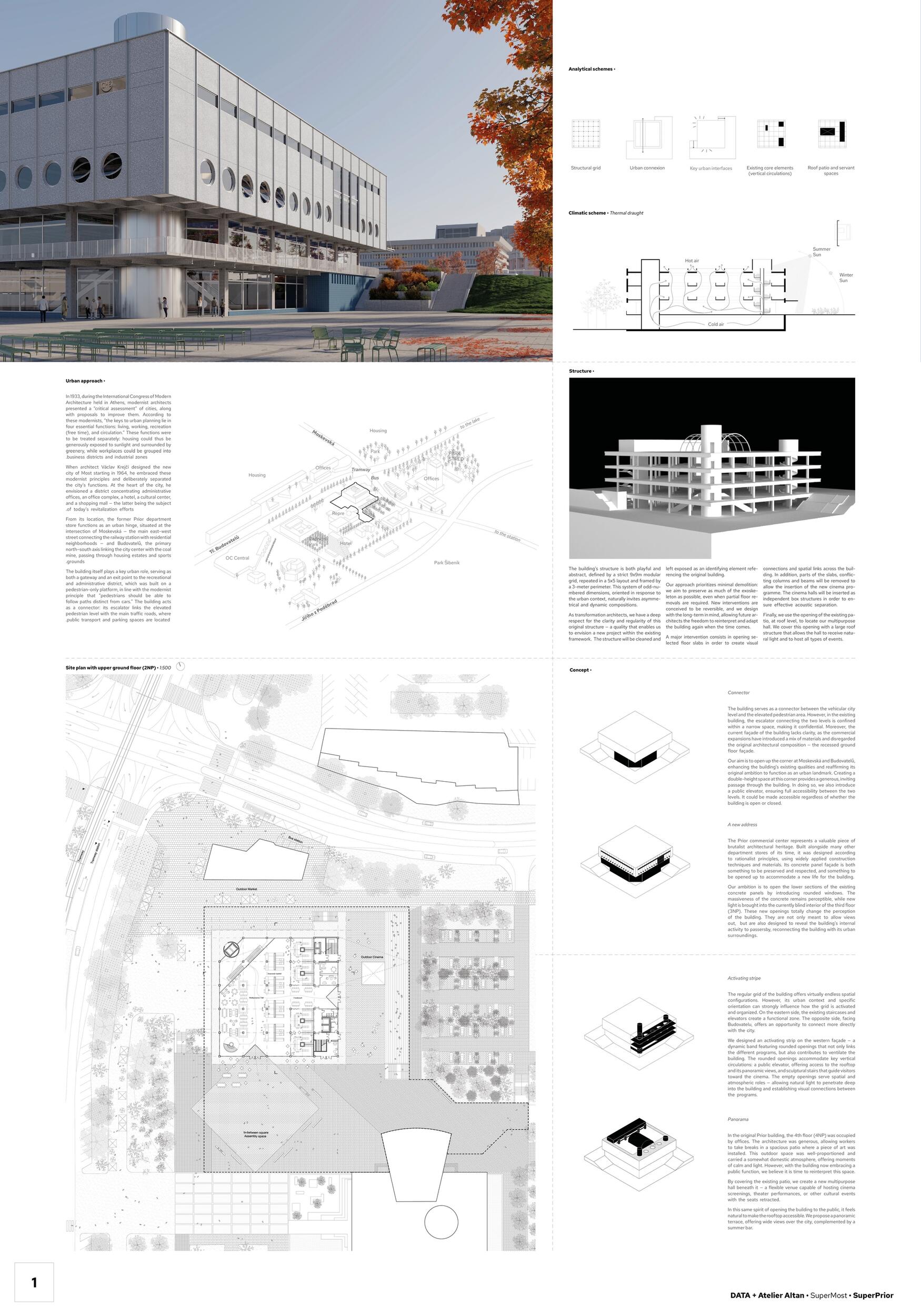
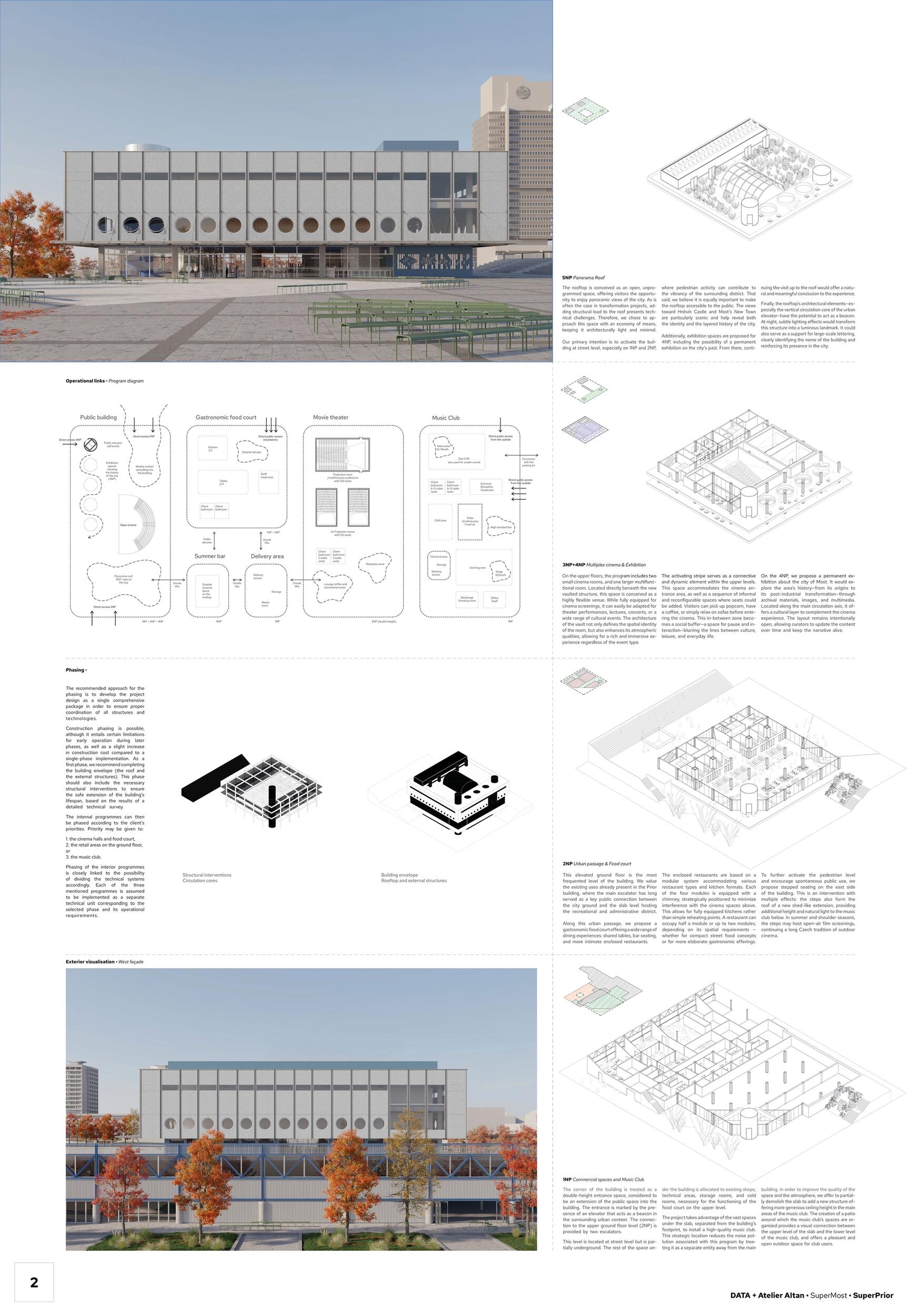
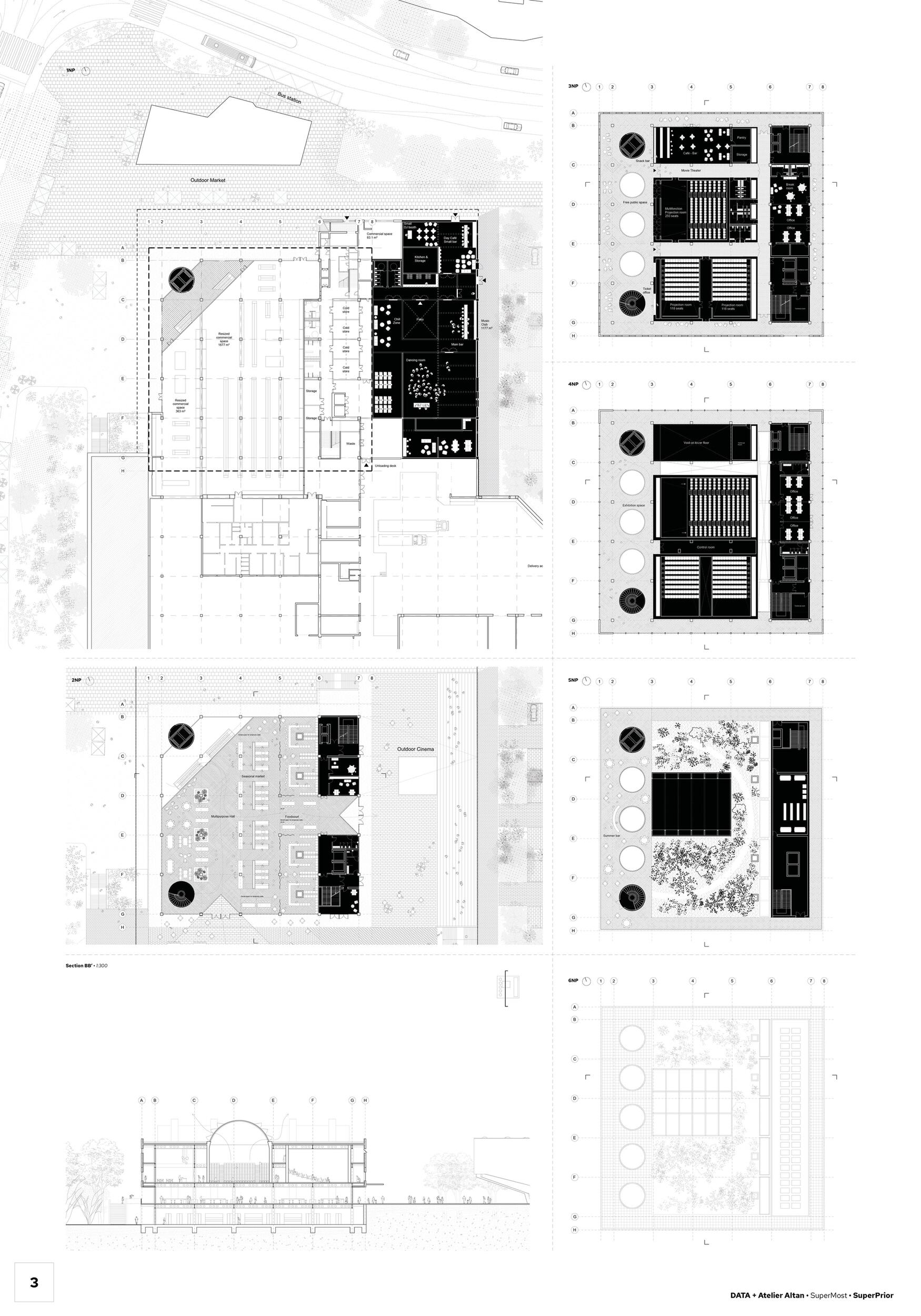
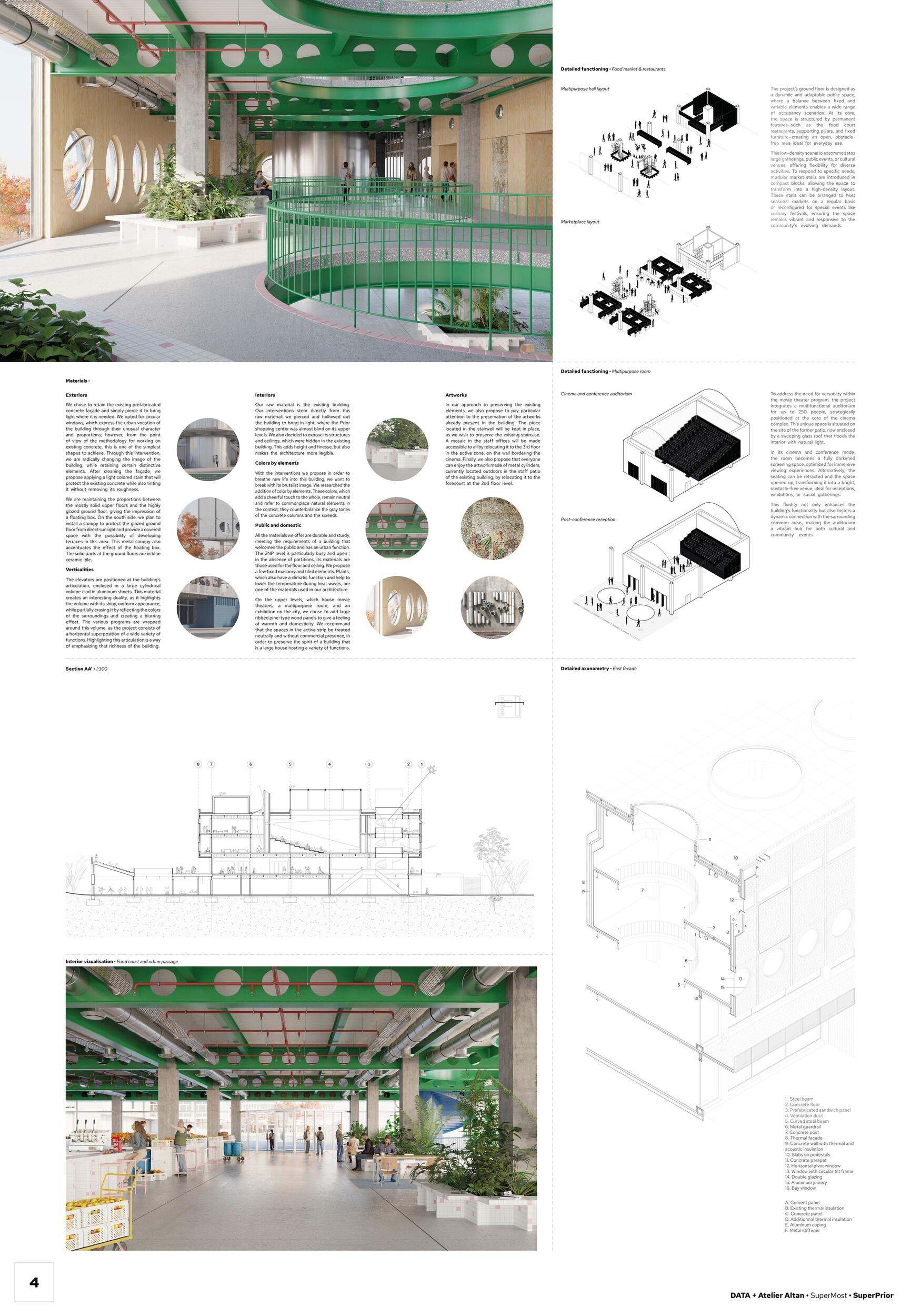
Our aim is to open up the corner at Moskevská and Budovatelů, enhancing the building’s existing qualities and reaffirming its original ambition to function as an urban landmark. Creating a double-height space at this corner provides a generous, inviting passage through the building. In doing so, we also introduce a public elevator, ensuring full accessibility between the two levels. It could be made accessible regardless of whether the building is open or closed. Our ambition is to open the lower sections of the existing concrete panels by introducing rounded windows. The massiveness of the concrete remains perceptible, while new light is brought into the currently blind interior of the third floor (3NP). These new openings totally change the perception of the building. They are not only meant to allow views out, but are also designed to reveal the building’s internal activity to passersby, reconnecting the building with its urban surroundings. We designed an activating strip on the western façade — a dynamic band featuring rounded openings that not only links the different programs, but also contributes to ventilate the building. The rounded openings accommodate key vertical circulations: a public elevator, offering access to the rooftop and its panoramic views, and sculptural stairs that guide visitors toward the cinema. The empty openings serve spatial and atmospheric roles — allowing natural light to penetrate deep into the building and establishing visual connections between the programs. By covering the existing patio, we create a new multipurpose hall beneath it — a flexible venue capable of hosting cinema screenings, theater performances, or other cultural events with the seats retracted. In this same spirit of opening the building to the public, it feels natural to make the rooftop accessible. We propose a panoramic terrace, offering wide views over the city, complemented by a summer bar.

Jury Evaluation

The proposal demonstrates a high standard of architectural, operational, and functional resolution. It respects the building’s modernist essence and takes a sensitive approach to refurbishment, aiming to preserve the original artworks and the façade, which is enhanced with window openings that bring daylight into the interior. The programme is structured clearly, with priority given to the multi-purpose use of the cinema auditorium. A further asset is the connection to the market and the activation of the ground floor; the slope with an open-air cinema strengthens the outdoor programme. Operational relationships are handled rationally (flexible food-and-beverage units, separation of noisy uses by a technical buffer zone). The proposal offers undeniable architectural qualities, as well as user accessibility and sustainability, although the forecourt lacks a human scale.

Previous Next
4th Place
  • Author ADEPT + ohboi
  • Denmark, Czech Republic
Annotation

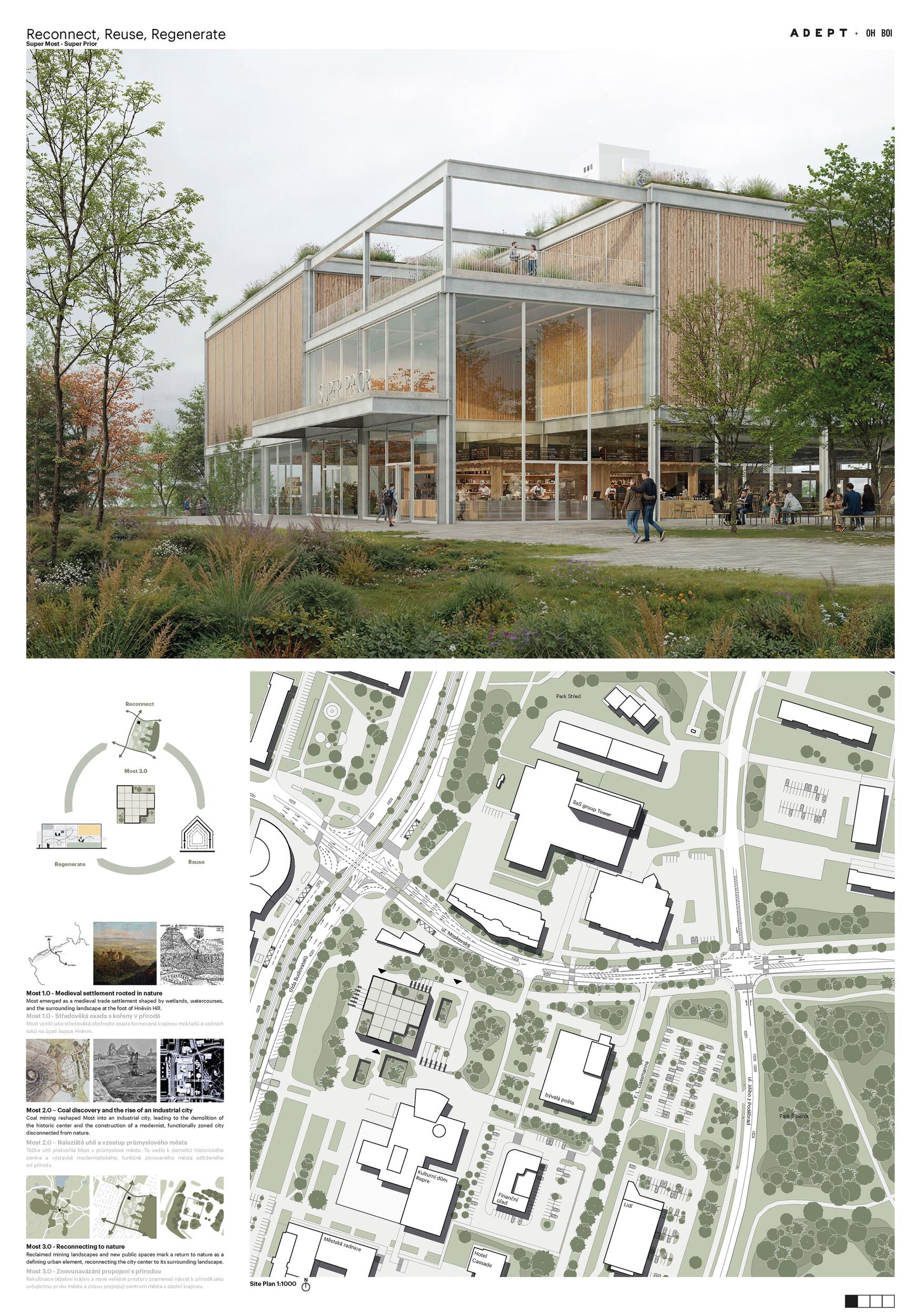
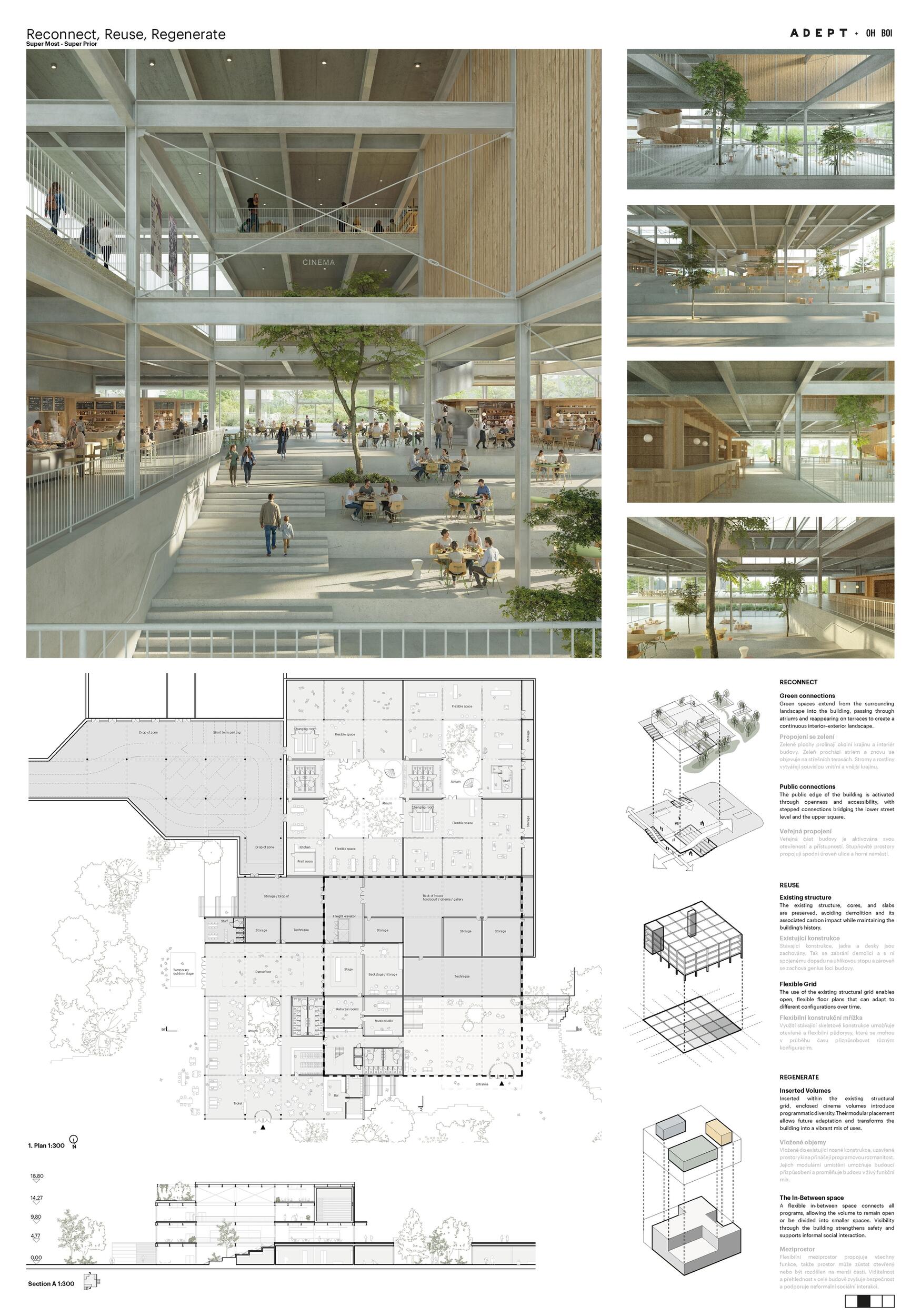
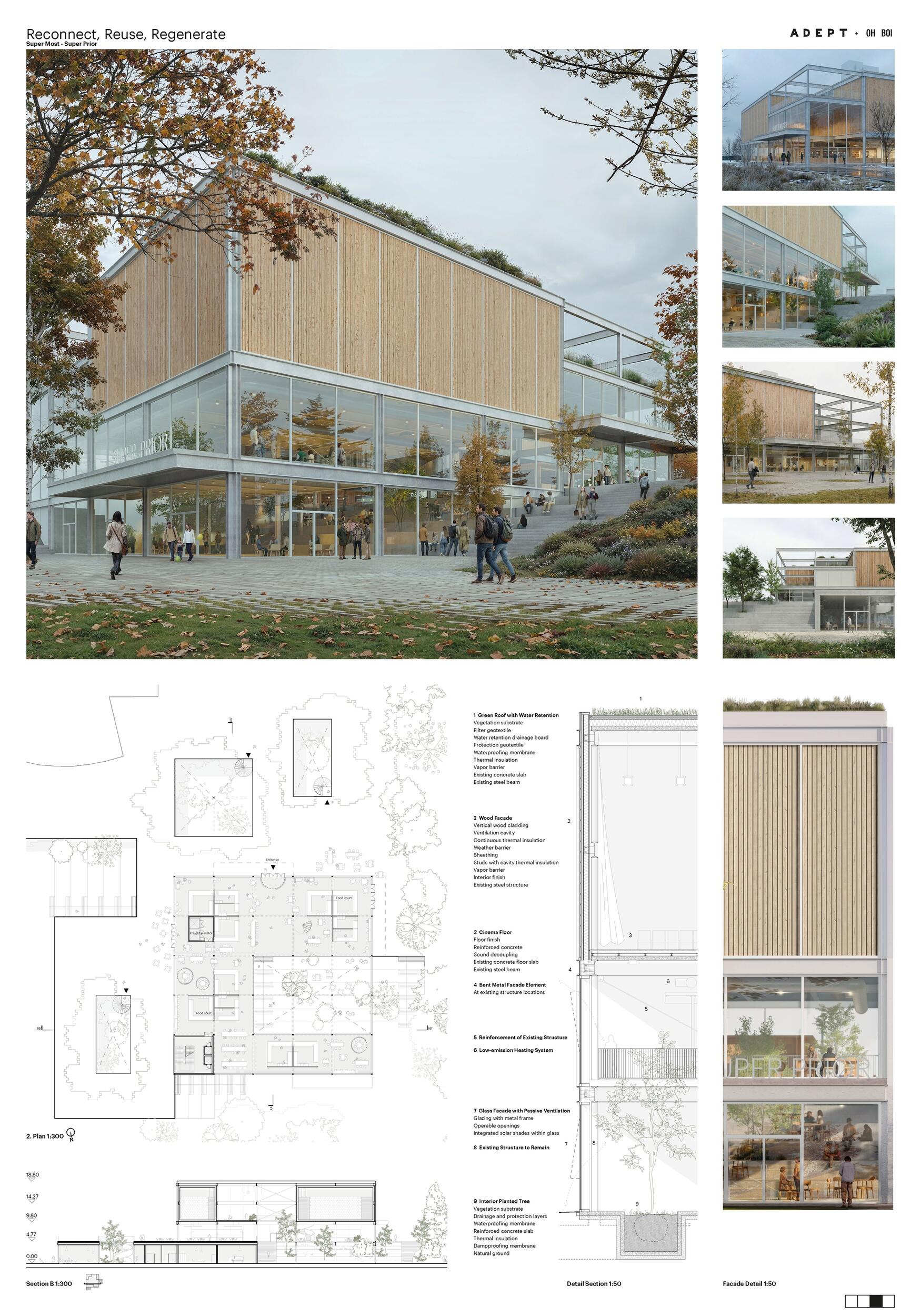
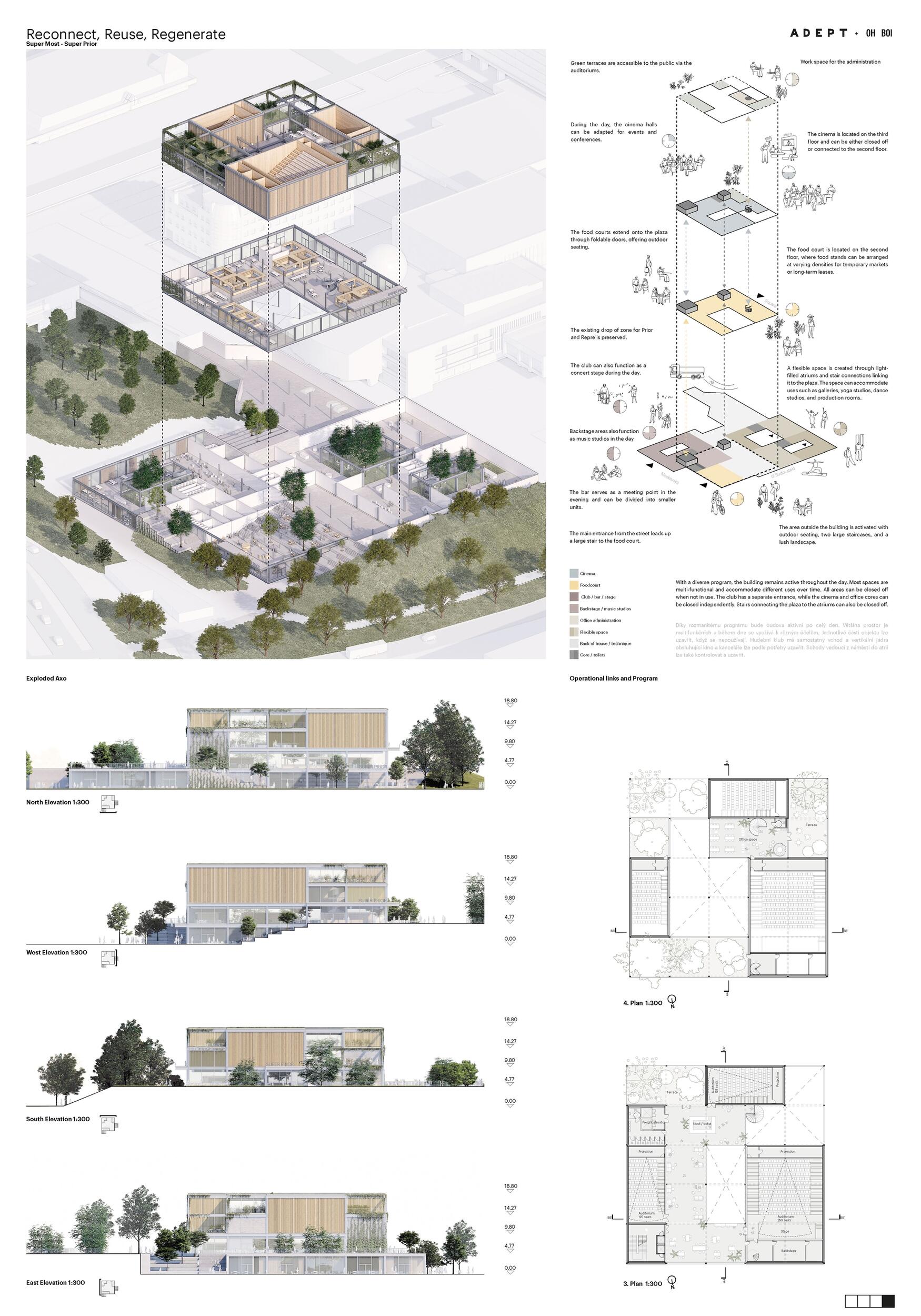
The proposal is structured around reuse, regeneration, and reconnection. The existing structural grid is retained to minimize demolition and embodied carbon, enabling flexible floor plans and green terraces. A stepped volume and public atrium activate the square and support continuous urban life. The unsealing of hard surfaces to green networks enhance biodiversity and reconnect the city center with its surrounding landscape. We begin with what is already there. The steel structural grid, concrete floor slabs, and cores of the former Prior building are preserved and reused, forming a cost-effective strategy that minimizes demolition and associated carbon impact. We build back only what is required. Selected structural bays are opened as green terraces instead of enclosed space, while open and flexible floor plans allow adaptation over time. Strategies to lower emissions include high-performance facade assemblies, the use of bio-based materials, low-emission heating, passive cooling strategies, and water-saving initiatives. We regenerate life in the city center. The building steps down toward Velká Mostecká Stávka Square, softening the overall volume and establishing a human scale through a gradual transition between outside and inside. The main stepped exterior connection continues into the building, while the glazed facade opens toward the square and street, linking urban life outside with public space inside. An open public atrium forms the spatial heart of the building, connecting all floors and allowing the market hall, music club, and cinema to intersect and overlap. This shared interior supports continuous use throughout the day and night, ensuring safety, visibility, and long-term urban vitality. Large green planted cuts in the public square bring daylight and greenery to the lower level, while transforming existing hardscaped areas of the square into places to sit, meet, and stay. We reconnect the city to its natural foundations. By densifying the city with green, hard surfaces are transformed and biodiversity is increased. A new green network links the city center to the surrounding urban parks, lakes, forests, and mountains. At the city center, these green links continue into stepped connections that bridge the lower street level and the upper square. The landscape is brought inside the building to establish a renewed relationship between city and landscape while re-establishing a local identity and community through nature.

Jury Evaluation

The proposal is based on an ambitious concept focused on reconnecting the city centre to the broader regional landscape and on working with the existing structure of the building. The architectural concept is clearly defined and employs strong spatial elements, particularly rooftop terraces and the activation of the ground floor. A significant asset is the intention to enable everyday use by local residents and to create high-quality facilities for the building’s operation (for example, a sustainable concept for the music club). However, the architectural expression is less convincing in relation to the modernist context – the timber façade does not resonate sufficiently with the character of the building. The proposal addresses accessibility and sustainability, yet its environmental ambitions remain largely declarative.

Previous Next
5h Place
  • Author atelier gram + dílna
  • Czech Republic
Annotation

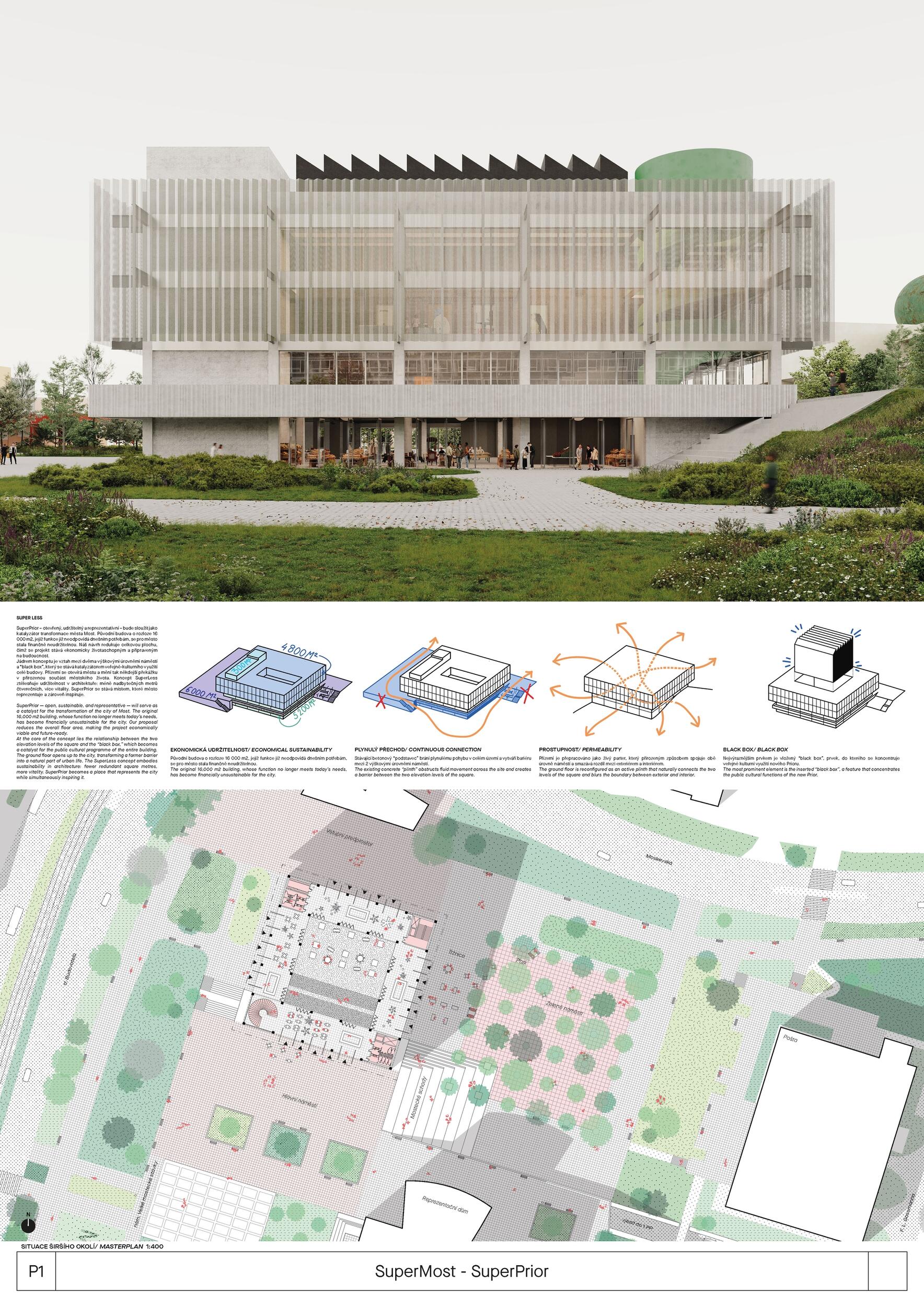
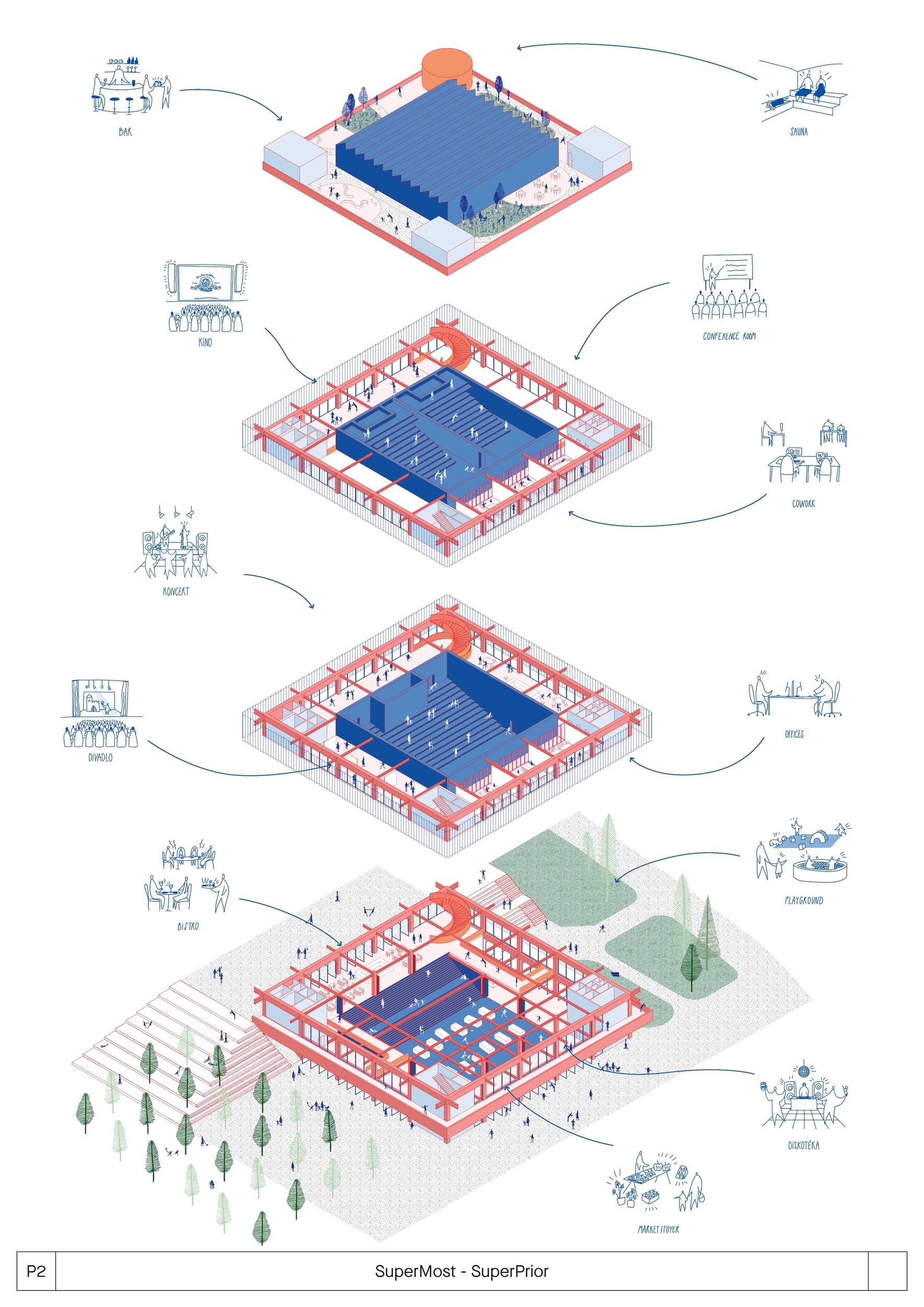
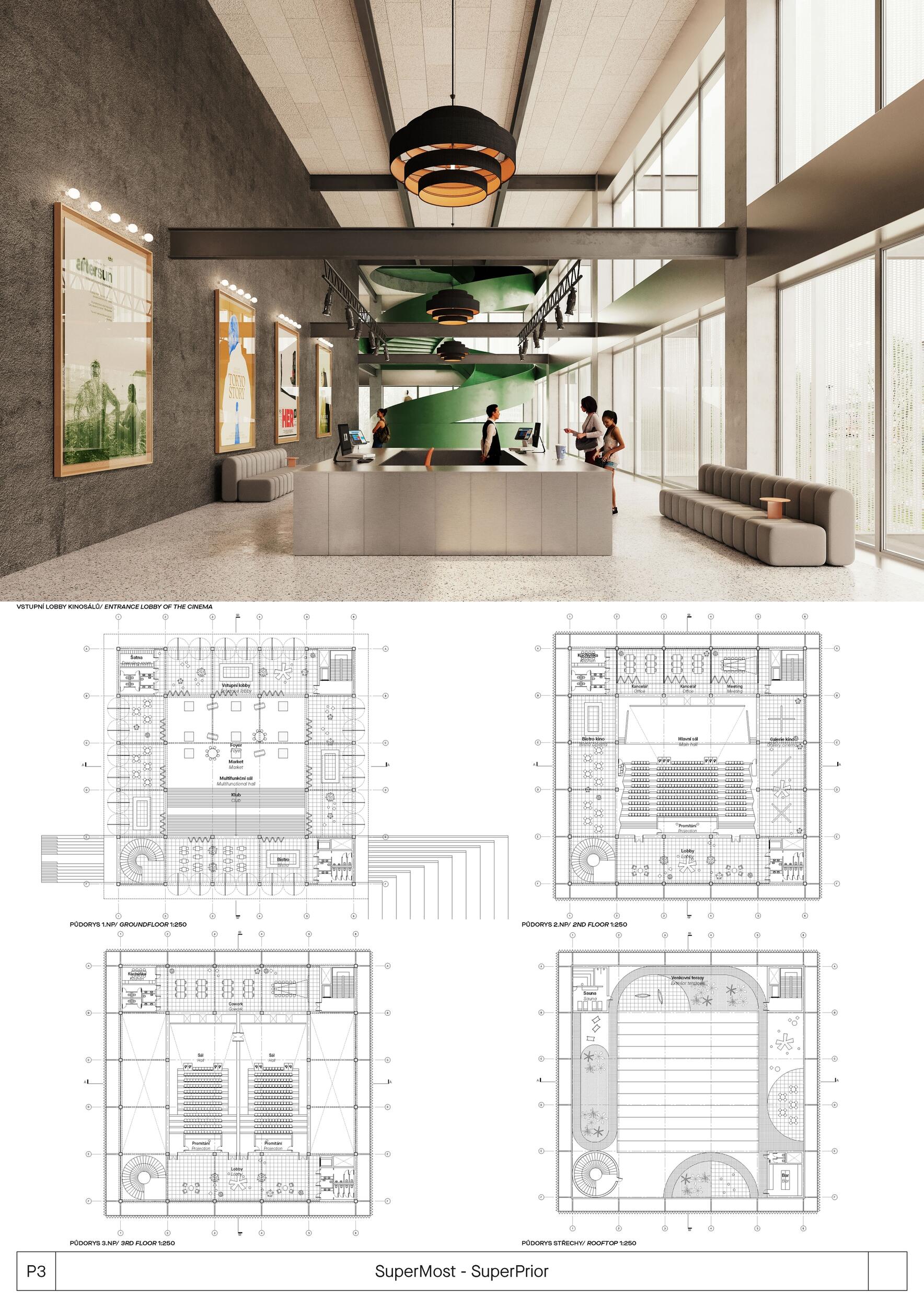
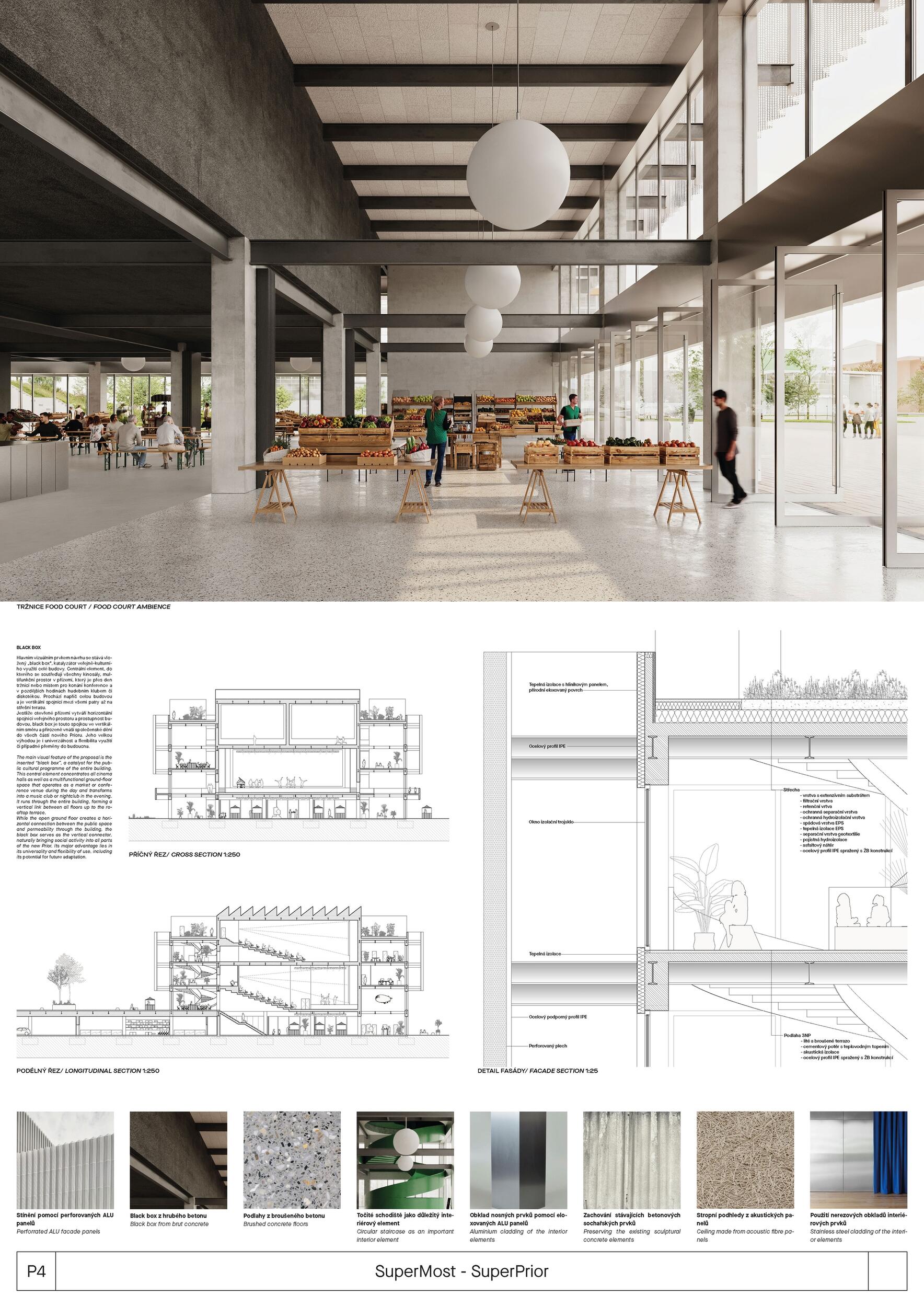
SuperPrior — open, sustainable, and representative — will serve as a catalyst for the transformation of the city of Most. The original 16,000 m2 building, whose function no longer meets today’s needs, has become financially unsustainable for the city. Our proposal reduces the overall floor area, making the project economically viable and future-ready. At the core of the concept lies the relationship between the two elevation levels of the square and the “black box,” which becomes a catalyst for the public cultural programme of the entire building. The ground floor opens up to the city, transforming a former barrier into a natural part of urban life. The SuperLess concept embodies sustainability in architecture: fewer redundant square metres, more vitality. SuperPrior becomes a place that represents the city while simultaneously inspiring it. Rethinking of the Prior must take into account its immediate context, which today is dominated by a concrete plinth that acts as a barrier to free movement throughout the area. While vertical and horizontal permeability were core principles of the original Prior, our proposal not only preserves this intent but actively enhances the building’s integration with its urban surroundings. The ground floor, previously perceived as a barrier, is reimagined as a permeable and vibrant parterre that connects the square with surrounding pedestrian flows and blurs the boundary between exterior and interior. The main visual feature of the proposal is the inserted “black box”, a catalyst for the public cultural programme of the entire building. This central element concentrates all cinema halls as well as a multifunctional ground-floor space that operates as a market or conference venue during the day and transforms into a music club or nightclub in the evening. It runs through the entire building, forming a vertical link between all floors up to the rooftop terrace. While the open ground floor creates a horizontal connection between the public space and permeability through the building, the black box serves as the vertical connector, naturally bringing social activity into all parts of the new Prior. Its major advantage lies in its universality and flexibility of use, including its potential for future adaptation. The operational relationships of the design are based on the connection between the open ground floor and the vertical core of the building. The principle of permeability is not applied only on the horizontal level of the ground floor, but naturally extends throughout all floors. The black box spaces are arranged to actively support activity across the entire building. Their openness at ground-floor level enables a flexible connection between the public realm and the building’s internal program. This creates a continuous operational system linking the square, internal circulation, spaces surrounding the cinema halls, and the rooftop terrace, allowing for a variable use of the building.

Jury Evaluation

The proposal meets the requirements for architectural and operational quality and introduces a number of interesting intentions, particularly an effort to pursue a flexible and open approach to the transformation of the building and to create an overarching urban structure accommodating a variety of activities. The engagement with the site’s memory is a positive aspect, as are the references to the original design (such as the retention of balconies) and the restrained material palette, although the use of perforated metal on the façade may appear alien in relation to the character of the surrounding built environment. Placing the cinema auditoria at the centre of the layout helps to anchor the basic operational logic of the building. However, the architectural concept lacks a clearly defined programme hierarchy and a convincingly developed phasing strategy and operational model. The high degree of proposed variability of the interior spaces raises doubts about the long-term functional and operational sustainability of the scheme.

Previous Next