Art for the main railway station in Mladá Boleslav

1st Prize
  • Author Tomáš Džadoň
  • Křinec
Annotation

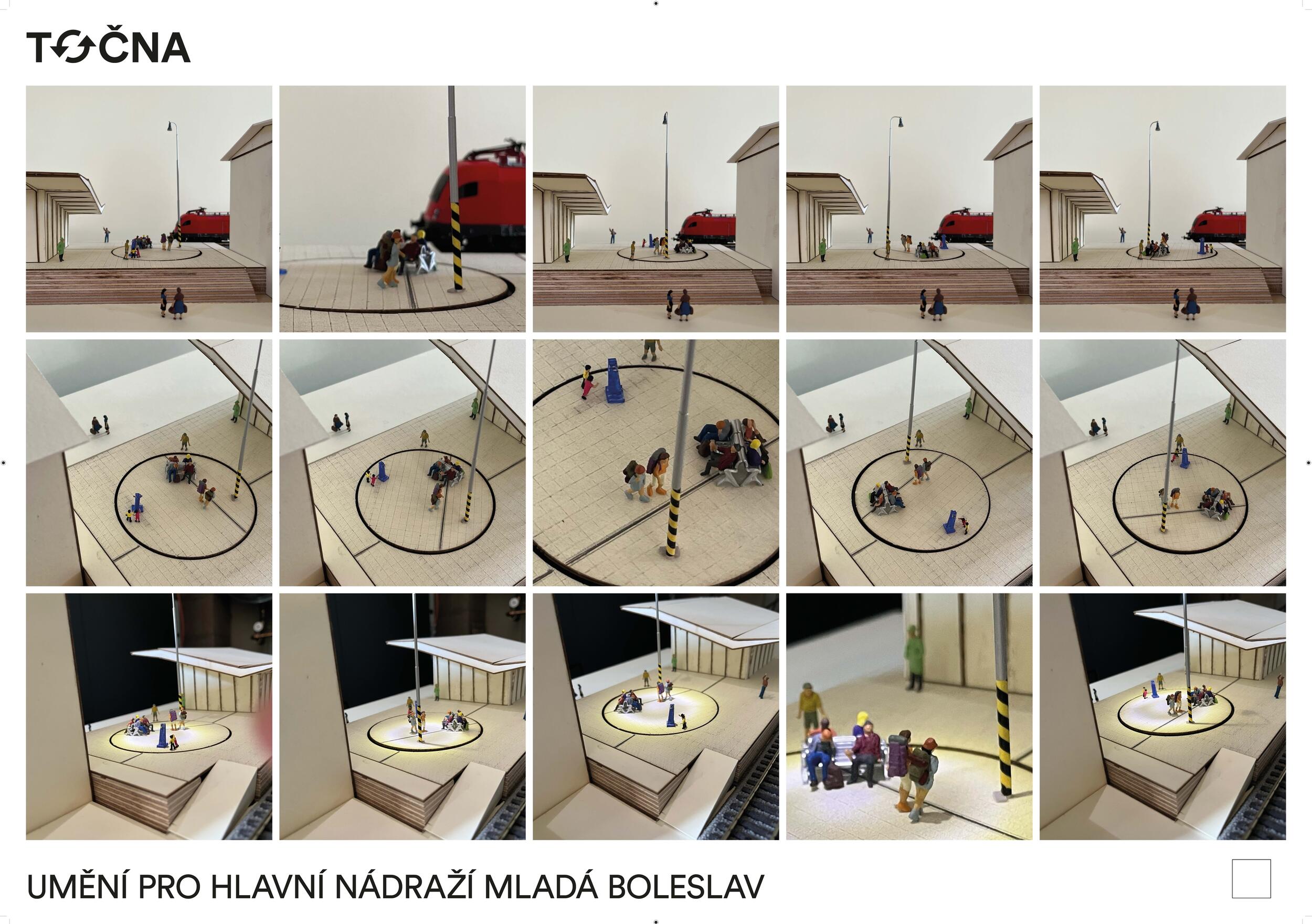
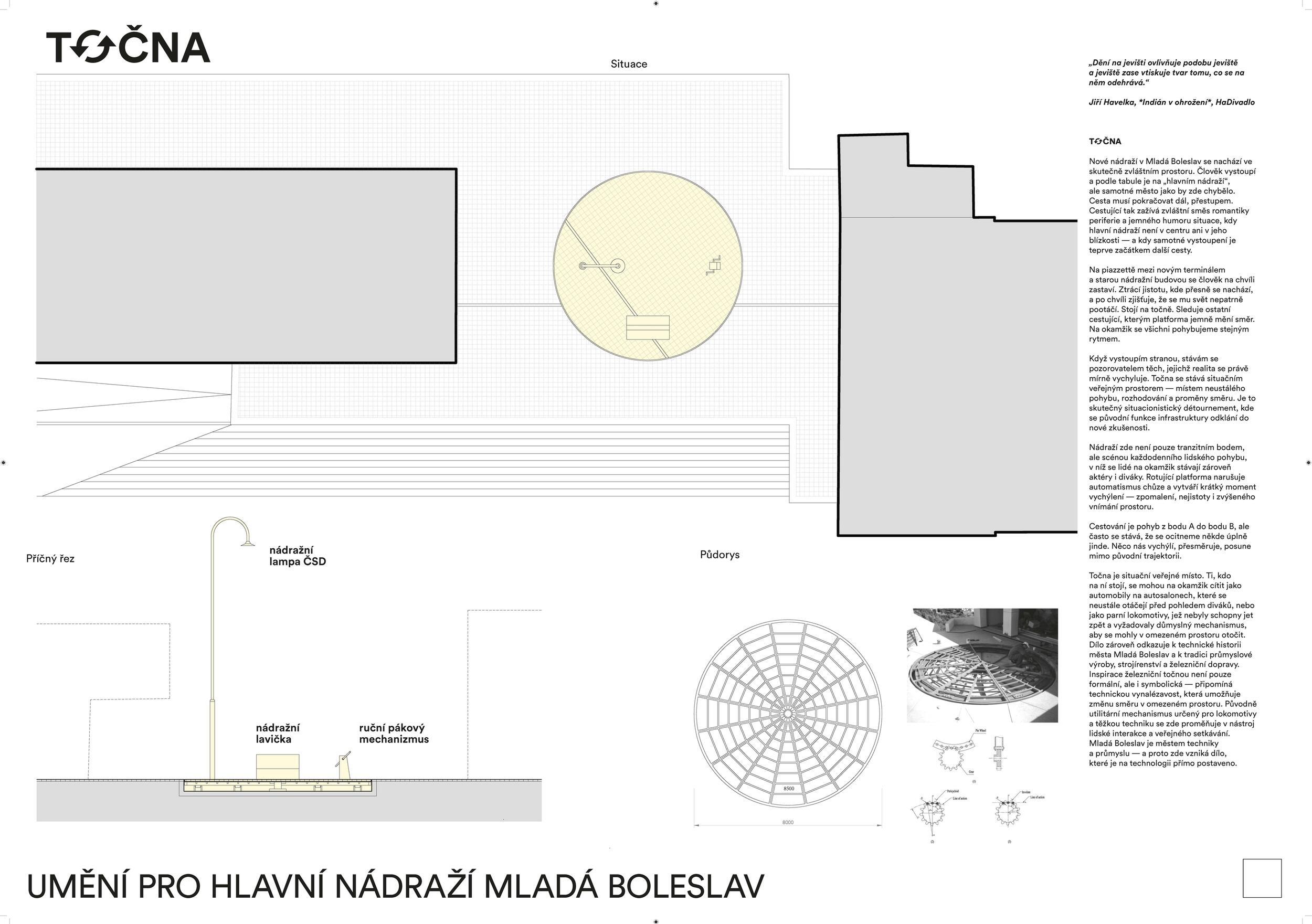
The turntable takes the form of an almost nine-meter rotating platform located in the area of ​​the Mladá Boleslav railway station. It responds to the continuous movement of passengers, the rhythm of arrivals and departures, and the very principle of routing in the transport hub. It enters the normal walking trajectory and temporarily changes the person's orientation in space. The visitor becomes part of the mechanism — he can be passively diverted by the platform, or actively influence its direction with his own movement and manual rotation. The work works with the motif of movement, change of direction, and technical skill, which have long been associated with the city of Mladá Boleslav. At the same time, it refers to the principle of the railway turntable as an ingenious technical solution enabling a change of direction in a minimal space.

Jury Evaluation

The author enters the piazzetta area in front of the new station building with the body of an 8.5 wide circular turntable, which slowly and irregularly rotates to set in motion a part of the piazzetta with a bench, a lamp and station visitors. The technical element of the turntable works with the dynamics and stopping of passengers in the transit and rest areas of the station and, in a figurative sense, creates an irregularly and permanently shifted social, spatial and visual situation. The basic element of the project is an industrial turntable, which is used in production and warehouse areas, and at the same time reminds the wider public of the manipulation of steam locomotives in historic station depots or - especially when illuminated in the evening - a theatrical turntable. Its use thematizes the change in the position of the passenger/observer in the context of station architecture - a passenger who remains on the turntable and at the same time follows new perspectives becomes an object of observation for those who have remained on the remaining part of the platform. The work brings humorous exaggeration and a subtle shift in the experience of the otherwise traditionally functionally utilitarian station environment. The judges agreed that Tomáš Džadoň's design, despite its extraordinary technical complexity, best met the competition's requirements: the poetics, civility, and context of the technical solution of the work strongly and at the same time seemingly invisibly materializes the process of searching for new perspectives and the challenge to step outside predefined schemes.
Previous Next
2nd Prize
  • Author Matěj Smetana
  • Prague
Annotation

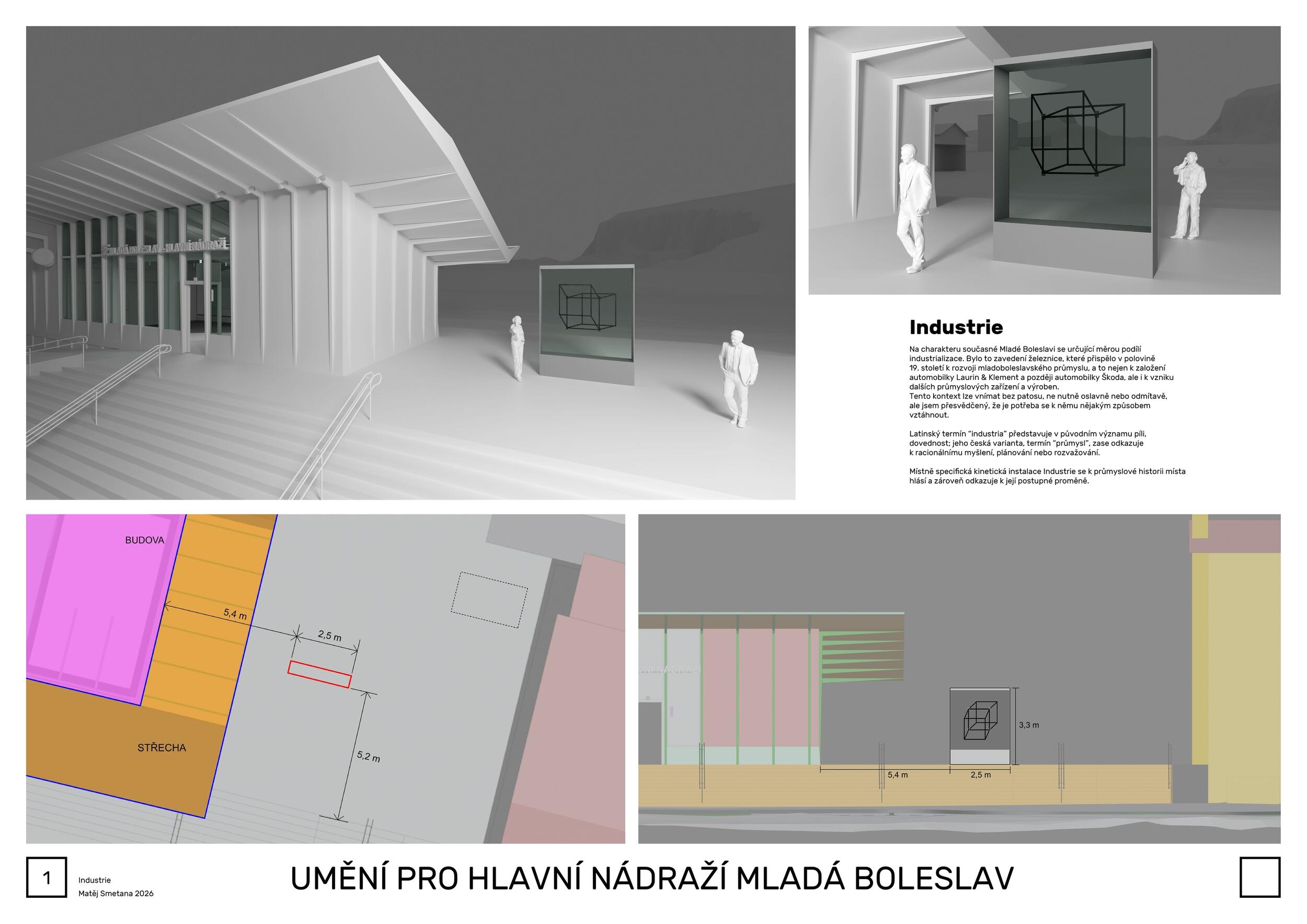
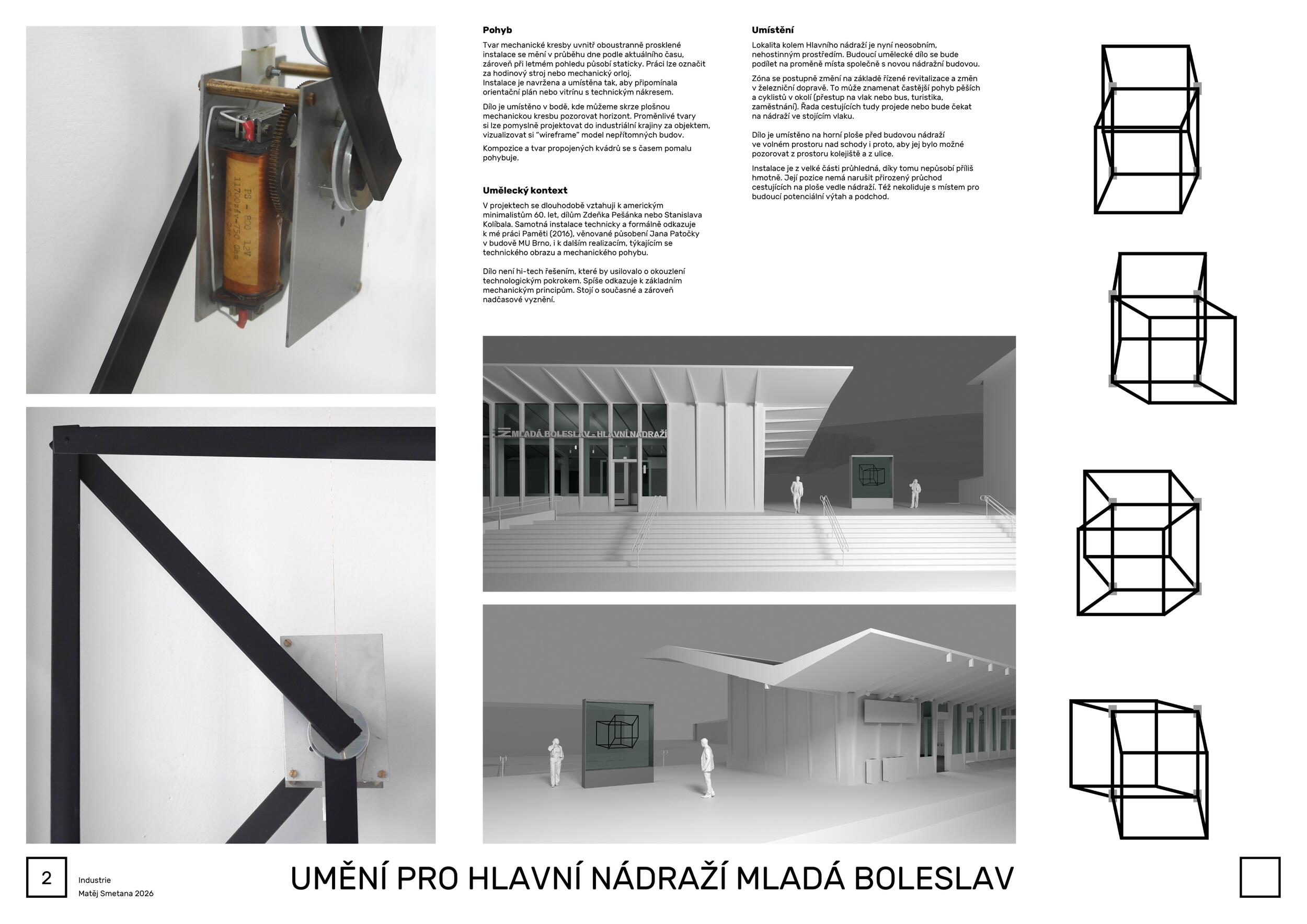
The site-specific kinetic installation Industrie acknowledges the industrial history of the place and refers to its gradual transformation. Thanks to its location in the space above the stairs next to the station, the work can be viewed from the train and from the street. The work intentionally resembles a technical object. The shape of the drawing inside the double-sided glass installation changes throughout the day according to the current time; through the planar mechanical drawing we can observe the horizon, projecting the changing shapes of absent buildings into the industrial landscape behind the object.

Jury Evaluation

Matěj Smetana's work Industria is committed to the industrial tradition, the history of the place and its gradual transformation. It presents the seemingly simple laws of movement and mechanics in a timeless way. The author designed a double-sided glass showcase for the piazzetta space, visible from both the train level and the road level. The mechanical drawing placed in it (interconnected squares that create the illusion of moving cubes in time sequences) should be controlled by four clockwork mechanisms that move it according to the current time, analogous to the hands of a clock. The work activates the viewer's attention with slow movement and configuration changes, thematizes the phenomenon of waiting, inextricably linked to traveling by public transport, and at the same time resembles an advertising showcase in its shape, whose expected content is subversively replaced by an object that is intended not to promote consumption, but for contemplation or meditation. Although the work can be understood as a mechanical astronomical clock or clockwork, which has long been associated with station furniture, it also serves as a specific prism through which the surrounding industrial landscape can be viewed and the horizon observed in the slow passage of time.

Previous Next
3rd Prize
  • Author Tereza Kalousová, Marie Štindlová, Erika Velická
  • Prague
Annotation

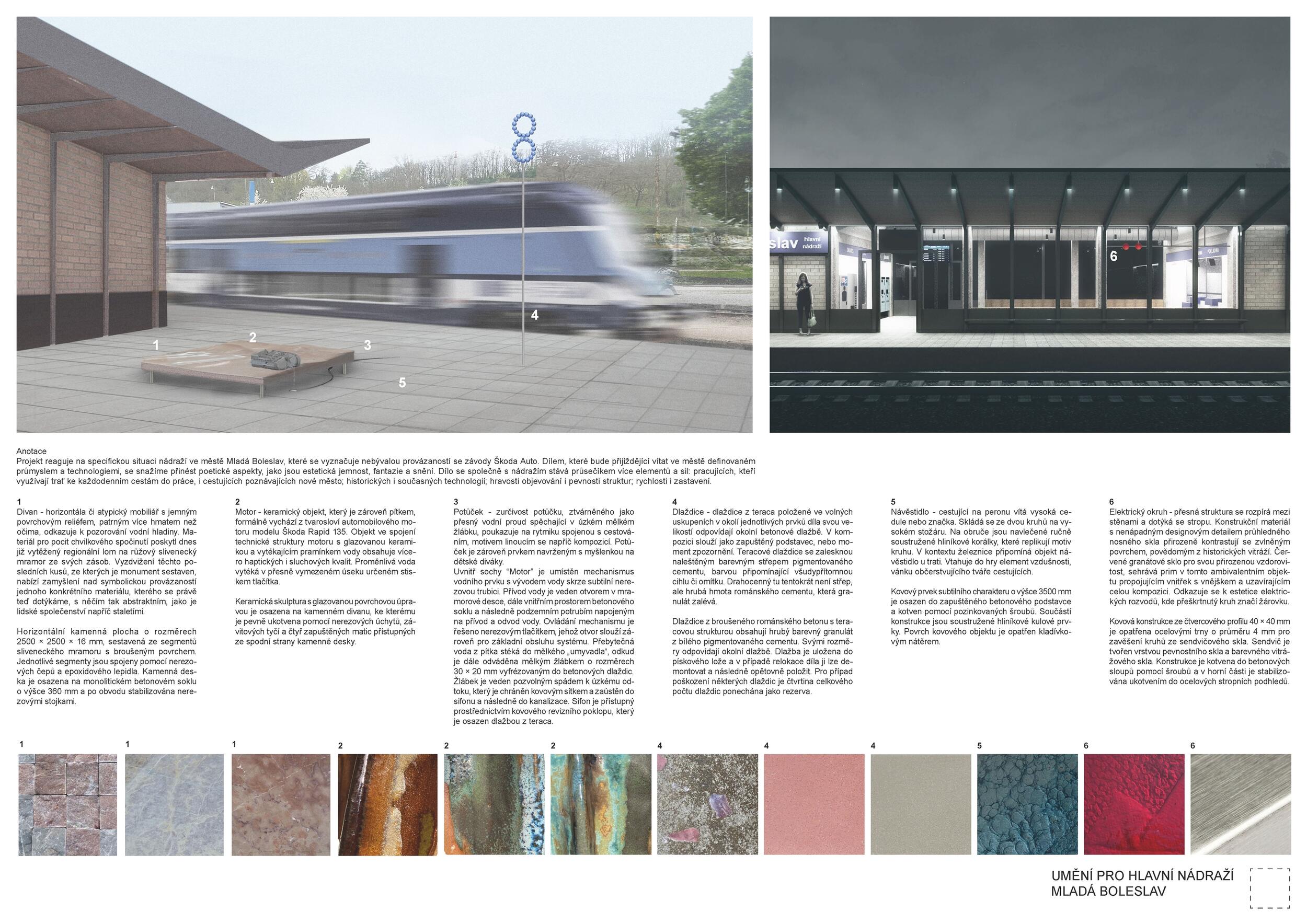
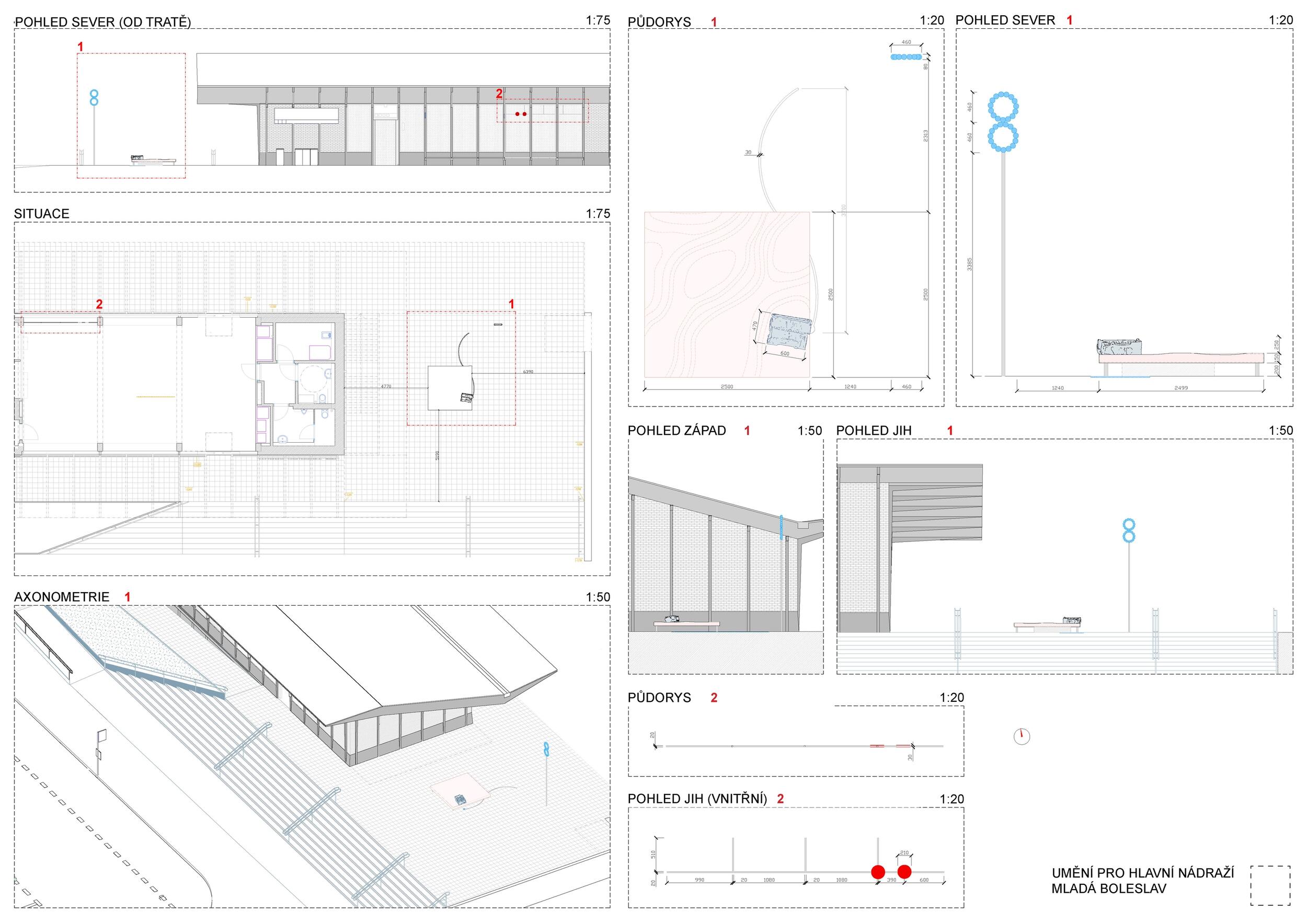
The project responds to the specific situation of the railway station in the city of Mladá Boleslav, which is characterized by its unprecedented connection with the Škoda Auto plants. With a work that will welcome visitors to a city defined by industry and technology, we try to bring poetic aspects such as aesthetic subtlety, fantasy and dreaming. Together with the railway station, the work becomes an intersection of multiple elements and forces: workers who use the track for their daily commutes, and passengers exploring a new city; historical and contemporary technologies; the playfulness of discovery and the solidity of structures; speed and stopping.

Jury Evaluation

Their work is an expression of attention and great sensitivity to natural materials and to the deeper connections and traditions of production and crafts in the immediate vicinity. The authors chose the composition of several elements placed on the piazzetta in such a way that they create an almost intimate impression of the interior. They relied on delicacy and subtlety as the fundamental motto of the whole, which would have the potential, with its hidden narrative and multi-layered possibility of interpretation, to activate fantasy and dreaming, slow down movement in the station space and cultivate hurrying passengers with a gentle appeal to their attention. The jury appreciated the thoughtful work with the material: the use of ceramic clay as a reference to the design use of this material in the development of car design, as well as the work with glass, associated with the nearby Podkrkonoše region. The drinking bottle and the water from it symbolically disappearing into the paving stones are not only a welcome refreshment for passengers, but can also carry an ecological appeal to care for the water disappearing from the landscape.

Previous Next
4th Prize
  • Author Lenka Kerdová, Eliška Perglerová, Iveta Šalamounová
  • Prague
Annotation

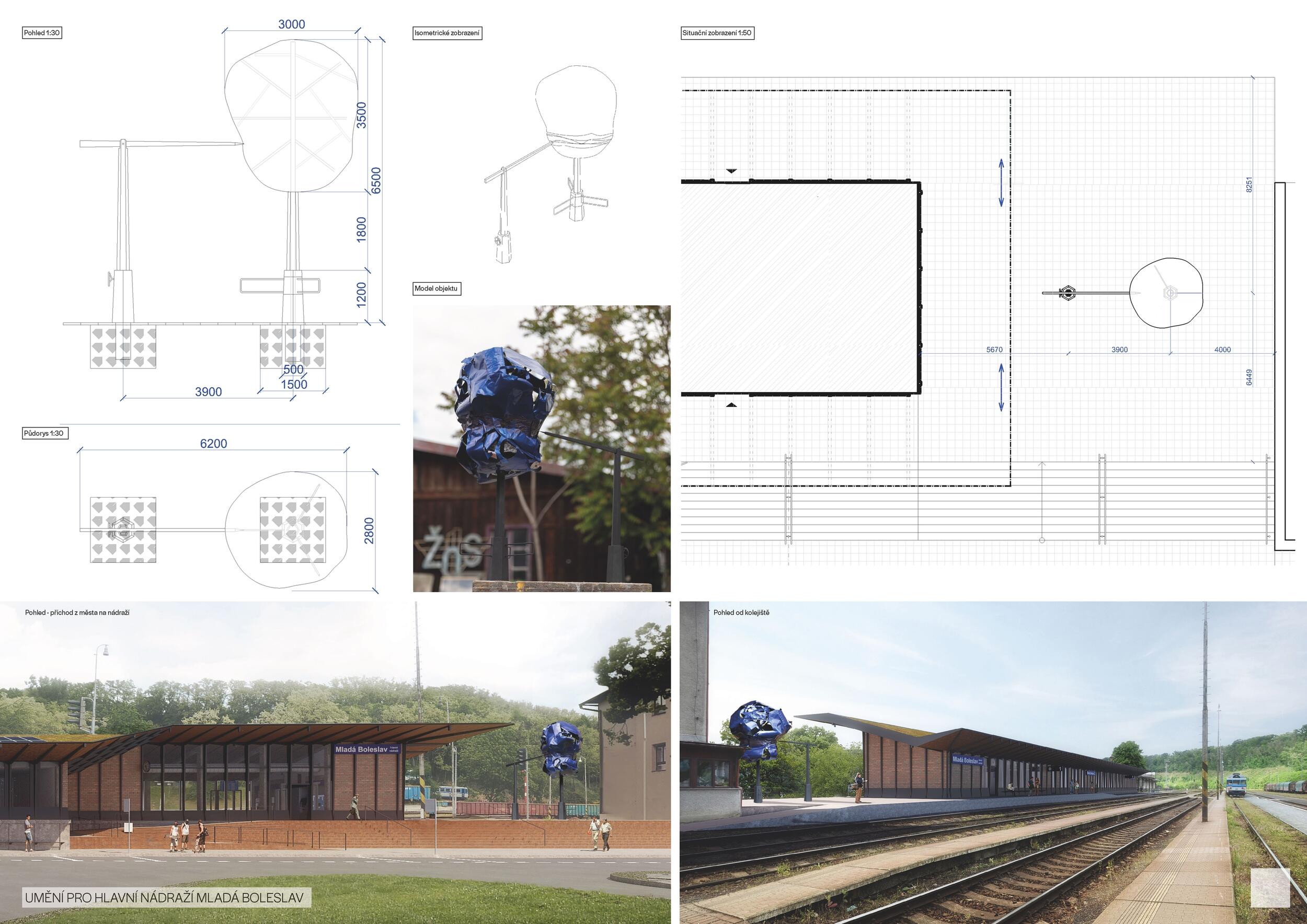
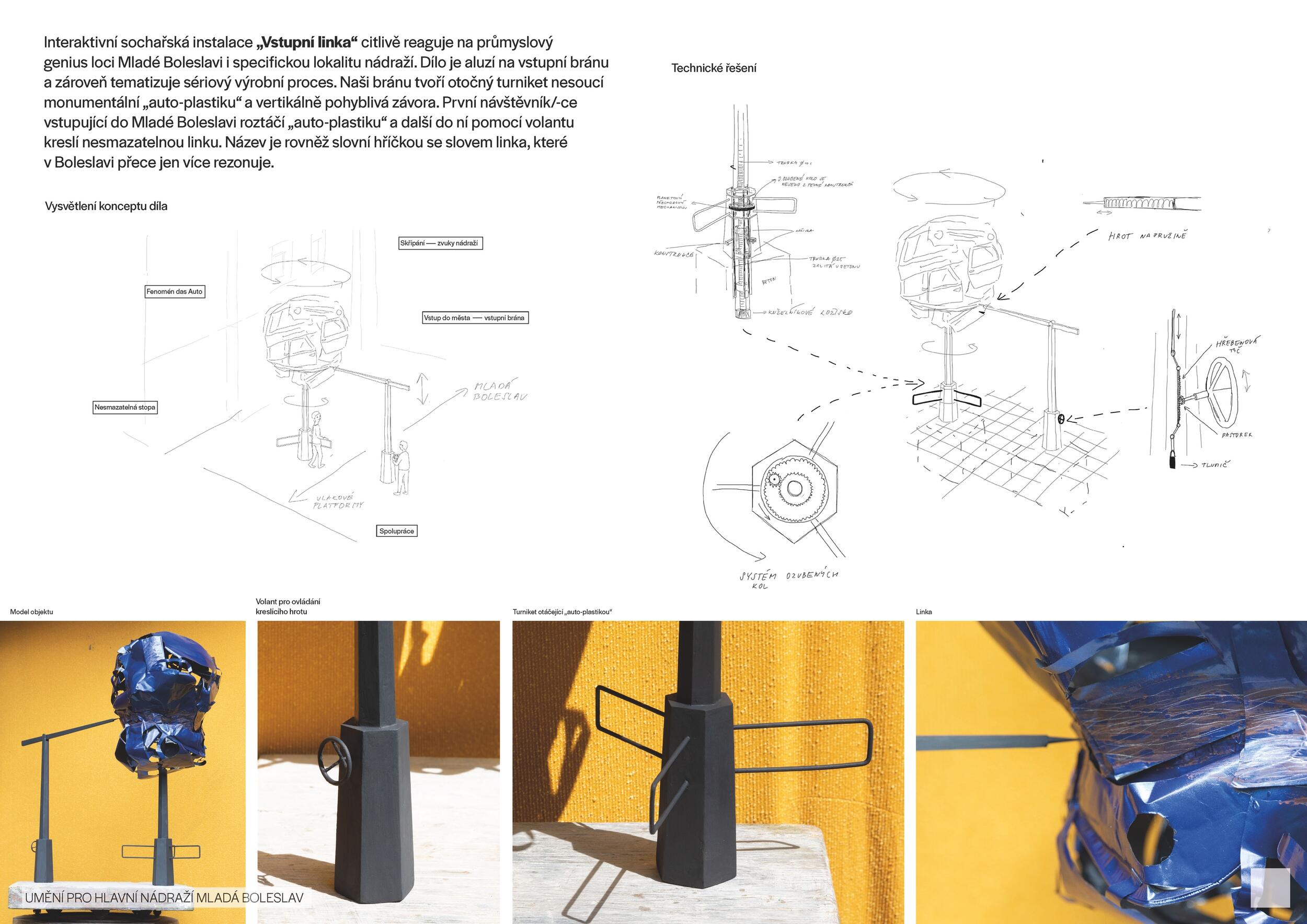
The interactive sculptural installation "Entry Line" sensitively responds to the industrial genius loci of Mladá Boleslav and the specific location of the railway station. The work is an allusion to the entrance gate and at the same time thematizes the serial production process. Our gate consists of a rotating turnstile carrying a monumental "car sculpture" and a vertically movable barrier. The first visitor entering Mladá Boleslav spins the "car sculpture" and the next one draws an indelible line on it using the steering wheel. The name is also a pun on the word line, which resonates more in Boleslav.

Jury Evaluation

The authors base their design on intimate knowledge of local realities, their work thematizes the role of the Škoda car factory in the city – on various levels of meaning. Their design consists of two parts, both of which are closely connected to car production and the locally specific terminology associated with it. – with a gate, as the entrance to the plant, but in a figurative sense also the gateway to the city, which is the railway station here, and with a line – a production unit of the factory operation and at the same time a line that a passenger can engrave and co-create on a rotating sculpture of painted body parts with the kinetic arm of a pencil / gate. The jury appreciated the participatory nature of the work, but concerns are raised by the unresolved technical side of the design and the question of the lifespan of the destroyed object and its security or replacement. The close connection to the tradition of car production in the city is understandable, but the jury sees its processing as somewhat straightforward.

Previous Next
5th Prize
  • Author Jiří Černický
  • Prague
Annotation

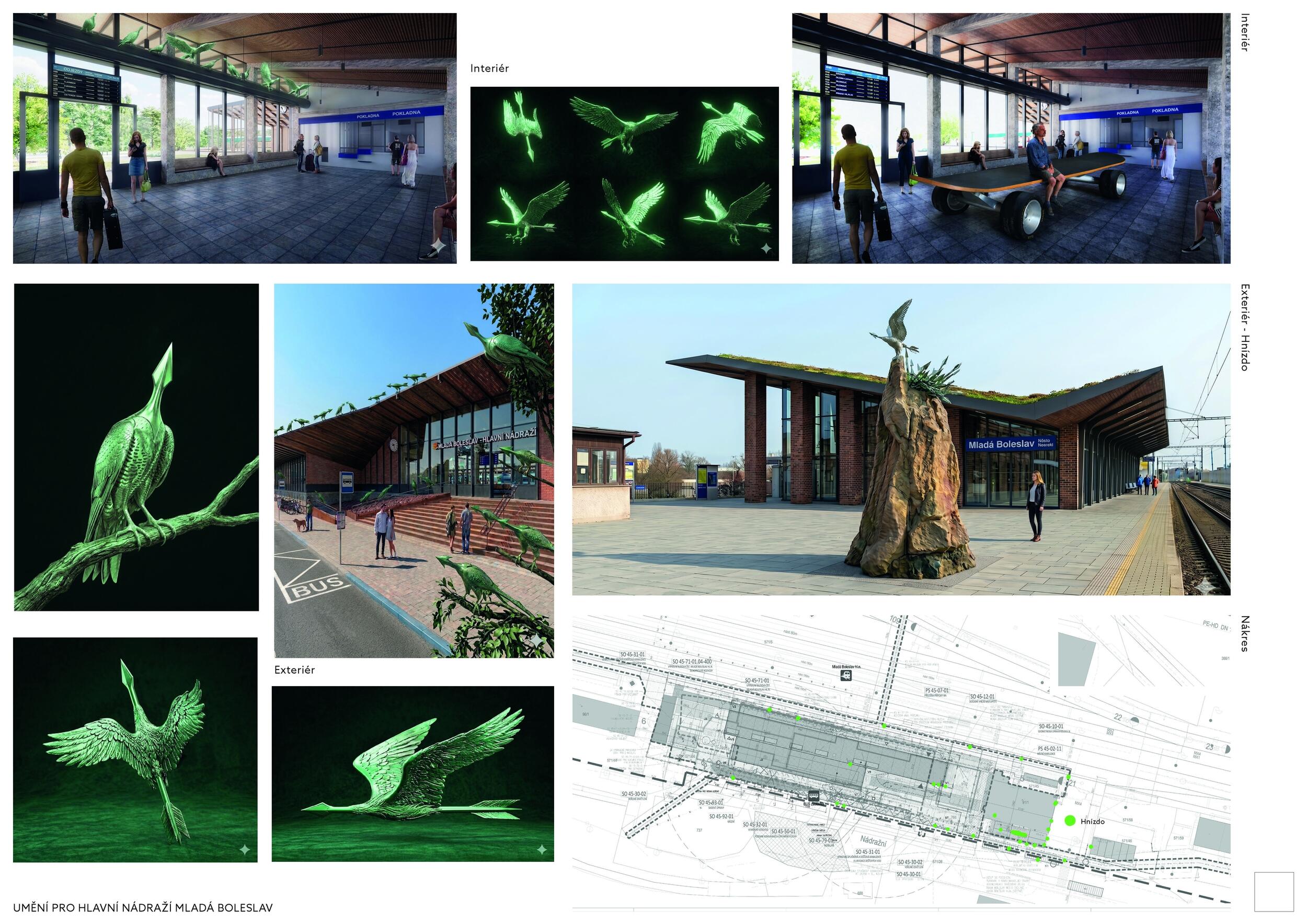
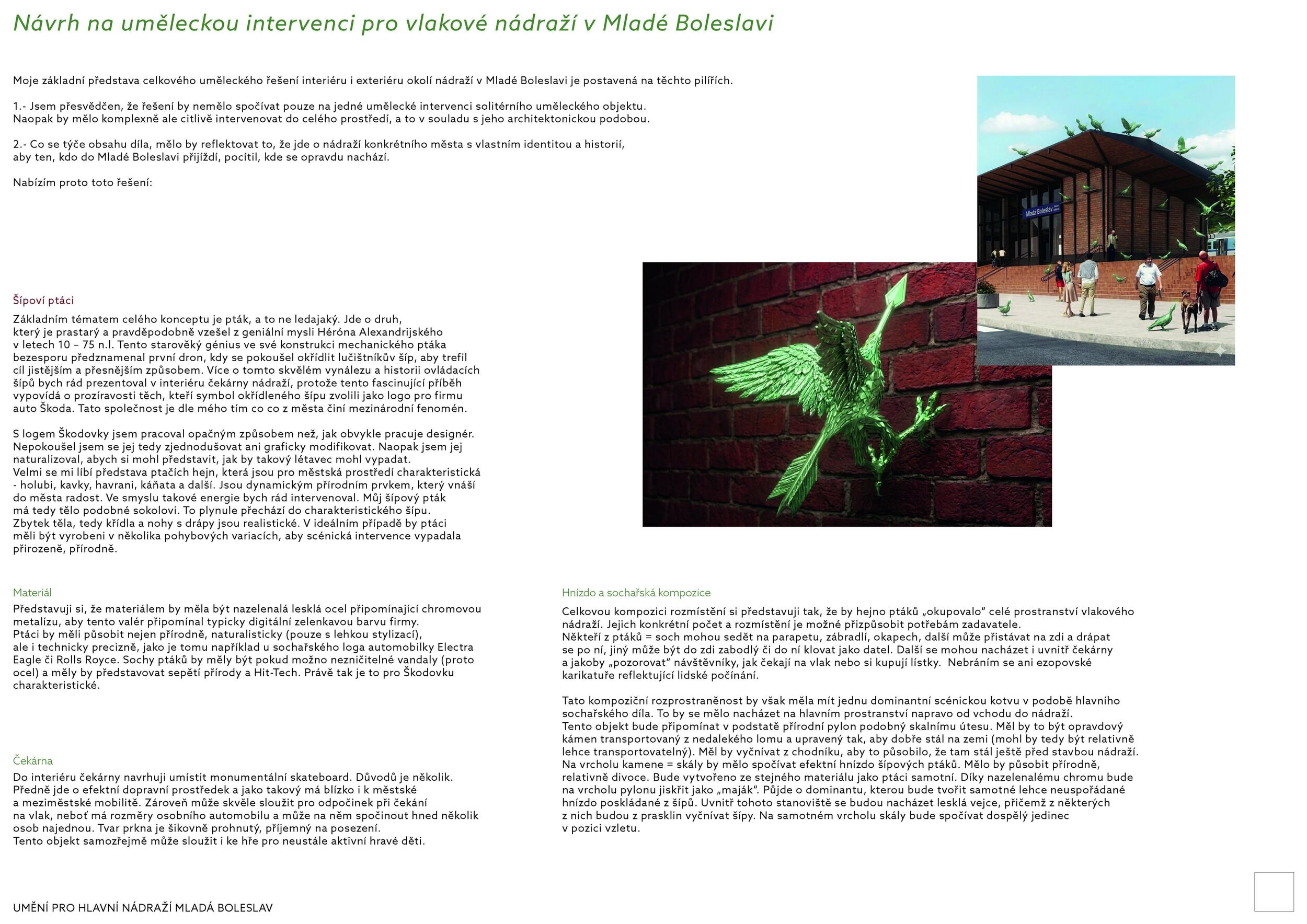
I am convinced that the solution should not be based on just one artistic intervention of a solitary art object. On the contrary, it should intervene comprehensively but sensitively in the entire environment, in accordance with its architectural form. As for the content of the work, it should reflect the fact that it is a train station of a specific city with its own identity and history, so that those who come to Mladá Boleslav can feel where they really are. The basic theme of the whole concept is a bird, and not just any bird. It is a species that is ancient and probably originated from the brilliant mind of Hero of Alexandria in the years 10-75 AD. This ancient genius, in his construction of a mechanical bird, undoubtedly foreshadowed the first drone when he tried to wing an archer's arrow to hit the target more confidently and accurately. I would like to present more about this great invention and the history of control arrows in the interior of the station waiting room, because this fascinating story speaks of the foresight of those who chose the symbol of the winged arrow as the logo for the Škoda car company. In my opinion, this company is what makes a city an international phenomenon. I worked with the Škoda logo in the opposite way to how a designer usually works. So I did not try to simplify it or modify it graphically. On the contrary, I naturalized it so that I could imagine what such a flying bird could look like. I really like the idea of ​​flocks of birds that are characteristic of urban environments - pigeons, jackdaws, ravens, buzzards and others. They are a dynamic natural element that brings joy to the city. I would like to intervene in the sense of such energy. My arrow bird therefore has a body similar to a falcon. This smoothly transitions into the characteristic arrow. The rest of the body, i.e. the wings and legs with claws, are realistic. Ideally, the birds should be made in several movement variations so that the scenic intervention looks natural.

Jury Evaluation

Jiří Černický's intervention Arrow Birds, like the previous work, is linked to the historical tradition of the car manufacturer. His work was inspired by the Škoda logo, the famous winged arrow, which has represented the company since 1923 as a symbol of speed, progress and precise production. The author chose a "mythicification" or naturalistic version of the subject in the form of a real bird, which should (in several movement variants) inhabit the exterior and interior of the new train station, thus adding to its atmosphere of uniqueness, mystery and tension. The station building thus functions as a kind of cliff onto which the birds flock. The effort to emphasize the specificity and identity of the city, which is intertwined with the existence of Škoda Auto, is significant. As in the case of the previous proposal, the jury agreed that the strong connection to the identity of the city and the car manufacturer is understandable, but the author responded to the challenge of the competition with a work of a more traditional nature. The jury also discussed whether the naturalistic interpretation of the winged arrow motif opens up other possible levels of meaning – in addition to dynamics and movement, a certain tension or sense of threat.

Previous Next